Fiesta–Test results–new malady

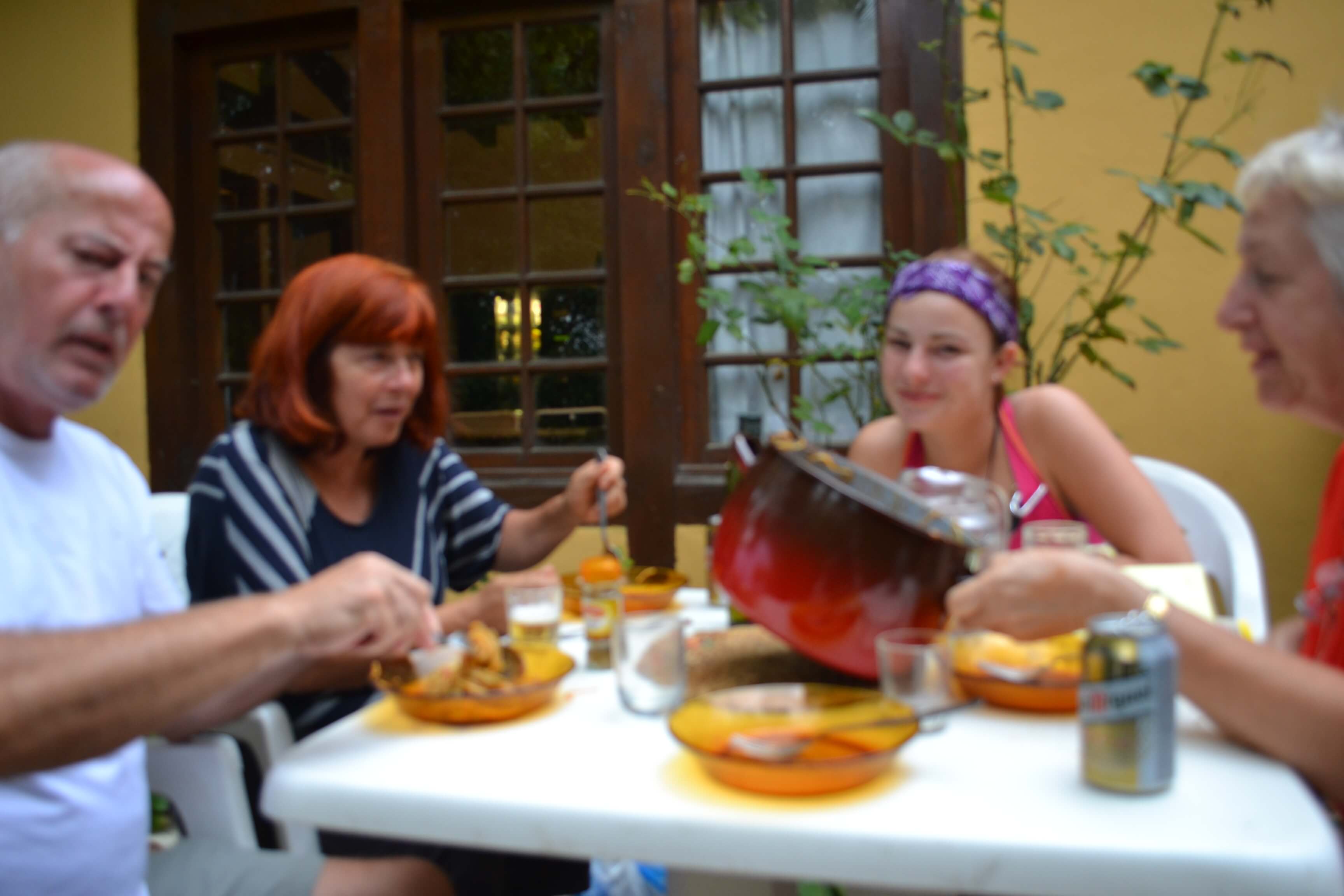
We sure packed a lot of activities into the last few weeks. Filled with happy anticipation to see our camino friends again, I drove Cameron’s old Land Rover to Grand Junction to pick up Julio, Marie Anne and a little later, Cameron as well.

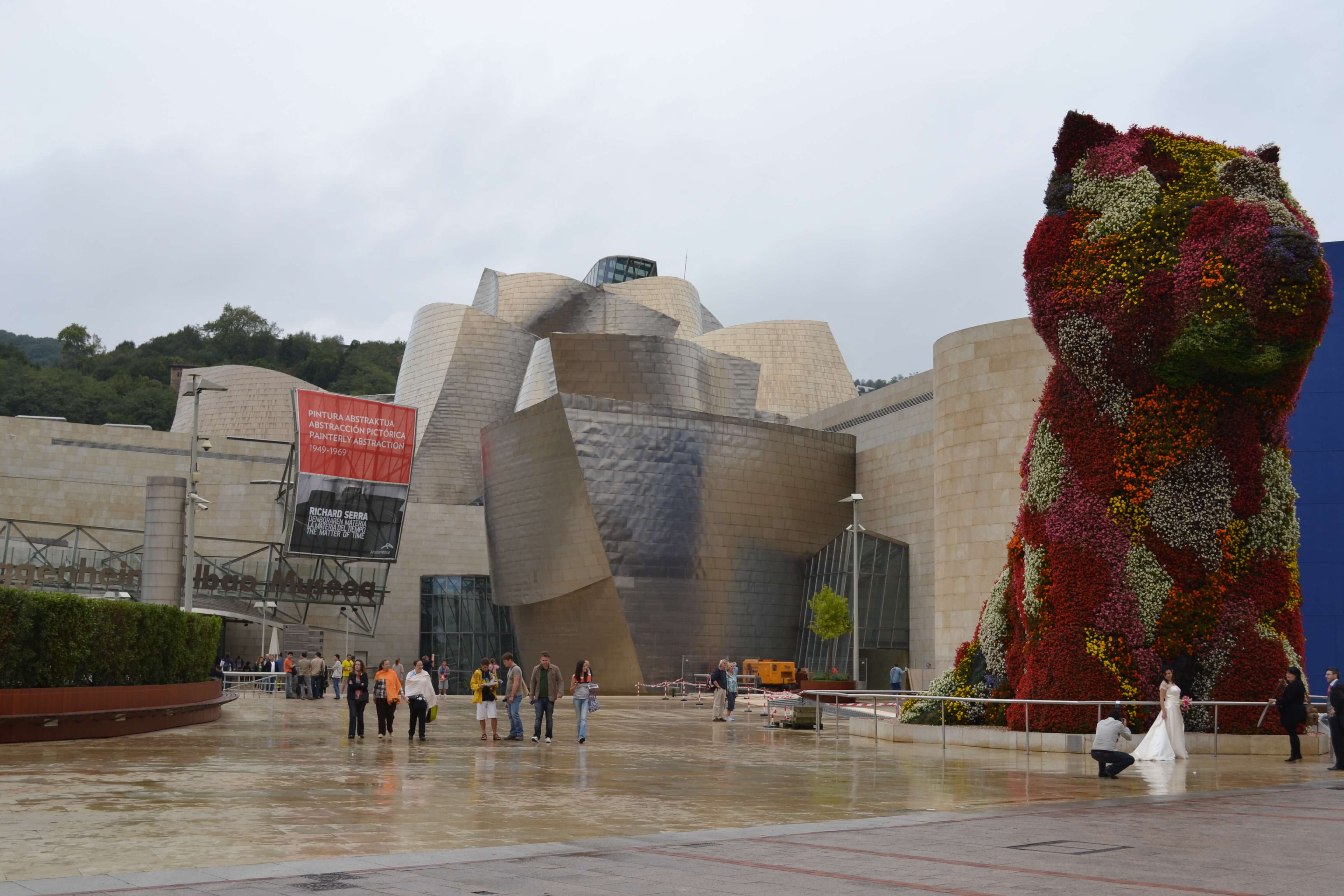
I’d bought a few flowers to greet MarieAnne and a bottle of Rioja wine (Bilboa) for Julio.

When I entered the hotel, they were already seated in the lobby, waiting. A big, cheery hello with a few tears from Marie Anne. They had visited New York for 4 days, then came by Amtrack to Grand Junction. Julio told me that MarieAnne, while looking out the window, kept saying ‘so big, so big.’

We stopped at a Diner and had a genuine American breakfast. Then it was time to pick up Cameron. What a happy  reunion all around. Carrie had seen them the day before and spend a few wonderful hours touring the Monument.

Next morning after breakfast we took them to Ouray and Box Canyon. Amazing how that water rushes and is pounding with great force through the hole in the rock that took millions of years to create. They were duly impressed.

Saturday morning, they were helping to set up the yard and cleaning, etc. for the Fiesta. Carrie came with her sister and her dad. Their mom came later with marvelous Truffels.

Pretty soon, all guests had arrived and we introduced our guest around, mostly to people that had read the blog and had many questions for both.

Sunday, we went to the Black Canyon and also had a picnic. Cameron decided that they should see The Arches in Utah’s canyonland. They took off Monday, while I took care of things here and also had several blood tests and an up coming CT scan to determine, whether there has been any growth.

Blood test results were great. Cancer markers had not gone up. Stable. On May 2nd, we all drove to Grand Junction for CT scan and an appoinment with oncologist afterward.

Dr. M. showed us the scan and was reasonably sure that there too, was no sign of growth. BIG exhale for me. I did tell her about the ‘new’ pain in my left, lower pelvis. I thought and believed that I had a kidney stone(s). After viewing the scan, she said that Radiologist pointed out some small stones in the the Urethra. Thus, the horriffic pain. I told her, that I was afraid turning into a Junkie trying to stay on top of this pain. I am not going to live like this, is what I said. I figured out the best way to medicate: 1 Ibuprofen (600 mg, followed 45 min later by 1/2 of Morphine (10 mg). I nearly cried with relief when the pain finally stopped. I also came down with a unpleasant chest cold. This constant pain is taking a big chunk out of my ‘cheerfulness’ and up-beat, positivity, etc. These pills are making me not only dizzy but weepy. I’m going to try a brownie, laced with Marijuana. No nightmares and bad side effects.

Well, smiled Dr. M. looks like you have another 3 mos before we check.  Keep up what you’re doing. Although I had not been doing that well and kept falling ‘off the wagon’ with eating all sorts of ‘regular’ food. But, now I’m back on it. I don’t feel very energetic when I don’t get my ‘greens’. She said, I want you to think about taking ‘Tamoxifen’. It’s an oral chemo pill. You can’t just keep having this cancer and even though, you’re doing well,  should think about this option. I want to talk to you about side effects, when the time comes.

Well! I did check on those side effects: Stroke, peritoneal/ vaginal cancer, and a host of other possibilities. How can this be called a ‘life saving’ med??

I have 3 months to do something and try to get the numbers down, the tumor reduced.

My Acupuncturist was ordering herbs to diminish stones. Now, I must call and cancel. I wonder if Dr. B. could be wrong? I’m just stunned.

Those few days were over too quickly and Julo and MarieAnne had to leave. They couldn’t say enough about wonderful, colorful Colorado and awesome Utah. We were marveling at the fact that last year, in May, none of us knew each other and yet, here we were, darn good buddies and an experience that has bonded us for life.

Friday, I had some nice friends here for lunch from Utah.

The Aunties came from Rangely for 2 days after, so we still had nice company. Then, they too were gone and took Cameron to the airport. Wow. The house was still and quiet. Everyone has abandoned me. I wandered through the rooms and not even the mouse is back.

I’ve finished my medicine wheel garden. Not all the planting as it takes a lot of plants (money) but I have time. When I checked on a peace pole, the lady offered to come with the Indian Society Members to perform a ceremony. No charge. I am so tickled.

I had an appointment with Urologist Dr. B. whom I had been to a few years ago. I couldn’t take any meds before driving 1 hr and 20 min. By the time I got there, I was in agony. The usual bloodpressure, vitals were taken. Dr. B. came in and after the cordials he looked at the CT scan and said that there were NO stones in the urethra. Only 2 small ones in the right kidney but they could easily get out if needed to. So? I asked. What is this pain? Classic symptoms of reduced urine flow, horrible, prolonged pain. Tiny, pink droplets. That does not mean stones? That’s right, he said. Well, I wanted to know, ‘WHAT is it?”

” I don’t know,’ he says. You need to go back to Dr. M. and find out where this is coming from. I can’t believe it! Back to square one! Where do I go? Whom do I see?

Last night, as I woke with pain again, I wondered whether this could be caused by scar tissue? I had this before, 10 years ago on my right side. Left over from a pediatric Ruptured Appendix surgery. These now, could be caused from the debulking surgery from Ovarian Cancer/Hysterectomy

I can feel the meds taking hold and numbing my brain and thoughts. I better stop before all sorts of nonsense appears.


Ode to feet

During our daily camino walk and climbing as well as blisters and other foot related maladies that I observed in other people, I was thinking about feet.

How unappreciative we usually are of our feet and the miracle they perform without us giving it a second thought. We spend a lot of money on hair, make up, nails. O.K. Some people have pedicures. I had my first one only a couple of months ago.

Usually, we just put on socks, shoes and run off. The first time I thought how very grateful I was for my feet was 2 years ago. One morning, while walking into the kitchen, I felt a sudden, sharp pain. I cried out and looked down what I’d stepped on. There was nothing. Puzzled, I looked at my right heel, sure that there would be a glass shard embedded. Nothing. The pain continued with each step and was so bad that I tried walking on tip toe.

I figured I probably pulled some muscle or small ligament and it would disappear after a few days. Well, it didn’t. I hobbled around doing my chores. I went on errands with the car and then hobbled into the store. I really have a high pain tolerance but this was getting worse. I had to stop walking. I had to stop volunteering at the soup kitchen, where I’d been chef once a week for 3+ months.

I took Ibuprofen, Tylenol, the usual. I was stuck in the house and getting depressed. I kept saying to my friends, ‘If I can’t walk anymore, they may as well shoot me.’ No one could tell me what the matter was. I gained weight for lack of walking. One day, I put the symptoms on Web MD. There was this odd name: Plantar’s Fasciitis. Now, I had a name but the prognosis was not very encouraging. I asked around and found a very capable therapist. For a month I went there and had electro-therapy.

While laying there, with nothing to do, for an hour, I talked. Poor guy had no choice . I’m glad to say that he and his wife became dear friends. Shortly after that, I changed my lifestyle due to cancer.

If someone would’ve said to me, a few years ago that what I was putting my mouth was wrong, I would’ve scoffed at them. I mean, I selected my vegetables carefully, I did not eat fast food, had no cokes or sweet tea, I didn’t even eat a lot but still had gained weight.

Well. Then when I did all that research on cancer and other immune illnesses, a light bulb came on. (Ten years prior, when I had cancer, I had eaten better and healthier but after my chemo and tests I thought ‘now, it’s gone’ and went back to my meat, sauces and oil/butter cooked foods.

It wasn’t long after I converted to Vegan, that a host of problems disappeared. Plantar’s Fasciitis has not returned.

I was absolutely certain that once people saw what it did for me, they’d be just so happy. They’d immediately copy it. (Some did.) Others were so full of resistance that I had to shut up about it.  Others tried it for a little while and because it’s not easy, in the beginning, they stopped, or, they changed it without the getting the great results. That was huge surprise and it continues to amaze me how people just want to have their crap (and eat it too.)

But, when I think of what my FEET accomplished I feel so very happy and grateful that something made me listen and change. I am in awe, that they carried me these hundreds of miles without a whimper. (The blisters don’t count.) I treat my feet much better now. I don’t need expensive pedicures.

Days on the Camino, What I Miss (Part II), and a Secret to Happiness

I was married, briefly.  The nature channels tell me there are penguins with longer relationships.

Last kilometers into Santiago

Read Our Story

ORDINARY MAGIC

I was married, briefly.  The nature channels tell me there are penguins with longer relationships.

Read Our Story

The ultimate Camino de Santiago Journey

By the time a judge brought down the curtain, my mother and I were six thousand miles away, standing at a waystation on a yellow-arrowed path, like characters in some 21st century update to the Wizard of Oz.  My mother wanted a cure for her cancer, or at least a break from “all the cutting and poison”, as she put it.  I hadn’t believed there were any answers for my uncertainties high on the wild-dog-infested and wind-swept spine of a mountain range in northern Spain, so I had sort of convinced myself I wanted nothing.

blockuote-white.png
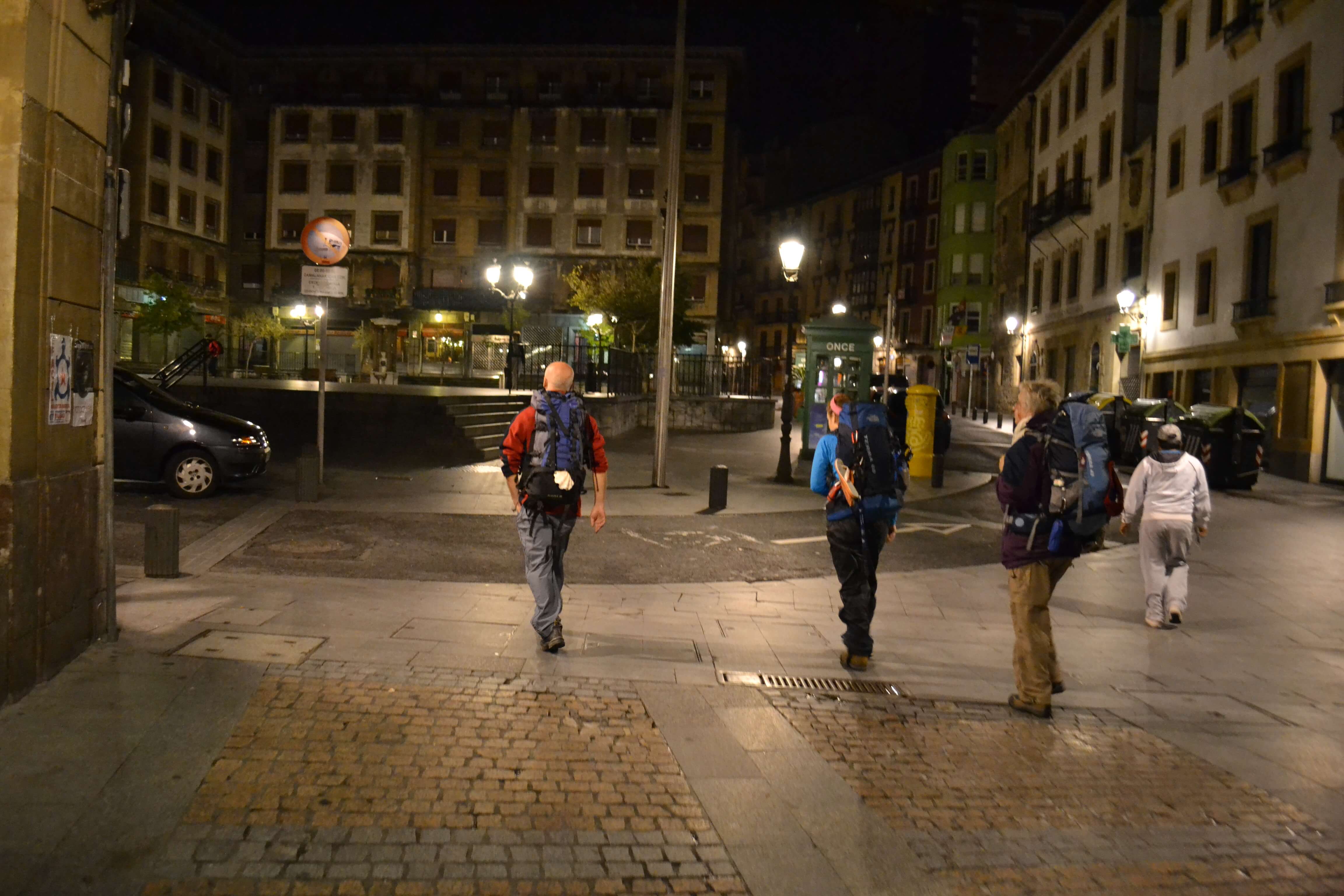
Inge in Bilbao, Spain, days before starting the Camino de Santiago

NEW ADVENTURE

I stood at the foot of a high rubbled mound. I was holding my new Nikon SLR, which I’d just bought from Costco via the rationale of this very trip. The video was on: Mom had talked about this moment for months, and I am nothing if not a catcher, or perhaps I mean a chaser, of moments. She was picking her way up the mound, through the powdery gray and white rocks. My fifteen-year-old second-cousin, Carrie, had abandoned her massive backpack and was watching the scene from my left. In a field to my right an older man, very tall, sturdy boots, backpack, was weeping.

Camino de Santiago Cruz de Ferro
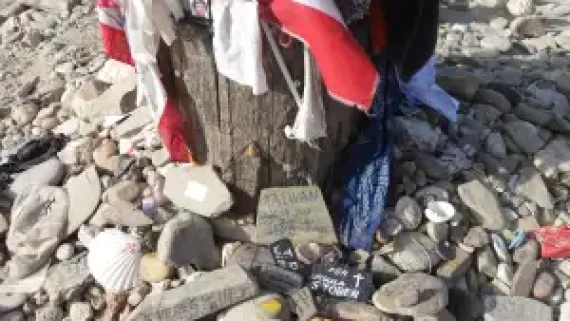
Offerings left behind at the Camino de Santiago’s Cruz de Ferro

The mound was pierced at its summit by a thirty-foot-tall oak post, about as big around as a telephone pole. The very top of the post was fitted with an iron cap, like the sort of hat an English bulldog might wear, if an English bulldog had scored an audience with the Queen. For a structure with the grand appellation of El Cruz de Ferro, an old Spanish-Latin term that means Cross of Iron, the cap supported an almost comically tiny iron cross whose three free arms ended in fleurs-de-lis. For thousands of years, some version of the Cruz de Ferro had spied on countless pilgrims – first Pagan, later Catholic, now mostly Pagan again – as they formed meaning out of this very waystation.

For thousands of years a mound of rocks marked the summit of this mountain range. A million pilgrims before us had built up the mound with hand-placed relics from their own private rituals of letting go: of anger, of grief, of resentment, of illness – letting go even of the fear of death. Because that is what people do on pilgrimages, of any kind, whether they mean to or not. They let go. That’s what the verb to forgive means. To forgive others, and, harder yet, to forgive oneself. Jesus was telling us what he knew about forgiveness, but the bastards killed him before he could show us how to forgive ourselves.

Sign up – or watch the new Camino movies on OrdinaryMagicBook.com!

An ancient tradition held that pilgrims should bring to the Cruz, from their own homes, a small stone and a more personal item, and to leave them behind at the Cross. My mother was now placing, among the rocks, a small stone she’d carried from an ancient canyon near her house in Colorado. Previous pilgrims had also brought and left behind other, more telling things. A tube of lipstick. A postcard of Bruges, scrawled in a woman’s hand. Folded pieces of paper and fragments of words in Spanish and English, German and Dutch, Korean and Basque. Underwear that raised certain questions. A Matchbox car that looked to my inner-nine-year-old’s eye like a ’68 Corvette, give or take two years. A toy soldier – missing a leg, poor bastard – and the half-eaten cookie on which he’d been subsisting among the pebbles.

On the wooden pole itself I could make out a tacked-up orange baseball cap and a clip-less biking pedal, a gourd on a string, a black-and-white photo of a European peasant family, circa 1930s, a 1970s photo of a boy, in a shirt with blue stripes, holding a Bible, a pre-printed fortune cookie’s fortune: Do not throw the butts into the urinal, for they are subtle, and quick to anger. I saw a Prada label, an AC Milan futbol jersey, and a broken pair of cheap sunglasses. A German pilgrim had erected a small German flag among the rocks. Not to be outdone, so had a Belgian. Or vice versa, let’s not start another war.

My mother, still with her back to my cousin and me, had reached the top of the mound. The Iron Cross now loomed over her, standing stoutly in the wind. She bowed her head and pulled her second, more personal offering from a pocket in her field jacket. She cupped it with both hands and held it over her head, a modest proposal to the cosmos about what she should be allowed to let go of. When I saw her shoulders start to shake I began to cry, too, but quietly, because I was the expedition videographer, not to mention its chief biographer, photographer, legal counsel, and practicing podiatrist.

I handed the camera to Carrie and went to join my mother.
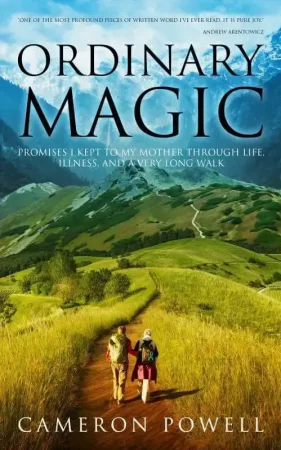
And now the book, Ordinary Magic: Promises I Made to My Mother Through Life, Illness, and a Very Long Walk is finally here!

100_1652
SAM_1968

Just When You Thought It Was Over: Portugal

Read Our Story

ORDINARY MAGIC

I was married, briefly.  The nature channels tell me there are penguins with longer relationships.

Read Our Story

The ultimate Camino de Santiago Journey

By the time a judge brought down the curtain, my mother and I were six thousand miles away, standing at a waystation on a yellow-arrowed path, like characters in some 21st century update to the Wizard of Oz.  My mother wanted a cure for her cancer, or at least a break from “all the cutting and poison”, as she put it.  I hadn’t believed there were any answers for my uncertainties high on the wild-dog-infested and wind-swept spine of a mountain range in northern Spain, so I had sort of convinced myself I wanted nothing.

blockuote-white.png
Inge in Bilbao, Spain, days before starting the Camino de Santiago

NEW ADVENTURE

I stood at the foot of a high rubbled mound. I was holding my new Nikon SLR, which I’d just bought from Costco via the rationale of this very trip. The video was on: Mom had talked about this moment for months, and I am nothing if not a catcher, or perhaps I mean a chaser, of moments. She was picking her way up the mound, through the powdery gray and white rocks. My fifteen-year-old second-cousin, Carrie, had abandoned her massive backpack and was watching the scene from my left. In a field to my right an older man, very tall, sturdy boots, backpack, was weeping.

Camino de Santiago Cruz de Ferro
Offerings left behind at the Camino de Santiago’s Cruz de Ferro

The mound was pierced at its summit by a thirty-foot-tall oak post, about as big around as a telephone pole. The very top of the post was fitted with an iron cap, like the sort of hat an English bulldog might wear, if an English bulldog had scored an audience with the Queen. For a structure with the grand appellation of El Cruz de Ferro, an old Spanish-Latin term that means Cross of Iron, the cap supported an almost comically tiny iron cross whose three free arms ended in fleurs-de-lis. For thousands of years, some version of the Cruz de Ferro had spied on countless pilgrims – first Pagan, later Catholic, now mostly Pagan again – as they formed meaning out of this very waystation.

For thousands of years a mound of rocks marked the summit of this mountain range. A million pilgrims before us had built up the mound with hand-placed relics from their own private rituals of letting go: of anger, of grief, of resentment, of illness – letting go even of the fear of death. Because that is what people do on pilgrimages, of any kind, whether they mean to or not. They let go. That’s what the verb to forgive means. To forgive others, and, harder yet, to forgive oneself. Jesus was telling us what he knew about forgiveness, but the bastards killed him before he could show us how to forgive ourselves.

Sign up – or watch the new Camino movies on OrdinaryMagicBook.com!

An ancient tradition held that pilgrims should bring to the Cruz, from their own homes, a small stone and a more personal item, and to leave them behind at the Cross. My mother was now placing, among the rocks, a small stone she’d carried from an ancient canyon near her house in Colorado. Previous pilgrims had also brought and left behind other, more telling things. A tube of lipstick. A postcard of Bruges, scrawled in a woman’s hand. Folded pieces of paper and fragments of words in Spanish and English, German and Dutch, Korean and Basque. Underwear that raised certain questions. A Matchbox car that looked to my inner-nine-year-old’s eye like a ’68 Corvette, give or take two years. A toy soldier – missing a leg, poor bastard – and the half-eaten cookie on which he’d been subsisting among the pebbles.

On the wooden pole itself I could make out a tacked-up orange baseball cap and a clip-less biking pedal, a gourd on a string, a black-and-white photo of a European peasant family, circa 1930s, a 1970s photo of a boy, in a shirt with blue stripes, holding a Bible, a pre-printed fortune cookie’s fortune: Do not throw the butts into the urinal, for they are subtle, and quick to anger. I saw a Prada label, an AC Milan futbol jersey, and a broken pair of cheap sunglasses. A German pilgrim had erected a small German flag among the rocks. Not to be outdone, so had a Belgian. Or vice versa, let’s not start another war.

My mother, still with her back to my cousin and me, had reached the top of the mound. The Iron Cross now loomed over her, standing stoutly in the wind. She bowed her head and pulled her second, more personal offering from a pocket in her field jacket. She cupped it with both hands and held it over her head, a modest proposal to the cosmos about what she should be allowed to let go of. When I saw her shoulders start to shake I began to cry, too, but quietly, because I was the expedition videographer, not to mention its chief biographer, photographer, legal counsel, and practicing podiatrist.

I handed the camera to Carrie and went to join my mother.
And now the book, Ordinary Magic: Promises I Made to My Mother Through Life, Illness, and a Very Long Walk is finally here!

100_1652
SAM_1968

The End of This Way

Supporting

DSC_0395 (1)
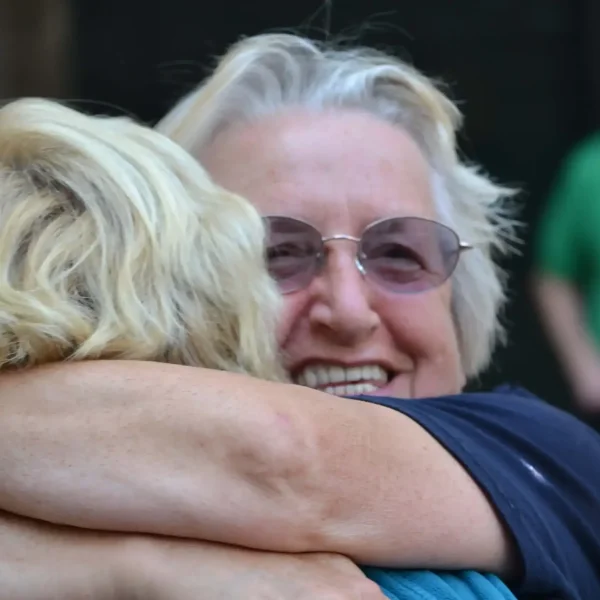
” Inge’s most loving embrace. Reuniting with a fellow pilgrim “

Supporting Treatment

Inge is a fighter. She beat cancer after grueling surgeries and chemotherapy 11 years ago, and she walked nearly 500 miles across Spain, in late 2011, in part because she hoped the returning cancer might just go away on its own. But the Emperor of All Maladies, as it’s been called, is still with her.

She’s been sent to test after test, and there are probably more tests, and treatments, to come.  We’ve been asked for an easier way for her friends and supporters to help out with the expenses, so here we invite anyone who has been touched by her or her story either to (1) buy the amazing book True History of the Camino de Santiago, written by Inge’s son, Cameron, or (2) donate any amount you choose toward her treatment. Subscribe with your email, above right, to watch Inge’s progress.

See what the True History of the Camino de Santiago book is all about: www.TrueHistoryCaminodeSantiago.com.

Donate:


Below are two little movies we made of Inge on the Camino de Santiago. We think they show her passionate, fighting spirit quite well.

Watch Inge Symbolically Leaving Her Cancer at the Iron Cross

In Santiago at Last: How She’ll Look Once She Beats the Emperor Again!

You can donate any amount you wish. Buen Camino!

Next to Last Day: Arzúa to Pedrouzo

About

ABOUT US

In early 2001, Mom (Inge) was diagnosed with Stage 3 ovarian cancer.  She had surgery and then grueling chemotherapy.  Already a gourmet chef, she changed the food she bought and how she cooked it.  And she held off the cancer for a decade.

In around May 2010, the periodic tests she underwent revealed three new growths in her pelvis, lung, and neck.  She responded by even more radically altering her diet, lost fifty pounds, and, six months later, saw one growth disappear and another grow smaller.  One stayed the same.  In July 2011, she had the tumor in her lung removed; a biopsy showed it had shrunk yet again, from 12 to 9 millimeters, but that it was cancerous.

In the weeks before her surgery, though, Inge had decided she wanted to walk the Camino de Santiago, in northern Spain.  She began training on the trails around the Black Canyon, and convinced her son, Cameron, to go to Spain with her.

Inge was born in Erlangen, Germany, in 1944, and, after stints as a governess in Bavaria and England, as a student at the Cordon Bleu School of Cooking, and as a flight attendant in New York City, she emigrated to the United States, in 1963.  She now lives in Montrose, Colorado.

Screenshot 2025-07-01 200225

CAMERON

Cameron is a writer (currently awaiting publication by Random House of a work co-written with his former wife), founder of career coachinglawyer coaching, and attorney recruiting firms, Internet entrepreneur, and recovering attorney. He’s an avid skier and hiker.

Quick jump to Cameron’s posts.

Notes from Kilometer 18, Give or Take

Read Our Story

ORDINARY MAGIC

I was married, briefly.  The nature channels tell me there are penguins with longer relationships.

Read Our Story

The ultimate Camino de Santiago Journey

By the time a judge brought down the curtain, my mother and I were six thousand miles away, standing at a waystation on a yellow-arrowed path, like characters in some 21st century update to the Wizard of Oz.  My mother wanted a cure for her cancer, or at least a break from “all the cutting and poison”, as she put it.  I hadn’t believed there were any answers for my uncertainties high on the wild-dog-infested and wind-swept spine of a mountain range in northern Spain, so I had sort of convinced myself I wanted nothing.

blockuote-white.png
Inge in Bilbao, Spain, days before starting the Camino de Santiago

NEW ADVENTURE

I stood at the foot of a high rubbled mound. I was holding my new Nikon SLR, which I’d just bought from Costco via the rationale of this very trip. The video was on: Mom had talked about this moment for months, and I am nothing if not a catcher, or perhaps I mean a chaser, of moments. She was picking her way up the mound, through the powdery gray and white rocks. My fifteen-year-old second-cousin, Carrie, had abandoned her massive backpack and was watching the scene from my left. In a field to my right an older man, very tall, sturdy boots, backpack, was weeping.

Camino de Santiago Cruz de Ferro
Offerings left behind at the Camino de Santiago’s Cruz de Ferro

The mound was pierced at its summit by a thirty-foot-tall oak post, about as big around as a telephone pole. The very top of the post was fitted with an iron cap, like the sort of hat an English bulldog might wear, if an English bulldog had scored an audience with the Queen. For a structure with the grand appellation of El Cruz de Ferro, an old Spanish-Latin term that means Cross of Iron, the cap supported an almost comically tiny iron cross whose three free arms ended in fleurs-de-lis. For thousands of years, some version of the Cruz de Ferro had spied on countless pilgrims – first Pagan, later Catholic, now mostly Pagan again – as they formed meaning out of this very waystation.

For thousands of years a mound of rocks marked the summit of this mountain range. A million pilgrims before us had built up the mound with hand-placed relics from their own private rituals of letting go: of anger, of grief, of resentment, of illness – letting go even of the fear of death. Because that is what people do on pilgrimages, of any kind, whether they mean to or not. They let go. That’s what the verb to forgive means. To forgive others, and, harder yet, to forgive oneself. Jesus was telling us what he knew about forgiveness, but the bastards killed him before he could show us how to forgive ourselves.

Sign up – or watch the new Camino movies on OrdinaryMagicBook.com!

An ancient tradition held that pilgrims should bring to the Cruz, from their own homes, a small stone and a more personal item, and to leave them behind at the Cross. My mother was now placing, among the rocks, a small stone she’d carried from an ancient canyon near her house in Colorado. Previous pilgrims had also brought and left behind other, more telling things. A tube of lipstick. A postcard of Bruges, scrawled in a woman’s hand. Folded pieces of paper and fragments of words in Spanish and English, German and Dutch, Korean and Basque. Underwear that raised certain questions. A Matchbox car that looked to my inner-nine-year-old’s eye like a ’68 Corvette, give or take two years. A toy soldier – missing a leg, poor bastard – and the half-eaten cookie on which he’d been subsisting among the pebbles.

On the wooden pole itself I could make out a tacked-up orange baseball cap and a clip-less biking pedal, a gourd on a string, a black-and-white photo of a European peasant family, circa 1930s, a 1970s photo of a boy, in a shirt with blue stripes, holding a Bible, a pre-printed fortune cookie’s fortune: Do not throw the butts into the urinal, for they are subtle, and quick to anger. I saw a Prada label, an AC Milan futbol jersey, and a broken pair of cheap sunglasses. A German pilgrim had erected a small German flag among the rocks. Not to be outdone, so had a Belgian. Or vice versa, let’s not start another war.

My mother, still with her back to my cousin and me, had reached the top of the mound. The Iron Cross now loomed over her, standing stoutly in the wind. She bowed her head and pulled her second, more personal offering from a pocket in her field jacket. She cupped it with both hands and held it over her head, a modest proposal to the cosmos about what she should be allowed to let go of. When I saw her shoulders start to shake I began to cry, too, but quietly, because I was the expedition videographer, not to mention its chief biographer, photographer, legal counsel, and practicing podiatrist.

I handed the camera to Carrie and went to join my mother.
And now the book, Ordinary Magic: Promises I Made to My Mother Through Life, Illness, and a Very Long Walk is finally here!

100_1652
SAM_1968

Leaving Mercadoiro; Rene the Eagle

Read Our Story

ORDINARY MAGIC

I was married, briefly.  The nature channels tell me there are penguins with longer relationships.

Read Our Story

The ultimate Camino de Santiago Journey

By the time a judge brought down the curtain, my mother and I were six thousand miles away, standing at a waystation on a yellow-arrowed path, like characters in some 21st century update to the Wizard of Oz.  My mother wanted a cure for her cancer, or at least a break from “all the cutting and poison”, as she put it.  I hadn’t believed there were any answers for my uncertainties high on the wild-dog-infested and wind-swept spine of a mountain range in northern Spain, so I had sort of convinced myself I wanted nothing.

blockuote-white.png
Inge in Bilbao, Spain, days before starting the Camino de Santiago

NEW ADVENTURE

I stood at the foot of a high rubbled mound. I was holding my new Nikon SLR, which I’d just bought from Costco via the rationale of this very trip. The video was on: Mom had talked about this moment for months, and I am nothing if not a catcher, or perhaps I mean a chaser, of moments. She was picking her way up the mound, through the powdery gray and white rocks. My fifteen-year-old second-cousin, Carrie, had abandoned her massive backpack and was watching the scene from my left. In a field to my right an older man, very tall, sturdy boots, backpack, was weeping.Camino de Santiago Cruz de Ferro Offerings left behind at the Camino de Santiago’s Cruz de FerroThe mound was pierced at its summit by a thirty-foot-tall oak post, about as big around as a telephone pole. The very top of the post was fitted with an iron cap, like the sort of hat an English bulldog might wear, if an English bulldog had scored an audience with the Queen. For a structure with the grand appellation of El Cruz de Ferro, an old Spanish-Latin term that means Cross of Iron, the cap supported an almost comically tiny iron cross whose three free arms ended in fleurs-de-lis. For thousands of years, some version of the Cruz de Ferro had spied on countless pilgrims – first Pagan, later Catholic, now mostly Pagan again – as they formed meaning out of this very waystation.For thousands of years a mound of rocks marked the summit of this mountain range. A million pilgrims before us had built up the mound with hand-placed relics from their own private rituals of letting go: of anger, of grief, of resentment, of illness – letting go even of the fear of death. Because that is what people do on pilgrimages, of any kind, whether they mean to or not. They let go. That’s what the verb to forgive means. To forgive others, and, harder yet, to forgive oneself. Jesus was telling us what he knew about forgiveness, but the bastards killed him before he could show us how to forgive ourselves.Sign up – or watch the new Camino movies on OrdinaryMagicBook.com!An ancient tradition held that pilgrims should bring to the Cruz, from their own homes, a small stone and a more personal item, and to leave them behind at the Cross. My mother was now placing, among the rocks, a small stone she’d carried from an ancient canyon near her house in Colorado. Previous pilgrims had also brought and left behind other, more telling things. A tube of lipstick. A postcard of Bruges, scrawled in a woman’s hand. Folded pieces of paper and fragments of words in Spanish and English, German and Dutch, Korean and Basque. Underwear that raised certain questions. A Matchbox car that looked to my inner-nine-year-old’s eye like a ’68 Corvette, give or take two years. A toy soldier – missing a leg, poor bastard – and the half-eaten cookie on which he’d been subsisting among the pebbles.On the wooden pole itself I could make out a tacked-up orange baseball cap and a clip-less biking pedal, a gourd on a string, a black-and-white photo of a European peasant family, circa 1930s, a 1970s photo of a boy, in a shirt with blue stripes, holding a Bible, a pre-printed fortune cookie’s fortune: Do not throw the butts into the urinal, for they are subtle, and quick to anger. I saw a Prada label, an AC Milan futbol jersey, and a broken pair of cheap sunglasses. A German pilgrim had erected a small German flag among the rocks. Not to be outdone, so had a Belgian. Or vice versa, let’s not start another war.My mother, still with her back to my cousin and me, had reached the top of the mound. The Iron Cross now loomed over her, standing stoutly in the wind. She bowed her head and pulled her second, more personal offering from a pocket in her field jacket. She cupped it with both hands and held it over her head, a modest proposal to the cosmos about what she should be allowed to let go of. When I saw her shoulders start to shake I began to cry, too, but quietly, because I was the expedition videographer, not to mention its chief biographer, photographer, legal counsel, and practicing podiatrist.I handed the camera to Carrie and went to join my mother. And now the book, Ordinary Magic: Promises I Made to My Mother Through Life, Illness, and a Very Long Walk is finally here!
100_1652
SAM_1968

Inge – Rabanal to Mercadoiro and the Iron Cross

Read Our Story

ORDINARY MAGIC

I was married, briefly.  The nature channels tell me there are penguins with longer relationships.

Read Our Story

The ultimate Camino de Santiago Journey

By the time a judge brought down the curtain, my mother and I were six thousand miles away, standing at a waystation on a yellow-arrowed path, like characters in some 21st century update to the Wizard of Oz.  My mother wanted a cure for her cancer, or at least a break from “all the cutting and poison”, as she put it.  I hadn’t believed there were any answers for my uncertainties high on the wild-dog-infested and wind-swept spine of a mountain range in northern Spain, so I had sort of convinced myself I wanted nothing.

blockuote-white.png
Inge in Bilbao, Spain, days before starting the Camino de Santiago

NEW ADVENTURE

I stood at the foot of a high rubbled mound. I was holding my new Nikon SLR, which I’d just bought from Costco via the rationale of this very trip. The video was on: Mom had talked about this moment for months, and I am nothing if not a catcher, or perhaps I mean a chaser, of moments. She was picking her way up the mound, through the powdery gray and white rocks. My fifteen-year-old second-cousin, Carrie, had abandoned her massive backpack and was watching the scene from my left. In a field to my right an older man, very tall, sturdy boots, backpack, was weeping.

Camino de Santiago Cruz de Ferro
Offerings left behind at the Camino de Santiago’s Cruz de Ferro

The mound was pierced at its summit by a thirty-foot-tall oak post, about as big around as a telephone pole. The very top of the post was fitted with an iron cap, like the sort of hat an English bulldog might wear, if an English bulldog had scored an audience with the Queen. For a structure with the grand appellation of El Cruz de Ferro, an old Spanish-Latin term that means Cross of Iron, the cap supported an almost comically tiny iron cross whose three free arms ended in fleurs-de-lis. For thousands of years, some version of the Cruz de Ferro had spied on countless pilgrims – first Pagan, later Catholic, now mostly Pagan again – as they formed meaning out of this very waystation.

For thousands of years a mound of rocks marked the summit of this mountain range. A million pilgrims before us had built up the mound with hand-placed relics from their own private rituals of letting go: of anger, of grief, of resentment, of illness – letting go even of the fear of death. Because that is what people do on pilgrimages, of any kind, whether they mean to or not. They let go. That’s what the verb to forgive means. To forgive others, and, harder yet, to forgive oneself. Jesus was telling us what he knew about forgiveness, but the bastards killed him before he could show us how to forgive ourselves.

Sign up – or watch the new Camino movies on OrdinaryMagicBook.com!

An ancient tradition held that pilgrims should bring to the Cruz, from their own homes, a small stone and a more personal item, and to leave them behind at the Cross. My mother was now placing, among the rocks, a small stone she’d carried from an ancient canyon near her house in Colorado. Previous pilgrims had also brought and left behind other, more telling things. A tube of lipstick. A postcard of Bruges, scrawled in a woman’s hand. Folded pieces of paper and fragments of words in Spanish and English, German and Dutch, Korean and Basque. Underwear that raised certain questions. A Matchbox car that looked to my inner-nine-year-old’s eye like a ’68 Corvette, give or take two years. A toy soldier – missing a leg, poor bastard – and the half-eaten cookie on which he’d been subsisting among the pebbles.

On the wooden pole itself I could make out a tacked-up orange baseball cap and a clip-less biking pedal, a gourd on a string, a black-and-white photo of a European peasant family, circa 1930s, a 1970s photo of a boy, in a shirt with blue stripes, holding a Bible, a pre-printed fortune cookie’s fortune: Do not throw the butts into the urinal, for they are subtle, and quick to anger. I saw a Prada label, an AC Milan futbol jersey, and a broken pair of cheap sunglasses. A German pilgrim had erected a small German flag among the rocks. Not to be outdone, so had a Belgian. Or vice versa, let’s not start another war.

My mother, still with her back to my cousin and me, had reached the top of the mound. The Iron Cross now loomed over her, standing stoutly in the wind. She bowed her head and pulled her second, more personal offering from a pocket in her field jacket. She cupped it with both hands and held it over her head, a modest proposal to the cosmos about what she should be allowed to let go of. When I saw her shoulders start to shake I began to cry, too, but quietly, because I was the expedition videographer, not to mention its chief biographer, photographer, legal counsel, and practicing podiatrist.

I handed the camera to Carrie and went to join my mother.
And now the book, Ordinary Magic: Promises I Made to My Mother Through Life, Illness, and a Very Long Walk is finally here!

100_1652
SAM_1968

Sarria to Mercadoiro to Ventas de Naron

Supporting

DSC_0395 (1)
” Inge’s most loving embrace. Reuniting with a fellow pilgrim “

Supporting Treatment

Inge is a fighter. She beat cancer after grueling surgeries and chemotherapy 11 years ago, and she walked nearly 500 miles across Spain, in late 2011, in part because she hoped the returning cancer might just go away on its own. But the Emperor of All Maladies, as it’s been called, is still with her.

She’s been sent to test after test, and there are probably more tests, and treatments, to come.  We’ve been asked for an easier way for her friends and supporters to help out with the expenses, so here we invite anyone who has been touched by her or her story either to (1) buy the amazing book True History of the Camino de Santiago, written by Inge’s son, Cameron, or (2) donate any amount you choose toward her treatment. Subscribe with your email, above right, to watch Inge’s progress.

See what the True History of the Camino de Santiago book is all about: www.TrueHistoryCaminodeSantiago.com.

Donate:


Below are two little movies we made of Inge on the Camino de Santiago. We think they show her passionate, fighting spirit quite well.

Watch Inge Symbolically Leaving Her Cancer at the Iron Cross

In Santiago at Last: How She’ll Look Once She Beats the Emperor Again!

You can donate any amount you wish. Buen Camino!

El Acebo to Ponferrada: More Jamón and What I Miss

Supporting

DSC_0395 (1)
” Inge’s most loving embrace. Reuniting with a fellow pilgrim “

Supporting Treatment

Inge is a fighter. She beat cancer after grueling surgeries and chemotherapy 11 years ago, and she walked nearly 500 miles across Spain, in late 2011, in part because she hoped the returning cancer might just go away on its own. But the Emperor of All Maladies, as it’s been called, is still with her.

She’s been sent to test after test, and there are probably more tests, and treatments, to come.  We’ve been asked for an easier way for her friends and supporters to help out with the expenses, so here we invite anyone who has been touched by her or her story either to (1) buy the amazing book True History of the Camino de Santiago, written by Inge’s son, Cameron, or (2) donate any amount you choose toward her treatment. Subscribe with your email, above right, to watch Inge’s progress.

See what the True History of the Camino de Santiago book is all about: www.TrueHistoryCaminodeSantiago.com.

Donate:


Below are two little movies we made of Inge on the Camino de Santiago. We think they show her passionate, fighting spirit quite well.

Watch Inge Symbolically Leaving Her Cancer at the Iron Cross

In Santiago at Last: How She’ll Look Once She Beats the Emperor Again!

You can donate any amount you wish. Buen Camino!

High Up in El Acebo, We Are Served a Human Heart

About

ABOUT US

In early 2001, Mom (Inge) was diagnosed with Stage 3 ovarian cancer.  She had surgery and then grueling chemotherapy.  Already a gourmet chef, she changed the food she bought and how she cooked it.  And she held off the cancer for a decade.

In around May 2010, the periodic tests she underwent revealed three new growths in her pelvis, lung, and neck.  She responded by even more radically altering her diet, lost fifty pounds, and, six months later, saw one growth disappear and another grow smaller.  One stayed the same.  In July 2011, she had the tumor in her lung removed; a biopsy showed it had shrunk yet again, from 12 to 9 millimeters, but that it was cancerous.

In the weeks before her surgery, though, Inge had decided she wanted to walk the Camino de Santiago, in northern Spain.  She began training on the trails around the Black Canyon, and convinced her son, Cameron, to go to Spain with her.

Inge was born in Erlangen, Germany, in 1944, and, after stints as a governess in Bavaria and England, as a student at the Cordon Bleu School of Cooking, and as a flight attendant in New York City, she emigrated to the United States, in 1963.  She now lives in Montrose, Colorado.

Screenshot 2025-07-01 200225

CAMERON

Cameron is a writer (currently awaiting publication by Random House of a work co-written with his former wife), founder of career coachinglawyer coaching, and attorney recruiting firms, Internet entrepreneur, and recovering attorney. He’s an avid skier and hiker.

Quick jump to Cameron’s posts.

Mom at the Cruz de Fierro

Read Our Story

ORDINARY MAGIC

I was married, briefly.  The nature channels tell me there are penguins with longer relationships.

Read Our Story

The ultimate Camino de Santiago Journey

By the time a judge brought down the curtain, my mother and I were six thousand miles away, standing at a waystation on a yellow-arrowed path, like characters in some 21st century update to the Wizard of Oz.  My mother wanted a cure for her cancer, or at least a break from “all the cutting and poison”, as she put it.  I hadn’t believed there were any answers for my uncertainties high on the wild-dog-infested and wind-swept spine of a mountain range in northern Spain, so I had sort of convinced myself I wanted nothing.
blockuote-white.png
Inge in Bilbao, Spain, days before starting the Camino de Santiago

NEW ADVENTURE

I stood at the foot of a high rubbled mound. I was holding my new Nikon SLR, which I’d just bought from Costco via the rationale of this very trip. The video was on: Mom had talked about this moment for months, and I am nothing if not a catcher, or perhaps I mean a chaser, of moments. She was picking her way up the mound, through the powdery gray and white rocks. My fifteen-year-old second-cousin, Carrie, had abandoned her massive backpack and was watching the scene from my left. In a field to my right an older man, very tall, sturdy boots, backpack, was weeping.

Camino de Santiago Cruz de Ferro
Offerings left behind at the Camino de Santiago’s Cruz de Ferro

The mound was pierced at its summit by a thirty-foot-tall oak post, about as big around as a telephone pole. The very top of the post was fitted with an iron cap, like the sort of hat an English bulldog might wear, if an English bulldog had scored an audience with the Queen. For a structure with the grand appellation of El Cruz de Ferro, an old Spanish-Latin term that means Cross of Iron, the cap supported an almost comically tiny iron cross whose three free arms ended in fleurs-de-lis. For thousands of years, some version of the Cruz de Ferro had spied on countless pilgrims – first Pagan, later Catholic, now mostly Pagan again – as they formed meaning out of this very waystation.

For thousands of years a mound of rocks marked the summit of this mountain range. A million pilgrims before us had built up the mound with hand-placed relics from their own private rituals of letting go: of anger, of grief, of resentment, of illness – letting go even of the fear of death. Because that is what people do on pilgrimages, of any kind, whether they mean to or not. They let go. That’s what the verb to forgive means. To forgive others, and, harder yet, to forgive oneself. Jesus was telling us what he knew about forgiveness, but the bastards killed him before he could show us how to forgive ourselves.

Sign up – or watch the new Camino movies on OrdinaryMagicBook.com!

An ancient tradition held that pilgrims should bring to the Cruz, from their own homes, a small stone and a more personal item, and to leave them behind at the Cross. My mother was now placing, among the rocks, a small stone she’d carried from an ancient canyon near her house in Colorado. Previous pilgrims had also brought and left behind other, more telling things. A tube of lipstick. A postcard of Bruges, scrawled in a woman’s hand. Folded pieces of paper and fragments of words in Spanish and English, German and Dutch, Korean and Basque. Underwear that raised certain questions. A Matchbox car that looked to my inner-nine-year-old’s eye like a ’68 Corvette, give or take two years. A toy soldier – missing a leg, poor bastard – and the half-eaten cookie on which he’d been subsisting among the pebbles.

On the wooden pole itself I could make out a tacked-up orange baseball cap and a clip-less biking pedal, a gourd on a string, a black-and-white photo of a European peasant family, circa 1930s, a 1970s photo of a boy, in a shirt with blue stripes, holding a Bible, a pre-printed fortune cookie’s fortune: Do not throw the butts into the urinal, for they are subtle, and quick to anger. I saw a Prada label, an AC Milan futbol jersey, and a broken pair of cheap sunglasses. A German pilgrim had erected a small German flag among the rocks. Not to be outdone, so had a Belgian. Or vice versa, let’s not start another war.

My mother, still with her back to my cousin and me, had reached the top of the mound. The Iron Cross now loomed over her, standing stoutly in the wind. She bowed her head and pulled her second, more personal offering from a pocket in her field jacket. She cupped it with both hands and held it over her head, a modest proposal to the cosmos about what she should be allowed to let go of. When I saw her shoulders start to shake I began to cry, too, but quietly, because I was the expedition videographer, not to mention its chief biographer, photographer, legal counsel, and practicing podiatrist.

I handed the camera to Carrie and went to join my mother.
And now the book, Ordinary Magic: Promises I Made to My Mother Through Life, Illness, and a Very Long Walk is finally here!

100_1652
SAM_1968

The Cross of Chemo

Read Our Story

ORDINARY MAGIC

I was married, briefly.  The nature channels tell me there are penguins with longer relationships.

Read Our Story

The ultimate Camino de Santiago Journey

I was married, briefly.  The nature channels tell me there are penguins with longer relationships.

By the time a judge brought down the curtain, my mother and I were six thousand miles away, standing at a waystation on a yellow-arrowed path, like characters in some 21st century update to the Wizard of Oz.  My mother wanted a cure for her cancer, or at least a break from “all the cutting and poison”, as she put it.  I hadn’t believed there were any answers for my uncertainties high on the wild-dog-infested and wind-swept spine of a mountain range in northern Spain, so I had sort of convinced myself I wanted nothing.

I stood at the foot of a high rubbled mound.  I was holding my new

THE WORLD

IS YOUR HOME

blockuote-white.png
Lorem ipsum dolor sit amet, consectetur adipiscing elit, sed do eiusmod tempor incididunt.
andre gide

NEW ADVENTURE

I stood at the foot of a high rubbled mound. I was holding my new

Camino de Santiago start
Inge in Bilbao, Spain, days before starting the Camino de Santiago

Nikon SLR, which I’d just bought from Costco via the rationale of this very trip. The video was on: Mom had talked about this moment for months, and I am nothing if not a catcher, or perhaps I mean a chaser, of moments. She was picking her way up the mound, through the powdery gray and white rocks. My fifteen-year-old second-cousin, Carrie, had abandoned her massive backpack and was watching the scene from my left. In a field to my right an older man, very tall, sturdy boots, backpack, was weeping.

Camino de Santiago Cruz de Ferro
Offerings left behind at the Camino de Santiago’s Cruz de Ferro

The mound was pierced at its summit by a thirty-foot-tall oak post, about as big around as a telephone pole. The very top of the post was fitted with an iron cap, like the sort of hat an English bulldog might wear, if an English bulldog had scored an audience with the Queen. For a structure with the grand appellation of El Cruz de Ferro, an old Spanish-Latin term that means Cross of Iron, the cap supported an almost comically tiny iron cross whose three free arms ended in fleurs-de-lis. For thousands of years, some version of the Cruz de Ferro had spied on countless pilgrims – first Pagan, later Catholic, now mostly Pagan again – as they formed meaning out of this very waystation.

For thousands of years a mound of rocks marked the summit of this mountain range. A million pilgrims before us had built up the mound with hand-placed relics from their own private rituals of letting go: of anger, of grief, of resentment, of illness – letting go even of the fear of death. Because that is what people do on pilgrimages, of any kind, whether they mean to or not. They let go. That’s what the verb to forgive means. To forgive others, and, harder yet, to forgive oneself. Jesus was telling us what he knew about forgiveness, but the bastards killed him before he could show us how to forgive ourselves.

An ancient tradition held that pilgrims should bring to the Cruz, from their own homes, a small stone and a more personal item, and to leave them behind at the Cross. My mother was now placing, among the rocks, a small stone she’d carried from an ancient canyon near her house in Colorado. Previous pilgrims had also brought and left behind other, more telling things. A tube of lipstick. A postcard of Bruges, scrawled in a woman’s hand. Folded pieces of paper and fragments of words in Spanish and English, German and Dutch, Korean and Basque. Underwear that raised certain questions. A Matchbox car that looked to my inner-nine-year-old’s eye like a ’68 Corvette, give or take two years. A toy soldier – missing a leg, poor bastard – and the half-eaten cookie on which he’d been subsisting among the pebbles.

On the wooden pole itself I could make out a tacked-up orange baseball cap and a clip-less biking pedal, a gourd on a string, a black-and-white photo of a European peasant family, circa 1930s, a 1970s photo of a boy, in a shirt with blue stripes, holding a Bible, a pre-printed fortune cookie’s fortune: Do not throw the butts into the urinal, for they are subtle, and quick to anger. I saw a Prada label, an AC Milan futbol jersey, and a broken pair of cheap sunglasses. A German pilgrim had erected a small German flag among the rocks. Not to be outdone, so had a Belgian. Or vice versa, let’s not start another war.

My mother, still with her back to my cousin and me, had reached the top of the mound. The Iron Cross now loomed over her, standing stoutly in the wind. She bowed her head and pulled her second, more personal offering from a pocket in her field jacket. She cupped it with both hands and held it over her head, a modest proposal to the cosmos about what she should be allowed to let go of. When I saw her shoulders start to shake I began to cry, too, but quietly, because I was the expedition videographer, not to mention its chief biographer, photographer, legal counsel, and practicing podiatrist.

I handed the camera to Carrie and went to join my mother.

100_1652
SAM_1968

Mom Approaches El Cruz de Ferro — the Iron Cross of Letting Go

Read Our Story

ORDINARY MAGIC

I was married, briefly.  The nature channels tell me there are penguins with longer relationships.

Read Our Story

The ultimate Camino de Santiago Journey

I was married, briefly.  The nature channels tell me there are penguins with longer relationships.

By the time a judge brought down the curtain, my mother and I were six thousand miles away, standing at a waystation on a yellow-arrowed path, like characters in some 21st century update to the Wizard of Oz.  My mother wanted a cure for her cancer, or at least a break from “all the cutting and poison”, as she put it.  I hadn’t believed there were any answers for my uncertainties high on the wild-dog-infested and wind-swept spine of a mountain range in northern Spain, so I had sort of convinced myself I wanted nothing.

I stood at the foot of a high rubbled mound.  I was holding my new

THE WORLD

IS YOUR HOME

blockuote-white.png
Lorem ipsum dolor sit amet, consectetur adipiscing elit, sed do eiusmod tempor incididunt.
andre gide

NEW ADVENTURE

I stood at the foot of a high rubbled mound. I was holding my new

Camino de Santiago start
Inge in Bilbao, Spain, days before starting the Camino de Santiago

Nikon SLR, which I’d just bought from Costco via the rationale of this very trip. The video was on: Mom had talked about this moment for months, and I am nothing if not a catcher, or perhaps I mean a chaser, of moments. She was picking her way up the mound, through the powdery gray and white rocks. My fifteen-year-old second-cousin, Carrie, had abandoned her massive backpack and was watching the scene from my left. In a field to my right an older man, very tall, sturdy boots, backpack, was weeping.

Camino de Santiago Cruz de Ferro
Offerings left behind at the Camino de Santiago’s Cruz de Ferro

The mound was pierced at its summit by a thirty-foot-tall oak post, about as big around as a telephone pole. The very top of the post was fitted with an iron cap, like the sort of hat an English bulldog might wear, if an English bulldog had scored an audience with the Queen. For a structure with the grand appellation of El Cruz de Ferro, an old Spanish-Latin term that means Cross of Iron, the cap supported an almost comically tiny iron cross whose three free arms ended in fleurs-de-lis. For thousands of years, some version of the Cruz de Ferro had spied on countless pilgrims – first Pagan, later Catholic, now mostly Pagan again – as they formed meaning out of this very waystation.

For thousands of years a mound of rocks marked the summit of this mountain range. A million pilgrims before us had built up the mound with hand-placed relics from their own private rituals of letting go: of anger, of grief, of resentment, of illness – letting go even of the fear of death. Because that is what people do on pilgrimages, of any kind, whether they mean to or not. They let go. That’s what the verb to forgive means. To forgive others, and, harder yet, to forgive oneself. Jesus was telling us what he knew about forgiveness, but the bastards killed him before he could show us how to forgive ourselves.

An ancient tradition held that pilgrims should bring to the Cruz, from their own homes, a small stone and a more personal item, and to leave them behind at the Cross. My mother was now placing, among the rocks, a small stone she’d carried from an ancient canyon near her house in Colorado. Previous pilgrims had also brought and left behind other, more telling things. A tube of lipstick. A postcard of Bruges, scrawled in a woman’s hand. Folded pieces of paper and fragments of words in Spanish and English, German and Dutch, Korean and Basque. Underwear that raised certain questions. A Matchbox car that looked to my inner-nine-year-old’s eye like a ’68 Corvette, give or take two years. A toy soldier – missing a leg, poor bastard – and the half-eaten cookie on which he’d been subsisting among the pebbles.

On the wooden pole itself I could make out a tacked-up orange baseball cap and a clip-less biking pedal, a gourd on a string, a black-and-white photo of a European peasant family, circa 1930s, a 1970s photo of a boy, in a shirt with blue stripes, holding a Bible, a pre-printed fortune cookie’s fortune: Do not throw the butts into the urinal, for they are subtle, and quick to anger. I saw a Prada label, an AC Milan futbol jersey, and a broken pair of cheap sunglasses. A German pilgrim had erected a small German flag among the rocks. Not to be outdone, so had a Belgian. Or vice versa, let’s not start another war.

My mother, still with her back to my cousin and me, had reached the top of the mound. The Iron Cross now loomed over her, standing stoutly in the wind. She bowed her head and pulled her second, more personal offering from a pocket in her field jacket. She cupped it with both hands and held it over her head, a modest proposal to the cosmos about what she should be allowed to let go of. When I saw her shoulders start to shake I began to cry, too, but quietly, because I was the expedition videographer, not to mention its chief biographer, photographer, legal counsel, and practicing podiatrist.

I handed the camera to Carrie and went to join my mother.

100_1652
SAM_1968

Mom: Navarette, Azofra, Santo Domingo, Belorado, Burgos, Leon, El Acebo, Astorga

Online school
that really teaches

Any really short description of this school
which will interest the user

ADVANTAGES

The Future of Education

ABOUT

Why you should join us

Pellentesque sagittis morbi pretium mattis ut duis nulla. Risus dolor tortor congue venenatis egestas bibendum sed.

Gravida bibendum pharetra pharetra, vulputate. Amet orci,
odio diam mattis.

Tellus ullamcorper dui at enim laoreet mauris sit.

Pulvinar ullamcorper lorem tincidunt libero at ornare. Varius ac justo
feugiat fermentum, nunc.

0+

qualified teachers

0K+

graduates

0+

study hours

0+

universities

ABOUT

Let’s see How
the Learning process goes

Nulla arcu ullamcorper non vestibulum consectetur a tincidunt bibendum elit. Eget euismod in massa risus non.
COURSES

Top Categories

IT and Programming

IT and Programming

Mathematic Sciences

Mathematic Sciences

Languages

Languages

Art & Drawing

Art & Drawing

Law & Social Studies

Law & Social Studies

Physics & Chemistry

Physics & Chemistry

Let’s learn together

Augue gravida a arcu tellus ac.

SUBJECTS

Choose the subject you need

SALES

First lesson for FREE

Mauris, egestas euismod tincidunt semper. At arcu neque diam feugiat tellus id commodo eget. Nisi pulvinar bibendum eu nibh orci sapien.

PRICE LIST

Pricing plans

Basic

Proin viverra pellentesque lectus pretium, sed ullamcorper pellentesque.

$99

/ monthly

Medium

Proin viverra pellentesque lectus pretium, sed ullamcorper pellentesque.

$99

/ monthly

Premium

Proin viverra pellentesque lectus pretium, sed ullamcorper pellentesque.

$99

/ monthly

TESTIMONIALS

Students’ opinions

During our cooperation, the company’s employees have established themselves

NEWS

Our Latest News

Follow our Social Networks

Stay in the know and check us to get news

“I Want to Go to that Cross and Leave My Cancer Behind”

The Energy Meridians of Mother Earth

I had heard people say that the Camino runs along on one of earth’s energy meridians, also called ley lines. I’d heard that in pre-Roman times, people of the Pagan religions, and, later, Christian mystics, walked the Camino route from Santiago to Leon, and which in its entirety, as it covers seven sacred sites corresponding to the seven chakras of the human body, is called the Celtic Camino.

The ley lines of the earth are said to correspond to the energy meridians of the human body, as in Chinese medicine. Throughout the world, indigenous peoples have viewed the earth as a holographic representation of the human form. The great travel writer Bruce Chatwin described the connection between the Australian Aboriginal people and the land they walked, and sang out loud — in a wonderful book called The Songlines. Lucien Lévy-Bruhl, speaking of the Aborigines, said “The land is a living book in which the myths are inscribed . . . A legend is captured in the very outlines of the landscape.”

The Camino is also said to perfectly parallel the Milky Way, and some people believe that by following a path so powerfully charged with energy, a person is more likely to have intensely spiritual or religious experiences. One etymology of the name “Compostela” argues that it comes from Latin campus stellae, “field of the stars”.

Does this refer to the Milky Way, or to the belief that the bones of St. James made their way to Santiago from Israel (in a boat, in seven days) and were found when a shepherd spotted a star and somehow deduced that the star, billions of light years away, hung in the sky over a specific spot — the spot where the bones were interred and where the cathedral of Santiago de Compostela now stands?  If you are able to replicate this feat at home, please leave a comment in the Comments section.*

I picture a line of druids solemnly walking the same path, oak staffs in hand, white-haired and regal like Gandalf in “The Lord of the Rings”, to Finisterre, literally “end of land”, or what was then believed to be the end of the known world.  But the Celtic Camino actually runs from west to east and back again: it stretches from Santiago – its start, in the first chakra – to Leon, Spain and Toulouse, France, and finally to Rosslyn, Scotland. Even today, some people walk this route, which has them walking against the current of the Camino de Santiago pilgrims.

Some people believe that the tomb that allegedly contains St. James’ bones (again, a dubious claim) does not, in fact, house the remains of Saint James, but of a pagan priestess, and that the Catholic Church, as it so often did with Pagan churches, symbolism (e.g., the fish symbol, Christmas in place of the winter solstice, the god-man born of a virgin and a god) and rituals, took advantage of the pre-existing meaning assigned to the Camino to spread Christianity as far and wide as possible. Yet another theory holds that if there are any remains on the spot, they belong to Priscillian, an ascetic from Avila who was beheaded by the Church as a heretic in Treves, France, in 385 CE, but who was venerated as a martyr in Galicia and other parts of northern Spain.

Here’s what I found on a website discussing the matter of energy:

As we walk and travel along this sacred path, we offer a healing to heal the split for Mother Earth, as we simultaneously heal our own split. We walk up Her chakras, and as we do, we offer our healing, our light and love to ourselves, and to the Earth along this powerful meridian of energy.

And this author quotes another, one Peter Dawkins, who says:

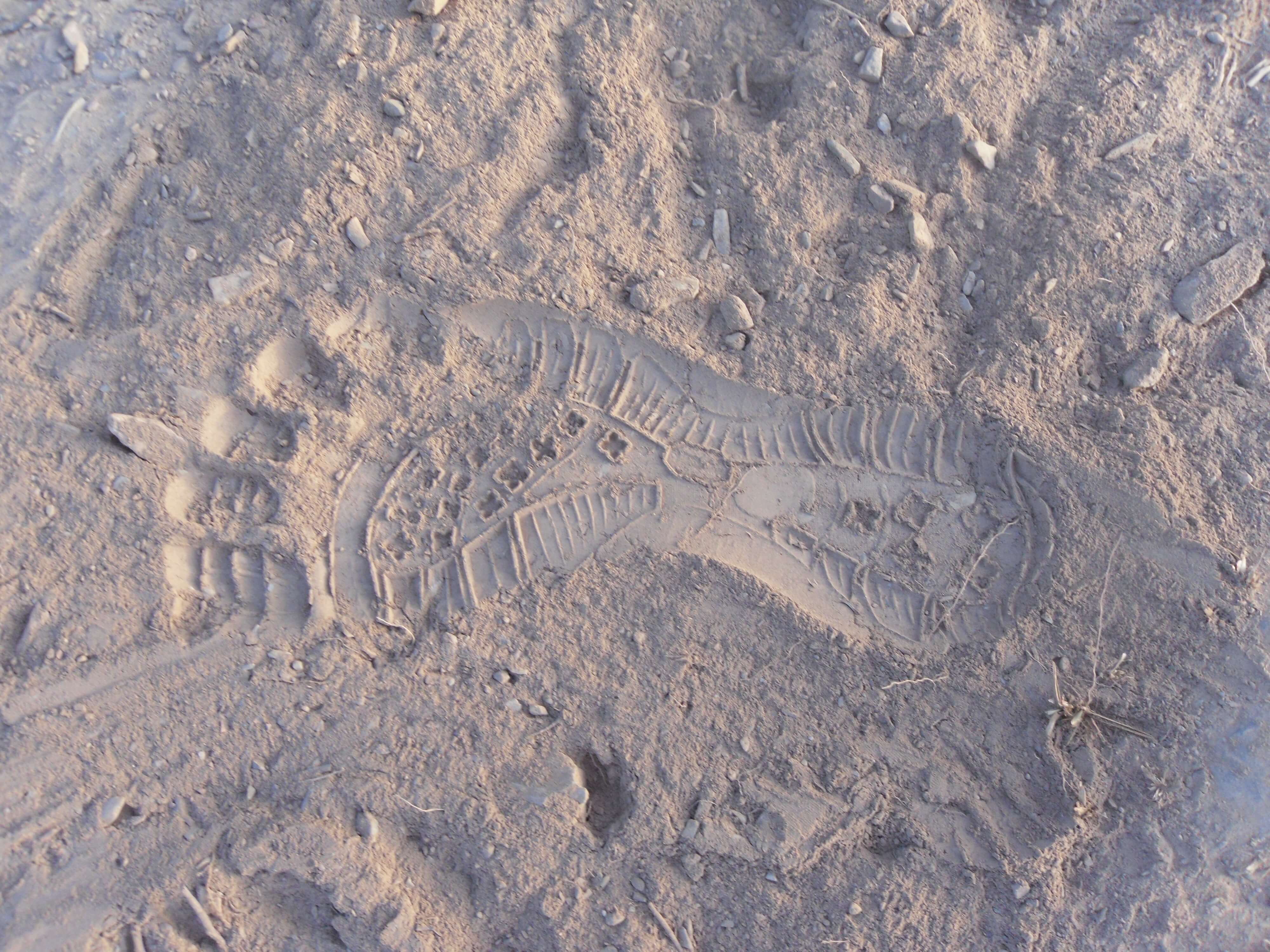
A certain pilgrim's footprint

A true pilgrim who pilgrimages in love leaves footprints of light. Many pilgrims leave many such footprints, and a well-walked pilgrims’ way can become a path of light. There are multitudes of pilgrimage routes crossing the earth, with thousands of people pilgrimaging them every year.

On the other hand, “Some of these meridians are polluted with . . . negative vibrational toxins such as battles, massacres, and the like. These vibrations are stored in the records of the land itself” – much as illness may be viewed as the storage of negative emotional energy – “reflecting back to its inhabitants and causing serious illness . . .”

If the history of the Camino tells us anything, it is that war was nearly continuous along it. Christians fought Christians, Moors and Saracens fought Christians, Christians persecuted Jews, and so on, ad nauseam. For most of the history of Spain, these wars were more about land and strategic advantage than religion. The Camino runs through an energetic wasteland of battles and massacres.

“Fortunately,” according to the same source, “these currents respond positively to spiritual impression.” And here we come back to the pilgrims, who walk it with prayers, mantras, and good faith in their hearts and minds. Once again, a practice that was originally Pagan has been superseded by Christian symbolism. Instead of walking along one of the great planet’s lines of energy, pilgrims redefined their seeking in a new narrative, a new storyline: We are seeking the legendary bones of St. James the Apostle.

The Human Scale

Mom said she’s been visualizing the energy blasting through her tumor. I’ve been told by more than a few people that my energy is palpable and can be felt in whatever part of a person’s body I direct it. I don’t know what to think of this, but I make a Cartesian wager when I place my hand on Mom’s lower back and visualize blocked energy getting unblocked, or see light and love flowing into her: there’s no penalty for being wrong, but what if it works?

Like the Catholics who would come later, Pagans often placed altars and other symbolism on the tops of mountains. Thus was the current site of the Cruz de Ferro, the Iron Cross, originally the site of a Pagan monument. It sits on the highest (or second-highest) point on the Camino.

The Cruz de Ferro, by tradition, is the place where pilgrims leave something behind. The place where they agree to let go of something. For months now, Mom has said, “I’m going to leave my cancer behind!” She has duly brought a stone, from home, and a paper copy of her PET scan with the third and last tumor circled in red.

And all of this has me worried.


* Another etymology is compositum, “the well founded”, or composita tella, meaning “burial ground”.

Astorga to Rabanal

Astorga to Rabanal del Camino, 22km. 

Friday, October 7, 2011.  I thought I’d have a solid night’s sleep, but I didn’t get to sleep until nearly 11, and between Mom’s snoring, Barbara’s (according to Mom), and apparently my own (per Carrie), the morning hours came far too quickly.  Mom got up far earlier than we did, as is her wont, and went to the kitchen to make some German-style potatoes.  She found the kitchen a disaster from the pilgrim revels of the night before (Mom thought “guitar-playing and drumming” would be too charitable, but there was strumming and banging involved).  The kitchen was the classic tragedy of the commons, but, Mom being Mom, she cleaned it.

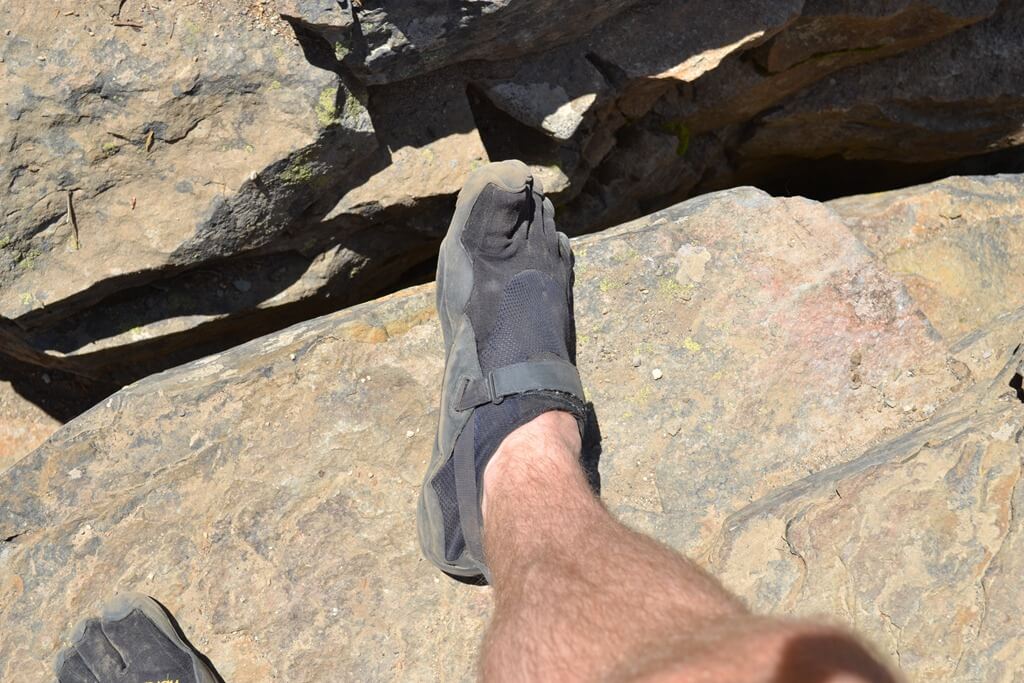
We were on the road at about 7:40a.m.  It was cool, cool enough for two layers of Icebreaker wool.  Unlike in days past, when, after 30 or 60 minutes I’d take off the top layer, I wore both layers the whole 22 kilometers.  In fact, after my hands stopped functioning in any way but to hold my poles, I added gloves.  And my five-toed socks.  My nose ran the entire way, ran so hard and fast I feared it might reach Santiago without me.

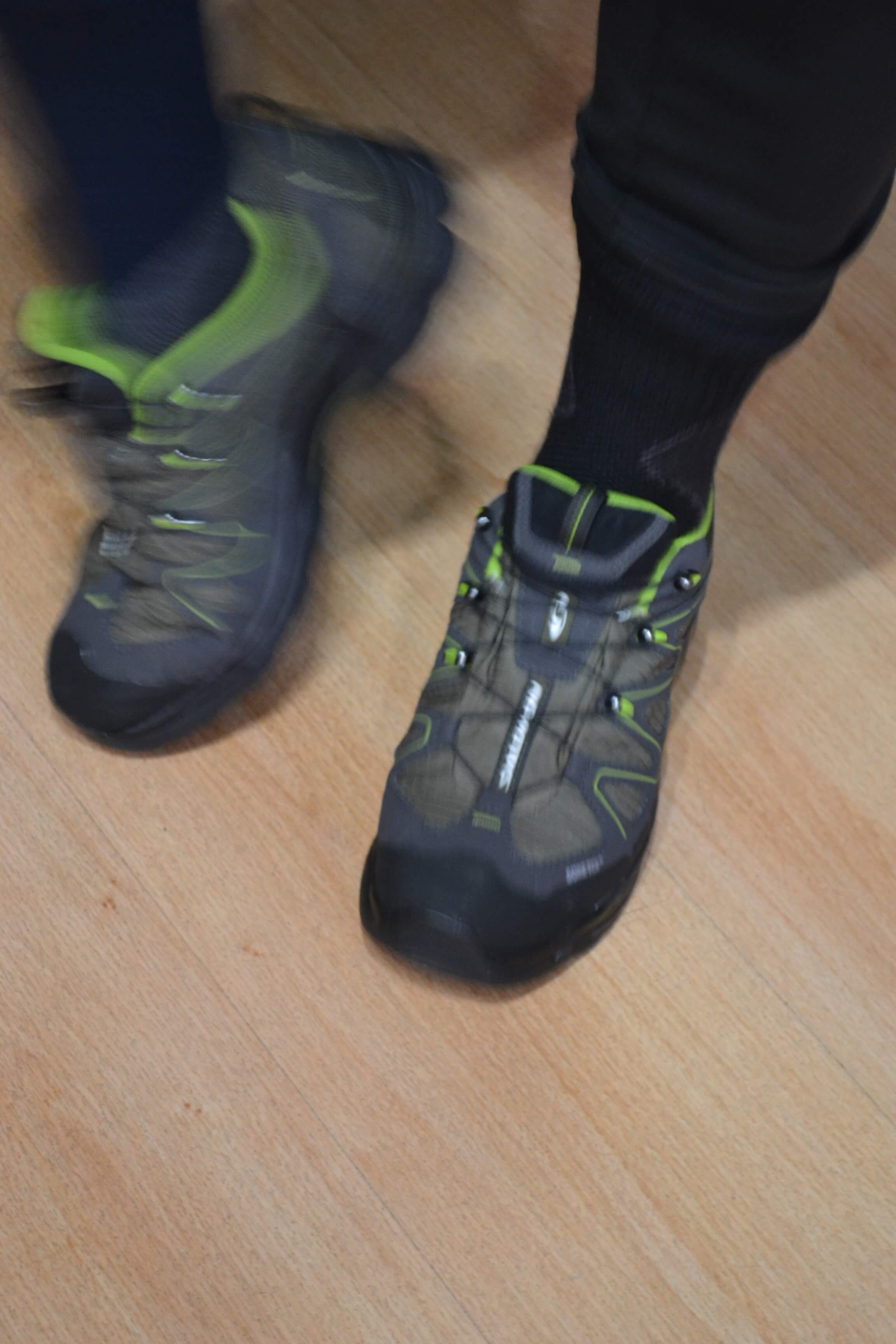
Mom was pleased with the new Salomon trekking shoes she had bought yesterday.  “Oh,” she
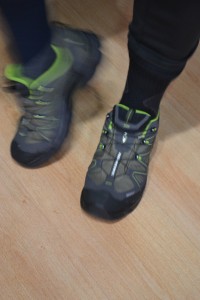
Mom's dancing in the shoe store blurs the shot

said.  “I’m going to sleep in these!”  For the first time since we began the Camino, she walked an entire stage in one pair of footwear, and did not resort to her sandals.

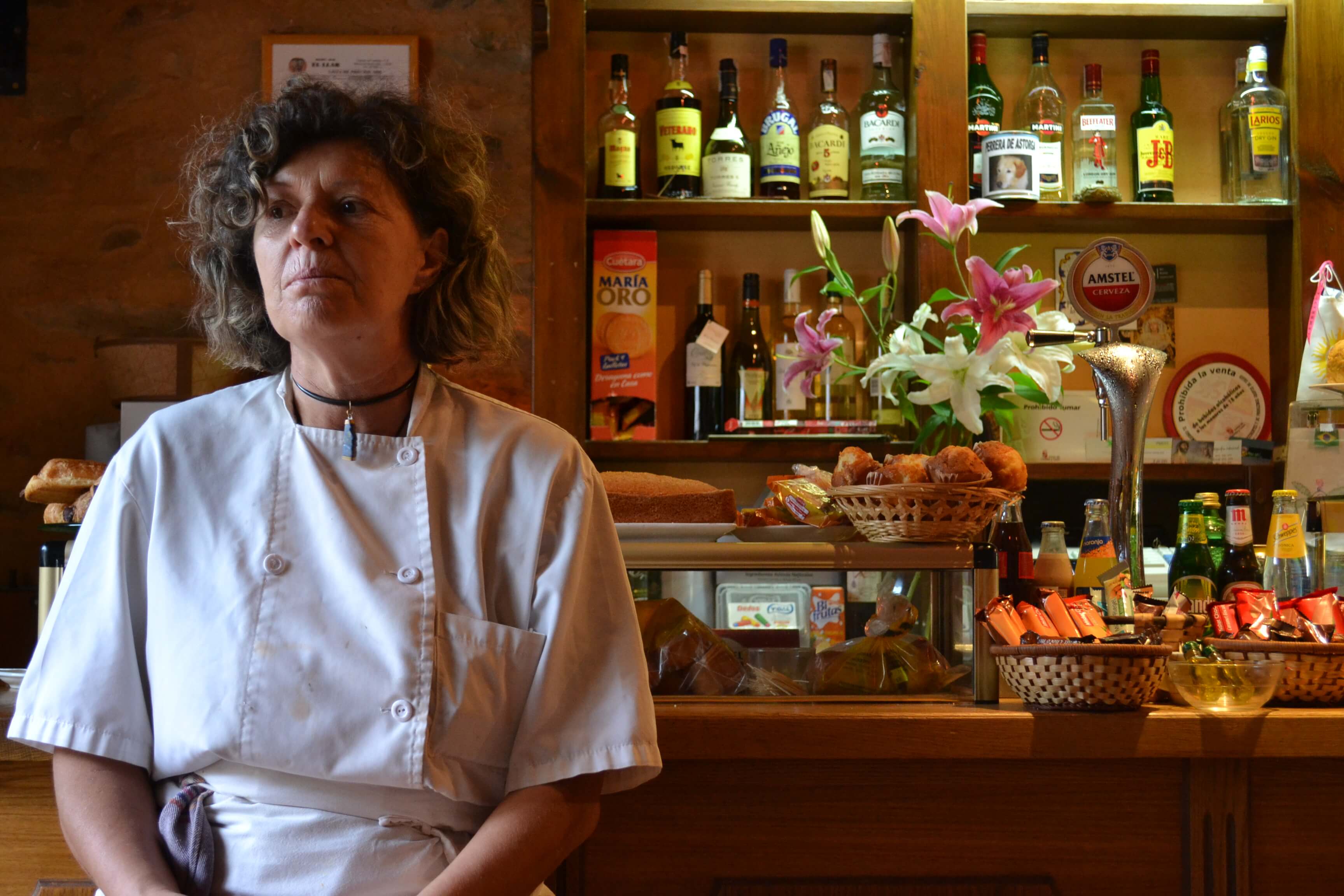
Even before we’d left Astorga, we came upon a wonderful aroma of fennel.  It was like walking through a licorice factory.  The blue of the dawning sky was beyond description.  The power lines sizzled and buzzed overhead – something I’ve heard only in Spain.  In Murias de Rechivaldo, we stopped for Second Breakfast at a small but cozy café run by a woman named Pilar.  She addressed me as “senor,” and the bathrooms, to Mom’s delight, had both towels and soap, a rarity on the Road.  (As long as I’m wearing wicking wool, I find towels unnecessary).  These things would earn her a larger tip.

Pilar was playing Tibetan mantras on the stereo.  “For patience,” she said, pronouncing it “pot-ience”.  “And for compassion.”
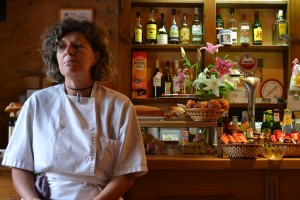
Senora Pilar


“There isn’t enough of that along the Road,” Mom said.  Pilar agreed.  They discussed Pilar’s liver problems, and her efforts to remain positive, and they shared tips on alternative medicine.  Pilar said that good food had changed her life and her health — notably, she no longer ate jamon.  Meanwhile, I talked with a Galician who has lived in Alberta for many years, his Canadian partner, and an Italian woman from Bologna.

The countryside between Astorga and Rabanal is sparsely populated.  As the earth’s population climbs, I hope that people, especially those in China and India, will keep Spain in mind.  The semi-arid terrain reminded me of the land in and around the Great Basin of the western United States:  yellow grasses, light-green shrubs, heather, broom, wild
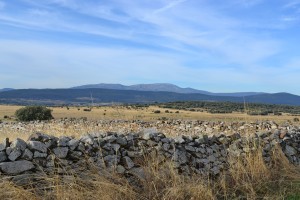
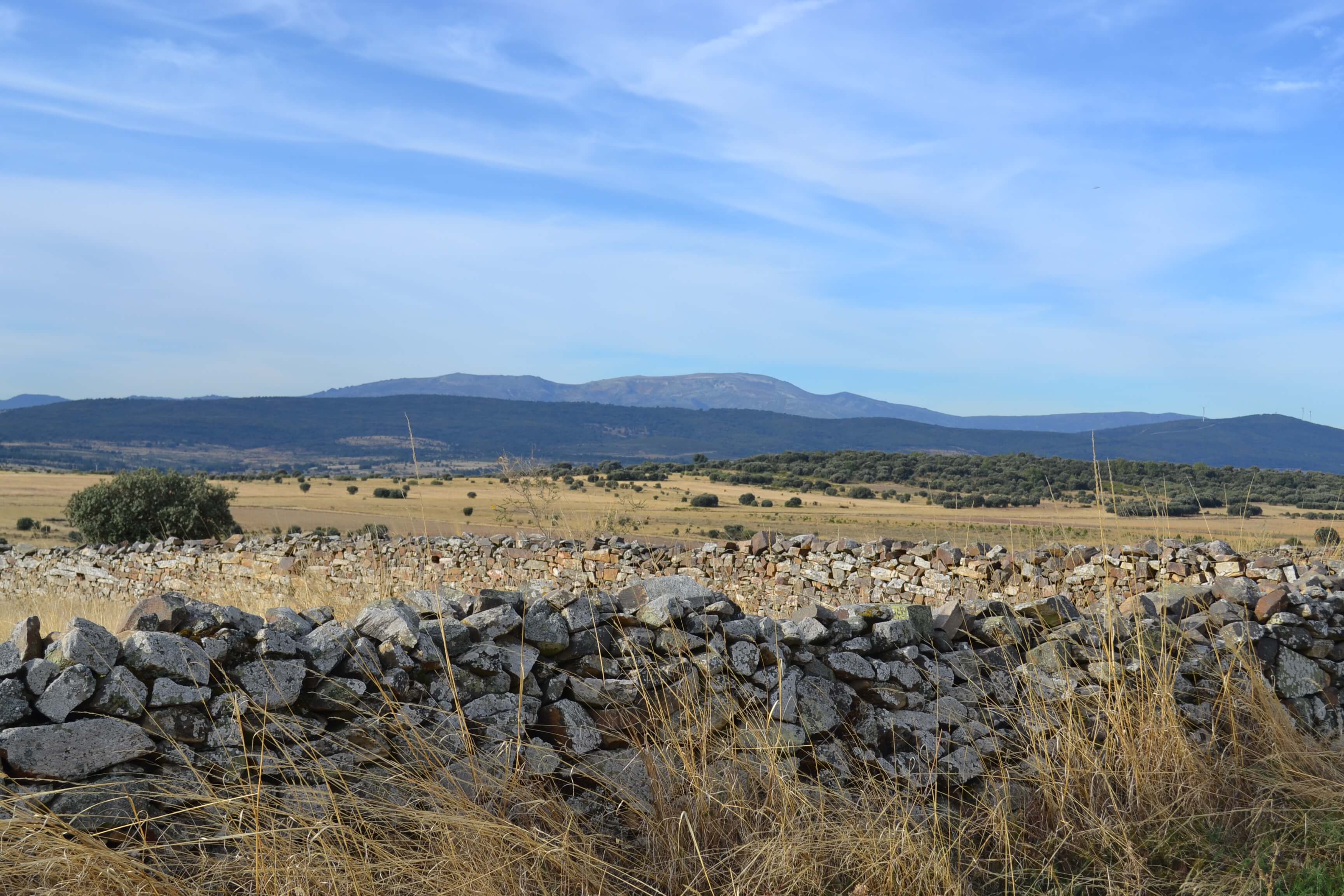
Stone corral

thyme, desert flowers, and a few types of dominant trees, none of them very tall, such as scrub oak.  In the distance I saw a few copses of aspens.

It should have been no surprise to see a sign, in El Ganso, advertising a Cowboy Museum.  (I couldn’t do it.  Not after the chocolate museum).  The soil was now red, too, reminding me that Colorado got its name from the Spanish – color red, color rado (red is now rojo in Spanish, but their explorers swept through the Colorado territory centuries ago).

We stopped for First Lunch in El Ganso and I took some notes and checked my email.  Mom fed stray cats bread with butter – “Have you noticed they only eat it if it has butter on it?” – and the cats all ended up standing on my feet because she was throwing the crusts between them.

For the first time since before Burgos – that is, since far on the other side of the plains of Castilla and Leon – we saw walls made of stone.  Some were in the fields, too large to have been a house, too small to enclose an entire property.  I decided they must have been corrals for sheep and cows.  The villages, too, were made of stone.  Roofs were made of mined slate or even thatch.  In the distance, hills, the ridgelines of which were covered with modern windmills too large for Don Quixote to tilt at.

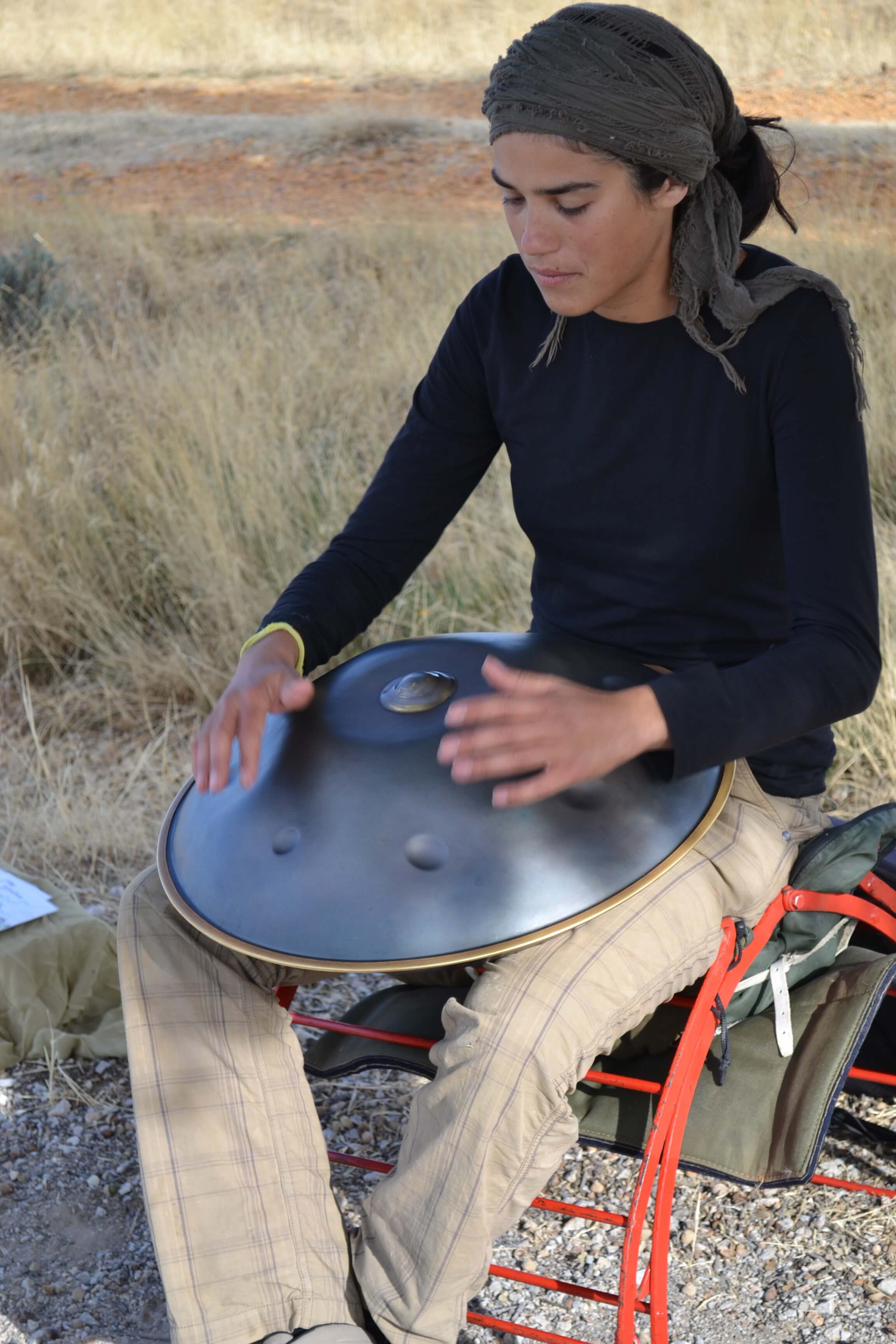
We came upon a tree under which a young man in long curly hair had set up a table.  He had been to Santiago and was now making his way back . . . to somewhere.  For a donation, he was offering coffee, chai, hummus, and cake.  Nearby, and much more alluringly, a slender, raven-haired woman played a haunting flying-saucer-like
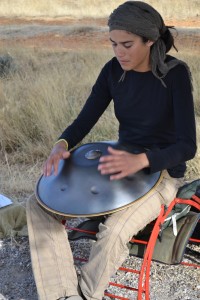
Spanish woman plays a hang in the middle of nowhere

instrument called a hang.  Invented by a Swiss, it had small dimples spaced around its perimeter, and by tapping the places in between, she caused it to make different notes.  The sound wasn’t too unlike the music played by the alien ship in “Close Encounters of the Third Kind”.  Hank, a young Dutchman, tried his hand at it, too.  I bought one of the woman’s CDs, and we moved on.

Hank and I walked for a while.  He told me about a man who was on the Camino with his daughter’s ashes, and who was walking an astonishing 75 kilometers per day.

He told me he himself was on the Camino to prove, as he put it, “that I can finish something.”  Shin splints had resulted in his early departure from the army, and his confidence had suffered.

“You thought something was wrong with you?” I said.  “You worried that it wasn’t just the injury but that you were weak?”

“Something just like that,” he said.  He was now traveling the world for a year, and filming his exploits.  He said he wanted to learn how to meditate, and for about an hour I talked to him about it.  Hank is probably the first person I’ve ever heard say, of English, “I love the language.”

“Why?”

“It’s just so easy and smooth.  Dutch is like German, they both sound so harsh.”

“To my ear,” I said, “Dutch sounds a little like German, but also a little like English, so in the end it sounds like the kind of language I would make up, if I were going to make up a language that sounded like complete nonsense.”
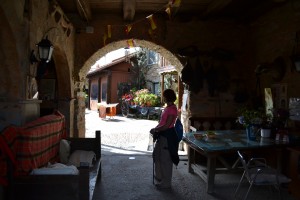
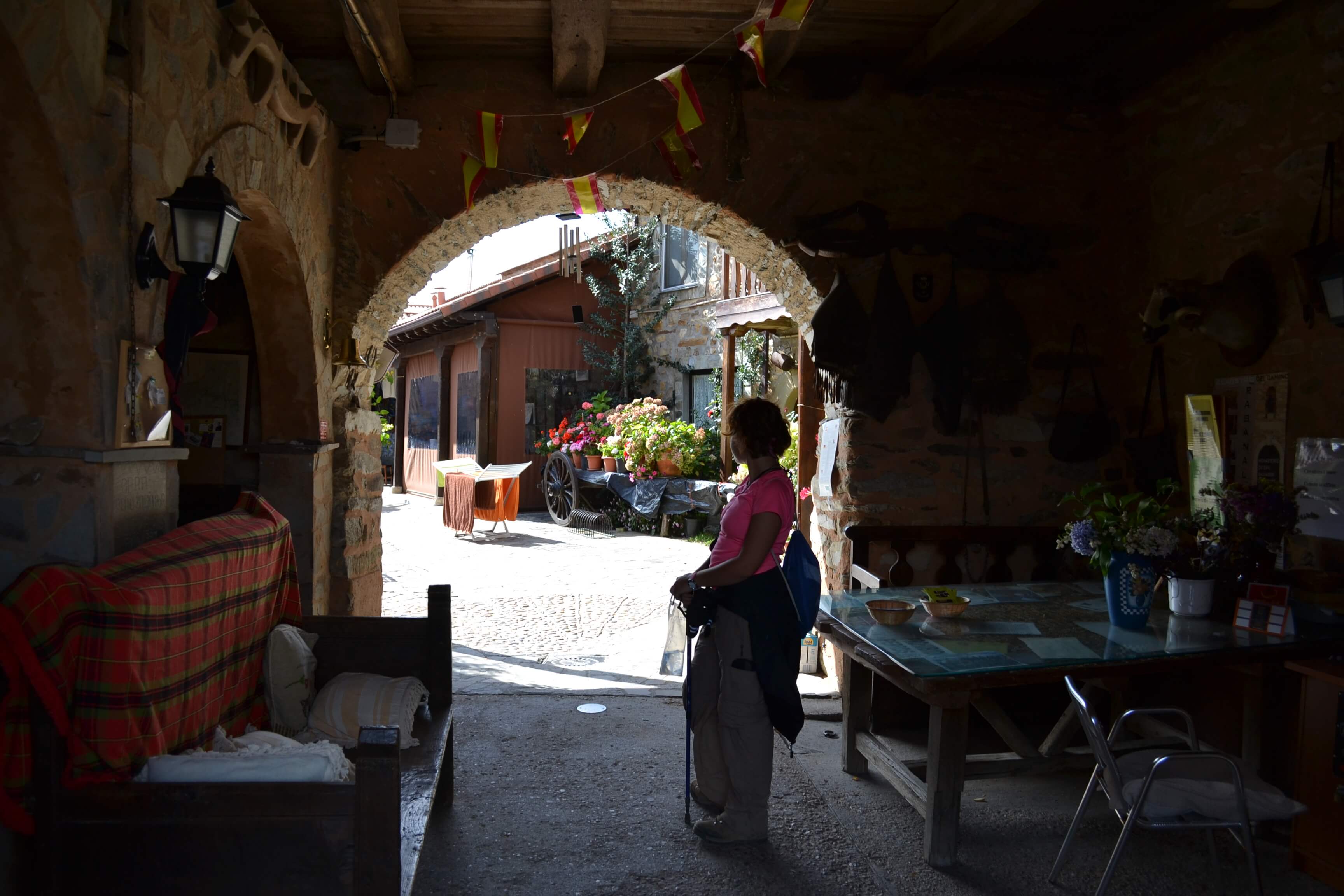
Rabanal Albergue entrada

Rabanal

The albergue in Rabanal was utterly charming.  Stone walls, wooden beams, an outdoor bar and patio, flowers and flowering bushes scattered about.  There’s even a mistletoe tree, about twelve feet tall.  I thought mistletoe grew only at Christmas, and near doorways.  The proprietress didn’t speak a lick of English, or anything other than Spanish, but she was all smiles, as was her mother, who must have been in her eighties.  The daughter, who was in her late fifties, walked through the dorm and would cry Hola!, and Mom and I answered a few times, until we realized that she was playing peek-a-boo with pilgrims sitting outside the windows.

Once I’d dropped my pack I headed to the restroom.  The light switch was not in the same room as the toilet stall.  That should have been my first warning.  Sure enough, after a few minutes of contemplation, I was cast into darkness.  This saves on electricity, but it necessitates the use of more paper.  I need to research how the Spanish are apparently able to do their business so quickly.  Is it all the oil in their diet?

Mom sat down at a table next to Barbara, the Bavarian woman, and Rainer, from
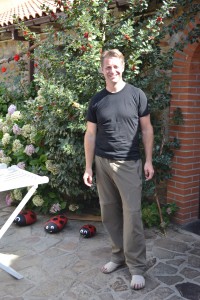
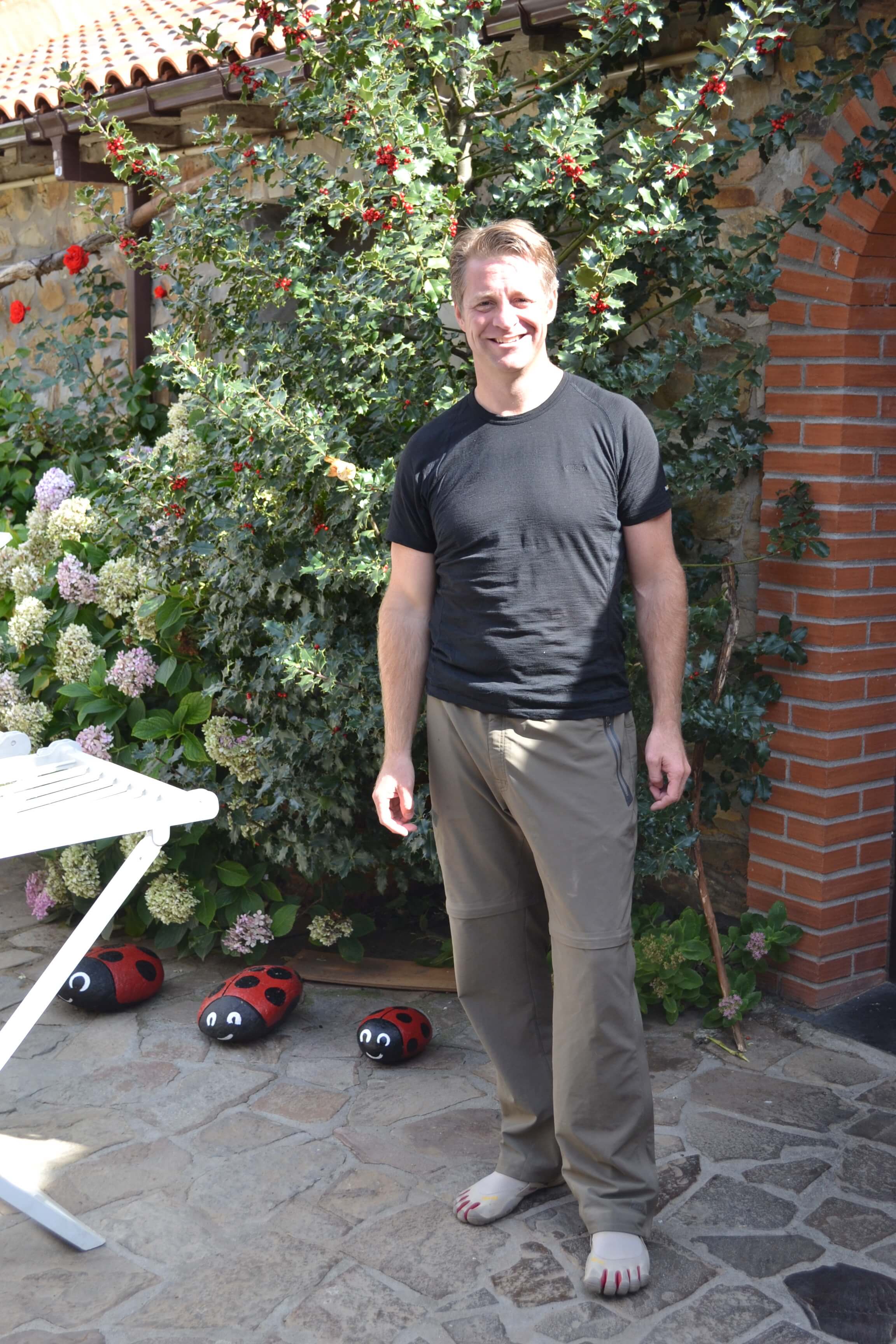
Okay, girls, this is a whole mistletoe tree. You know what to do.

Cologne.  He’d had a hard day of walking, he said, after having had too much of a local spirit.  Rainer said he was on the Camino because he’d had a rough two to three years, and he wanted to stop thinking about all his problems.

“Is it working?” I asked.  He shrugged.

Barbara had beaten cancer four years earlier.  She initially wanted to walk the Camino in order to spend some time by herself, but now, she said, she was feeling dankbarkeit, thankfulness or gratitude, for her life.  While away from her normal life, she realized how good she had it.  She had been married 26 years and she and her husband still felt about one another as they had when they met.  She had wonderful daughters.  She wanted everything, she said, to stay just the same.  There, I thought, was a dangerous thought to attach oneself to.

Atop the iglesias in Rabanal, the little churches, were more storks’ nests.  One of them, inside, was crumbling and rustic — perfect.  We went there for a Vespers mass, blessedly short, and attempted, in Latin, that odd reading/singing-without-a-clear-melody that Catholics are somehow able to do, perhaps right out of the womb.  We read a Psalm about the Lord crushing our enemies, and then we read from Romans about always doing things to please our neighbors.

“You did that really well,” Mom said to me.  “Like you’ve done it before.  But that priest was not going to let you be lead singer, no way.”

As we exited the church, another group of worshippers was waiting outside.  Two women looked at my footwear aghast, as if I’d just walked across the face of the Lord, stopped, backed up, and wiped my feet.  Soon the whole group had turned to watch me walking away, for all I know clutching their rosaries and crossing themselves.  It’s this sort of thing that could make even a sociopath self-conscious.

Across a narrow road from a hotel that had wi-fi, I sat down with my computer in the cold.  Vodafone charges me by the gigabyte, so when I want to upload pictures to Facebook or the blog, I use free wi-fi.  A cat sat across the road from me, near the door of the restaurant.  We exchanged a knowing glance, we two scavengers.

Morning in Rabanal del Camino:  An Ode to My Fellow Pilgrims

It must have gotten into the 30s last night.  Even with a blanket and two layers of clothes, I was cold.  There was very little snoring, at least that I heard.  I call this a miracle, and credit St. James himself.  Mom said Rainer was sawing away because he’d drunk two bottles of wine the night before.  In the morning he was nursing both a café con leche, from the bar and, in his left hand, a Coke.  He said he felt awful and didn’t know why.

“Alcohol?” I said.

“Could be,” he said.

Although we’re no longer at risk of walking in hot weather, at this altitude and with current weather reports, pilgrims continue to insist on going to bed before 10 and getting up before 7a.m. to begin walking.  And thus begins the second movement of each night’s Orchestral Maneuvers in the Dark (shout out to Yuka for the 80s reference).  At first, one tentative soul glides around, quiet as can be.  He is soon joined by another pilgrim or two.  There is rustling, but it’s tentative.

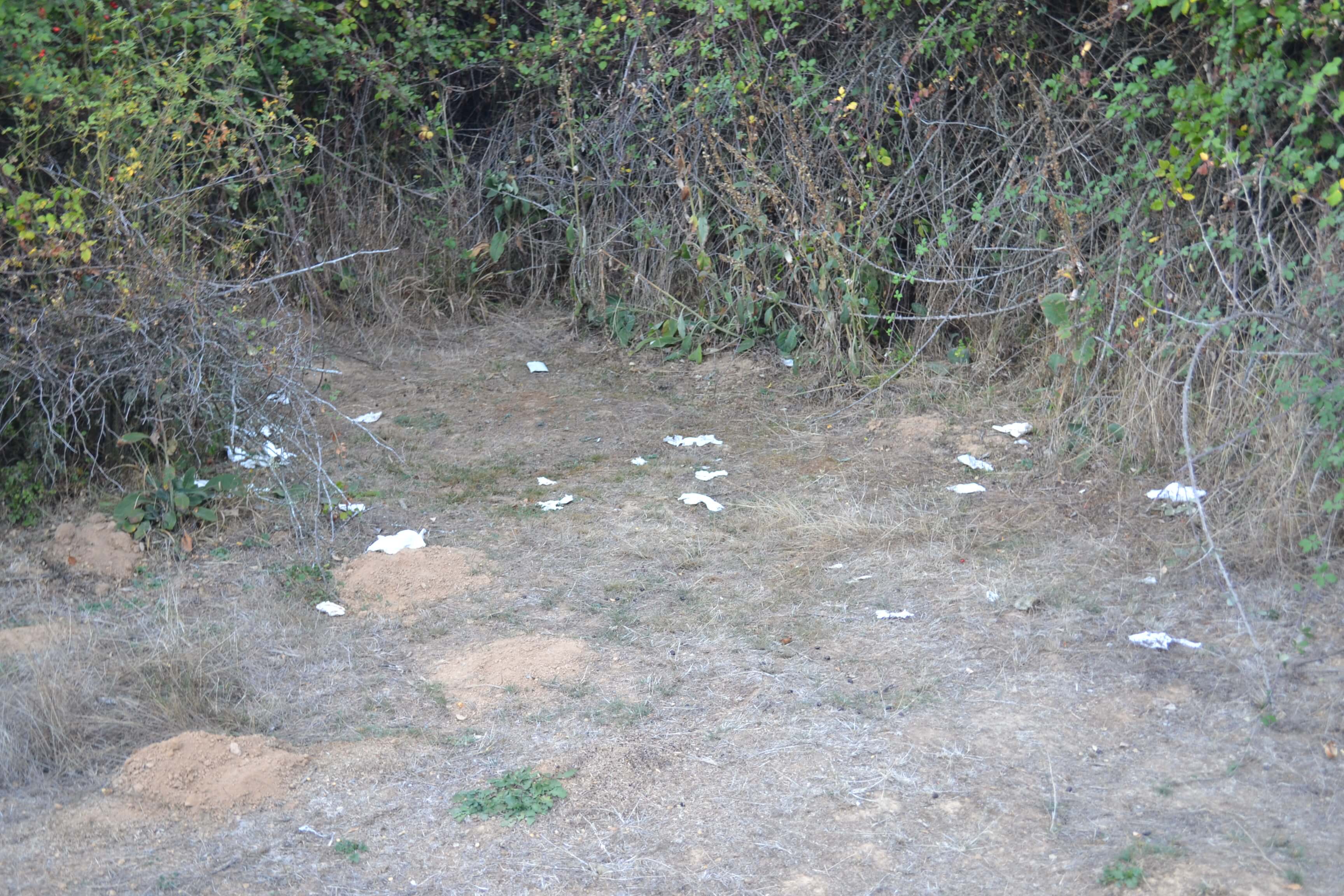
But then the broken-window phenomenon sets in.  With each new person, and each new noise, comes more permission for the next person to be louder.  Soon the rustling turns into a manic stuffing, and then a loud zipping, and sotto voce voices turn into whispers fit for artillerymen, and eventually, no matter how many bleary-eyed people are still enclosed in sleeping bags, pilgrims are now calling out to one another, stomping about, slamming
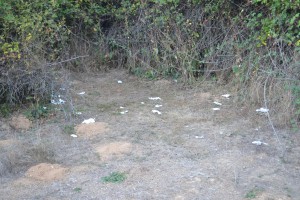
These are externalized costs, in economist-speak.

doors.  It’s truly amazing that these are the same seemingly normal, well-adjusted people we have met the night before.  Then again, once on the trail, some of them will also be unable to bury, or even to lift a rock to cover up, their used toilet paper.

I’m used to a wilderness ethic, at least in America, that says you pack out whatever you bring in.  In true wilderness areas, that even includes your own waste.  That’s what plastic bags are for.  The Camino, by contrast, needs either to educate pilgrims better or to provide trash cans.  Pilgrims disrespect their fellows, the locals, and the environment with their trash.

Tomorrow, we will finally reach the Cruz de Ferro, the highest point on the Camino and, by tradition, the place where pilgrims leave something behind — where they let go of something.  It is probably the most important part of the Camino for Mom.  “I’m going to leave my cancer there,” she said, a few months ago.  But will she?  And isn’t the hope itself dangerous?


León to Astorga, City of Chocolate

León to Astorga

To give Mom’s toe more time to heal, and because walking from León to Santiago would

Gaudí's Palace

have required an aggressive 18 kilometers a day, every day, for 12 days, we took a short bus ride from Burgos to Astorga.  Astorga is a pleasant little town.  Marie Anne had recommended that we be sure to stop here.  There is an embarrassing wealth of cathedrals and churches for such a small town, and a Museum of Chocolate, which Carrie was determined to see.  The old town in which we’re staying sits on a bluff overlooking the surrounding countryside.

Legend has it that both Santiago and St. Paul preached in Astorga.  Both legends seem to me unlikely, but the city did merit a bishopric of its own.  Because it’s at the foot of two very steep climbs, it became a place on the Camino for travelers to rest up before the next ascent.  As a result, there were once more hostels here than anywhere but Burgos.

Astorga was originally a Celtic settlement and in 14 BCE became a Roman stronghold in what was known as Asturica.  Still visible today are the ruins of a sumptuous private home, complete with baths (featuring, as in the baths I’ve seen in Israel, hot, cold, and

Ruins of a Roman Villa

even tepid water), and the town’s walls. Plinius called the city urbs magnifica, “magnificent city”, but most of what the Romans built was destroyed when the Visigoth Teodorico II defeated the Suevi tribe that had settled the area after the fall of Rome. The Moors later destroyed the Visigothic city.  After the campaigns of Alfonso I of Asturias (739-757) against the Moors, the city was abandoned until the 11th century, when it became a major stop on the Camino.  The city was unusually welcoming to its Jewish residents until 1492, when all Jews were either forcibly converted, killed, or expelled from Spain.

Astorga has a fine cathedral, to judge from the outside.  But both times we arrived it was

Astoga Cathedral

closed, so we’ll never know what’s inside.  It might have held the Holy Grail, or a BMW Z8.  We ran into the same problem at the neo-Gothic, fairytale Bishop’s Palace designed by the great and whimsical Antonio Gaudi.

Happily, in Astorga there is a fine little albergue.  The owners or managers are a Spanish couple, and the volunteer hospitalerosare German, this time a couple from a town near Koblenz.  Mom was utterly delighted with the kitchen, which led to a patio with a view for

Mom and a view of and from the Patio at the Astorga Albergue

many miles, and she could not have been happier about immediately going shopping and making lunch – German-style hamburger patties with onions and German potato salad, along with white asparagus, raw red peppers, banana slices, and grapes.

We got a room with a view – and the room holds only four people, the fourth being Barbara, a woman of a certain age from near Munich, whose daughter was once a satisfied exchange student in Iowa.  She has that Bavarian accent that reminds me of my relatives, and childhood, in Bavaria.  Barbara’s crown has broken, so she is off to see a dentist.  Curiously, this happened to another pilgrim just a few days ago.

I’m tired today.  I didn’t get much sleep last night.  At least one man, and maybe two, sounded like nothing so much as a motorcycle starting up.  I am becoming an aficionado of snoring sounds.  It’s like Nabokov, collecting and documenting butterflies, only with more rage.  Truly, hostels need to provide those little anti-snore strips and require that snorers use them.  It should also be made kosher for other pilgrims to wake a snorer without a strip and ask him to get one or to banish himself from the albergue, if not from society entirely.

I am looking forward to a greater probability of a full night’s sleep.  It would depress me beyond measure for Barbara’s crown, say, to get broken again.

Counting another bus trip, we’ll have about 169 kilometers to go, out of the original 800+.  If we budget 11 days (we leave from Lisbon on October 22, but wanted to spend some time in Portugal), then we need to cover 15.4 kilometers per day.  That’s easily doable, if we can avoid injuries and other health issues.  Apparently one must cover the last 100 kilometers to get the special badge of the pilgrim.  Or maybe it’s an embossed certificate from the Pope, along with an accounting of the sins remitted (and how does he know?  But then, Santa Claus knows, so why can’t the Pope know?)  Julio told us that in Santiago, the townsfolk offer to host pilgrims in their own homes, and that there is some kind of ceremony at the cathedral where the pilgrims’ names are called out publicly.

XOCOLATL

One proud native informed us that Astorga was the site of the first manufacture of chocolate in Europe.  (He also said the first shop was in Aachen, Germany).  I wasn’t able to confirm this with Google, and the Museo de Chocolate, for which we had high hopes, was of no help.  The museum appears to have been carved out of the living quarters of someone’s home, and it offers less an education in things chocolate than a collection of old chocolate-making tools.  But its curators’ primary interest seems to have been Spanish-language chocolate advertising in the late 19th and early 20th centuries.  Somewhere in the world, a Ph.D. student with an esoteric thesis will be very happy someday.

The Spanish were the first to bring chocolate to the Old World, and like so much else, they got it from the Aztecs.  Montezuma drank the stuff eight times a day, and believed it was the key to good health.  When Hernán Cortés, the conquistador who destroyed Aztec civilization, broke into Montezuma’s palace, in 1591, to rob his treasury of its gold and silver, he was astonished to find only a truck-load of cocoa beans.  Cortés brought Xocolatl! to Spain, where the bitter stuff was made more palatable to European tastes by mixing the ground roasted beans with sugar and vanilla.  When more and more sugar was added, it became edible to Americans.

Catching Up: Logroño and Navarette

Logroño

Checking into the municipal albergue is now old hat. The one in Logroño was staffed with more unfriendly, unsmiling volunteers who speak a rapid Spanish that none of us can follow. What it boils down to is, we need to show our credentials and show our passport, then take a shower and come back to pay. We received throw-away sheets and pillowcases, which is what some albergues do now. We had arrived so quickly that we didn’t know what to do with ourselves. The 9 kilometers were so easy, but I was still tired. We tried to find a notary for Cameron and a grocery store.

This albergue has a nice big kitchen, but the two stoves have been removed and only a slow microwave exists. We bought veggies and salad (tomatoes, cucumbers, cheese, and chorizo, and bread, of course). I haven’t eaten so many carbs in a long time. But there’s absolutely no choice. I wonder if the veggies are sprayed. I am so far off my diet, I don’t even see it anymore. My energy level is down, and I would even consider eating meat just to get something of substance into my stomach. I bought two large, lovely red peppers to eat on the way in case there were only the uncovered mayo tuna tapas.

The guys took off to do business, and Marie Anne and I went to a café in the square. We were people-watching while we had our café con leche and mousse. It’s a lovely afternoon and people are busy going to and fro. Most of them are very nicely dressed. The more mature women as well. Their hair is coiffed, clothes match, nice shoes. We don’t see many overweight people. There was a beautiful cathedral with an ornate façade.

After washing our clothes and arranging the service to take Quasimodo to the next village in the morning (who has been replaced by a fat-baby daypack). We had another salad for dinner, and I went to bed to read for a while. There are three dormitories and probably 36 people in each. There were only two toilets and two showers for women, and as many for men. Toilet paper is a rarity, and one had better bring one’s own or be caught with one’s pants down. I hear people speak Spanish and laugh, some in broken English, and finally lights are out, and all is quiet . . . until midnight.

The snoring concert begins, and it’s awful. I went to the bathroom and then tried to go back to sleep. The Irish guy who was up a little while ago, tending to his injured foot, is now talking in his sleep. At two o’clock I’m still awake, and all four snorers are snoring at the same time. Nothing helps. I even contemplated dragging my mattress into the kitchen.

Even though I had only 13 or so kilometers to hike the next day, it’s a lot when you’re tired.

The flax (which I call “my dirt”) started to work, so I was up again. Finally, I took ibuprofen, and slept one-and-a-half hours before the plastic rustling began. I tried to go to the bathroom first, so I could take care of my dental issues. I snuck back to my bunk and retrieved coffee. There was not a pot to heat water.

A young Spanish man pantomimed that I should place a glass of water into the microwave. “Ahh,” I said. “Good idea.”

And then I decided to take my flax in the mornings, because I believe it will work much better, and won’t give me so many colon issues.

Logroño to Navarette

Marie Anne, Carrie, and I left Logroño while it was still cool so we could arrive before the hot noon sun caught us. Cameron and Julio were once again dealing with the notary. We made decent progress, and only stopped several kilometers out of town. The landscape changed back to being hilly, with lots of vineyards. We stopped at a bar, luckily open, and had our morning café con leche. I had to take of two blisters on my right foot. It was a beautiful spot by a pond, surrounded by green hills.

Then we started again and the Camino ran along the highway, divided by a chain-link fence. Every link had a hand-made cross in it, some made of wood, others of plastic bottles. I fashioned one from yellow flowers and placed it there as well. I remembered my visit to Oklahoma City, where people had done the same thing. I tried to explain that the bombing had hit the sangre de couer of the people of Oklahoma City, and she understood.

I was thinking as we were walking about the ancient pilgrims, and their hardships. How they were often robbed, and if they didn’t have enough, they might be beaten and thrown into the river. So in spite of all my issues, they were much worse off.

I was also having a food obsession: where to get it, what I would do with it, if they didn’t have what I wanted, what we’d do instead. Once that problem was taken care of, then came the bathroom obsession. Where to put it all, when there was not even a tree.

Everywhere the harvesting of grapes had begun. The weather was still perfect, and I’m sure they’re very happy to have such a great year.

Navarette

We arrived in Navarette early, and the albergue was still closed. We waited at a nearby café, where other pilgrims sat, and got sleep in the warm noon sun. Soon, we saw Cameron and Julio. Both made the 13 kilometer trek in 2 hours – a serious butt-kicking. “Cheesus Crise!” Julio said as he sat down. “Jour son is trying to keel me.”

We heard some music that sounded like from an ancient time. We hurried to check in, but there was no hurrying the process. And so we got another lesson in patience.

I had had two blisters between my toes, so the going was a bit tough. When we reached the square, situated right by the church, under some very old trees that shaded a stage, we saw children in elaborate, very starched white dresses with colorful flowers on them. They danced some old folk dances while throwing shy glances at their beaming parents. We were starving, but found out that everything was closed due to the fiesta to come. I would have thought that a priest or two would care for these hungry pilgrims. What are pilgrims to do on days like this? I had read about locals coming with water or food to greet the pilgrims. Well, I don’t know how long ago this was, but we sure haven’t seen anyone, except hungry feral cats. We did find a restaurant open and ate a fairly decent meal, but it cost 50 Euros. As Julio says, “the fleecing of the peregrinos”.
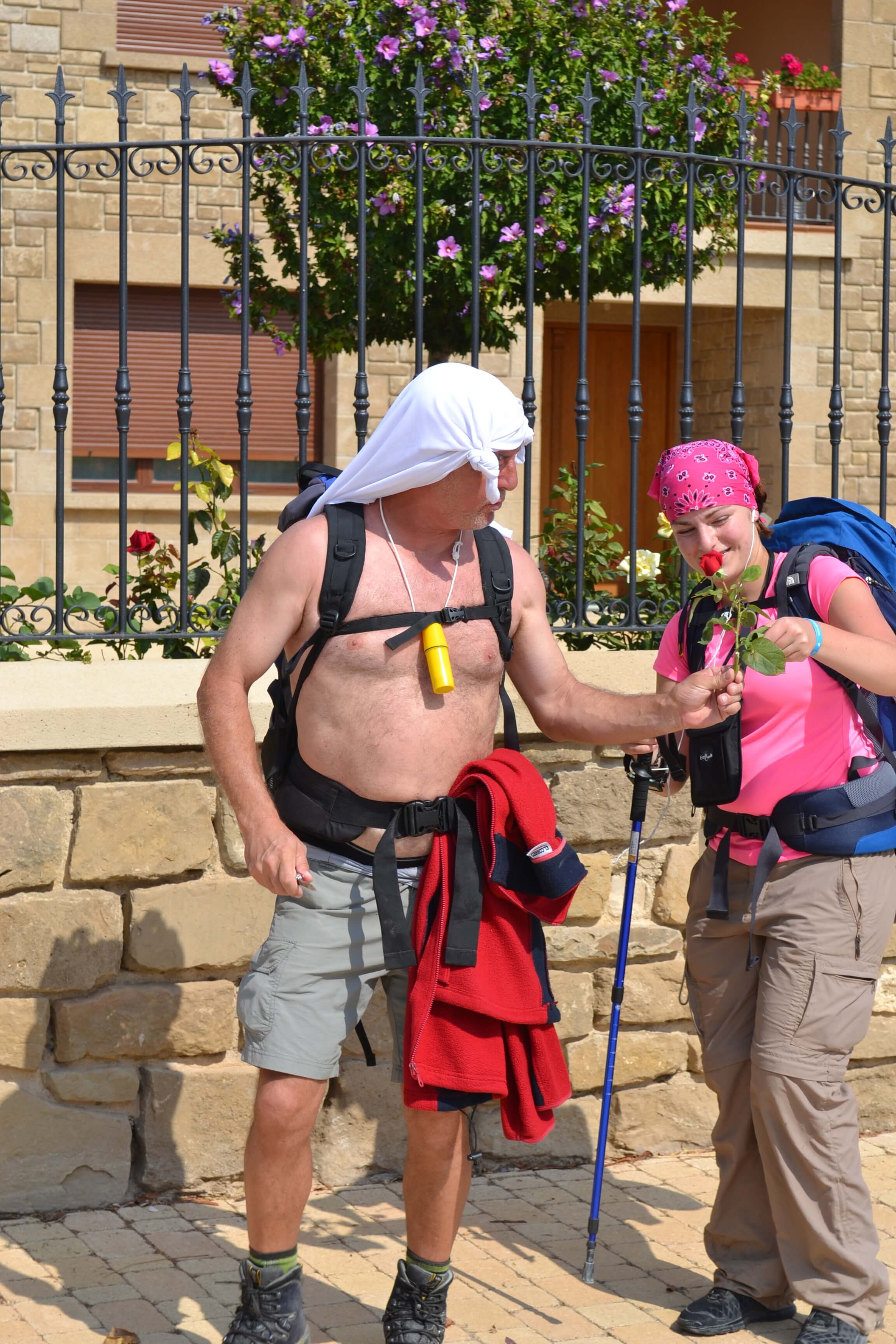
Carrie is catching a cold, and I hoped wasn’t getting worse. I can feel my throat tickle, and I groaned inwardly about yet another malady. We showered and changed, washed clothes, and arranged Quasimodo’s ride to the next town, since I really can’t carry mine with all these issues.

We wanted to visit the church, but due to the fiesta, it was closed. This is a smaller town, and rural, so I would imagine they would take their fiesta pretty seriously. During the fiesta, I had two bowls of the best soup ever!

Navarette, Azrofa, Santo Domingo de la Calzado

DSC_0395 (1)

Supporting Treatment

Inge is a fighter. She beat cancer after grueling surgeries and chemotherapy 11 years ago, and she walked nearly 500 miles across Spain, in late 2011, in part because she hoped the returning cancer might just go away on its own. But the Emperor of All Maladies, as it’s been called, is still with her.

She’s been sent to test after test, and there are probably more tests, and treatments, to come.  We’ve been asked for an easier way for her friends and supporters to help out with the expenses, so here we invite anyone who has been touched by her or her story either to (1) buy the amazing book True History of the Camino de Santiago, written by Inge’s son, Cameron, or (2) donate any amount you choose toward her treatment. Subscribe with your email, above right, to watch Inge’s progress.

See what the True History of the Camino de Santiago book is all about: www.TrueHistoryCaminodeSantiago.com.

Donate:


Below are two little movies we made of Inge on the Camino de Santiago. We think they show her passionate, fighting spirit quite well.

Watch Inge Symbolically Leaving Her Cancer at the Iron Cross

In Santiago at Last: How She’ll Look Once She Beats the Emperor Again!

You can donate any amount you wish. Buen Camino!

An Audience with El Notario

El Notario was a very sober man. Small, neat, with a short-sleeved white shirt and a modest tie (so modest it bordered on immodesty), he exuded authority and self-assurance.

Julio made sure to legitimate me right away.

El es un abogado de Princeton,” he said.

“Harvard,” I said.  The Spaniards thought this was funny.

El Notario placed before us the documents that Eva had drawn up. He verified Julio’s identity and made him swear to translate faithfully (Julio would violate this by saying “blah blah blah” over extensive portions of the document). The documents contained so much legalese that even when they were upside-down, an American lawyer could read them: Latin is still the lingua franca of the legalist. They said that Don Cameron Christopher Powell did not understand Spanish, and that Don Julio Angel Redondo Garcia was acting as interpreter and translator. They also appeared to say that they had no real legal effect.

When all the preliminaries had been completed, El Notario reached for a Bic pen and held it up before me as if he were putting Excalibur into my care. He held up my passport before me and pointed at my signature as if to say, “It should look like this”. (Perhaps he did say that). I signed my name in two places.

He appeared to think we were done.

I explained to Julio that a document with only my signature on it would not be useful to the American authorities, who rather expected that the State, County, signature, and commission expiration would be filled out by a notary on the same document, and who would neither look at nor understand the beautifully produced four-page instrument that Eva had so carefully prepared for El Notario’s stylish signature.

To my dismay, El Notario was not reaching for his pen. “Notaries in Spain never expire,” Julio translated. “Their license to print money is forever, perhaps beyond death.”

“Could he write ‘No expiration’?”

Sadly, he could not.

He told us to come back in an hour, so that the separate, Spanish documents could be changed to reflect the fact he would be applying his pen to the English-language document. Like a man sitting in a cab from New York to Washington, D.C., I could see the meter ticking upward.

But there was one good thing to come of it all. “For the rest of Camino,” I told Julio. “You will call me Don Cameron.”

From Pamplona to “Ave Maria” in Los Arcos

Pamplona to Cizur Menor

I didn’t walk from Pamplona, as I was feeling very shaky.  I thought perhaps it was due to low

Lunch in Cizur Menor

blood sugar (the H’s hurt with each step) and I just couldn’t face even walking four miles.  Carrie, Marie Anne, and I took a cab with Cameron’s pack too.  In Cizur Menor was a lovely albergue, with a small pool filled with goldfish and turtles, blooming hydrangeas and other lovely foliage.  It was more like a small resort.  Julio cooked again and we sat outside and ate pasta.  I was pretty tired and in bed by 8:30.  I slept well until all the snoring started.  I got up at 2 for the bathroom again, then at 3:10 and once more at 4.  At 5:30 I gave up to handle my dental issues and have a cup of tea.

To Puente La Reina

We started out at 7:30 and walked approximately 8km, had a decent lunch, and walked through beautiful countryside that reminded me of Tuscany.  We had to climb up another hill, and down a rocky path, but the view on both sides and around us was well worth it.  Large fields, now empty and harvested, cypresses and blackberry bushes.  My foot started to hurt and it was getting hot, but I will not complain.

Finally, we came to Puente La Reina.  Beautiful old monastery. Upon arrival we were told that our backpacks hadn’t made it.  Julio took over, helpful as usual, helping us immensely with language.  We had the packs brought by taxi.  Marie Anne and I tried to find a grocery store, but, it being Saturday and a fiesta for running the bulls, everything was closed.  Lots of movement in town, with people sitting all over outside, picturesque houses again, with lots of flowers.

We went to see the old bridge and I took pictures.  Got the rest of our little family and

Puente La Reina

went to see the bulls being run.  A DJ played good loud music and Marie Anne and I danced.  It was so much fun.  Then the two little bulls came running up and down the street as young men tried to touch their horns.  The bulls sure looked tired after a while, but it was all in good fun.

Julio found a store and we invited a young man who has been walking from England since June.  Carrie has made a friend.  An older gentleman and artist.

Estella

Estella.  I call her the elusive, because I was under the impression that the town was only 19km from Puente La Reina, but the walk seemed to go on for a long time.  Problem was we got a late start due to some miscommunication, so we were behind everyone.  The path looked in some places like Douglas Pass, or in any case like the road to the Black Canyon.  We walked up the hill and I was really breathing hard.  When I reached the top, there was the little family giving me a standing ovation.  Then

Julio interrogates an olive tree

we saw lovely vineyards, hills, olive trees, and figs.  Julio picked some of each and offered them to me to make up for the lack of veggies.  Later, Julio cooked a whole pot of pasta, which we shared with others.

My legs are sunburned and red like lobsters.

The Way of the Camino

The way of the Camino is such that everyone, regardless of nationality or religion, is

English lasses with ready medical supplies

immediately helping.  The sharing and caring makes it so worthwhile.  They don’t ask your interpretation of the Bible before they’re willing to help.  No one holds himself above another.  Sometimes the aid is as small as a band-aid.  Other times, people stop and dig through their entire backpack to find what you may need.  People call out a friendly “Hola!” when the pass, and everyone wishes you “Buen Camino”.

When I rest for a minute to catch my breath, the ones who pass always ask if I’m okay.

The Long Road to Los Arcos

Morning came early and we hurried to get started, as I could not face another day with most of the time in 100 degrees Fahrenheit.  Our journey today will be 21km to Los Arcos.  Again we made a good start in the cool morning mist.  The stars were shining and we heard the click-clack of the walking poles. (I have two BFFs, Preparation H and ibuprofen).  The many hills that I have to climb don’t elicit any more comments from me.  It is what it is.

The last two-plus kilometers were really, really hot, and it was all I could do to place one foot in front of the other.  Finally, we see Los Arcos, and I was soooo glad.  (It turned out to be 24km).

When we got inside the albergue, Julio was already there, helping us with the credentials.  The front desk was staffed with volunteers.  When it was my turn, one of them barked at me, “Do you speak English?”  I said “Yes”.  Then she said, “Well, how come he” – Julio – “has to do this for you?”  I didn’t understand her attitude or what she was getting at, and I said, “I’m sorry, but I feel really sick, and right now I can’t even manage my name.”

She looked at me and said, in the same tone, “What do you want me to do?”

I was so exhausted and in pain that this was all it took to make me tear up, and I said, “For what I have, there’s nothing you can do.”  Tears flowed freely, and I wondered whether we had walked into a prison camp by mistake.  Then my son took over and told her in no uncertain terms what he thought of her and her sour attitude.  Then Julio, in Spanish, said many words.  I stumbled off to find the dormitory before I collapsed, led by my son.

The Mourning Father

After a shower and a rest, I felt somewhat improved once more, and we decided to go and look at the cathedral.  When we opened the heavy, ornate door, I stood speechless in front of the golden splendor and beauty.  Gold, carvings, painted walls, and stunning decoration.  As we stood to gaze at some statues, Cameron put his hand on my lower back, where the tumor resides, and I felt the energy, and I was choked up and couldn’t speak.

I lit five candles, for four of my loved ones who had passed, and for the son of my friend Pat, her only son, who died last year not long after his marriage.  She misses him so.  After he died, instead of giving her a card, I had given her a small, potted tree for her to plant.

We sat in silence in the pews, when suddenly, there was this grand voice, starting “Ave Maria”.  We looked up in surprise, and I saw a lone man with both hands stretched before him, imploring the statute of Mary, who had her place of honor in the center of the altar.  His voice was brimming with emotion, and I started to cry.  I was remembering how violinists played “Ave Maria” at my brother Gunter’s wedding to Elfriede, and they were so beautiful and young.

Looking over at Marie Anne, I saw her crying too.  Everyone had stopped to sit or stand and listen.  Then the singer paused, and after a moment, he started another “Ave Maria”.  He went on for over ten minutes.  His voice carried, and the acoustics were phenomenal.  By this time, I was no longer thinking that he was singing from religious devotion, but from some other emotion.

He came down, and people approached him to shake his hand and thank him for his beautiful gift.  I also shook his hand and he said something in French, which I didn’t understand.  I just placed my hand over my heart to let him know how he touched me.  We walked to the courtyard and I was still wiping my face when I found out that he sang as a tribute to his son, who had died a short time ago, and that today would have been his birthday.  I looked at him as tears streamed down his face, and there was such deep pain (I cry as I write this).  I folded him into my arms and he sobbed, in English, “My son, my son”.

I could only touch my heart in silent communication.  Everyone – Cameron, Julio, Marie Anne, and a few others – was openly weeping now.  Later, when we returned to the albergue, we told the story, and everyone wanted to hear him sing.  They were affected the same way.

Morning Meditations in Logrono

It’s a crisp morning in Logrono.  It’s going to be another beautiful day in Spain, if perhaps a bit hot, especially given our late start.  The women have gone ahead, while Julio and I sit in a café-bar called Ibiza and consume bocadillos and café con leche (me) and hot chocolate (Julio).  Julio reads El Pais, one of the national papers, and translates for me the occasional outrage.  Julio often sounds outraged, but you don’t ever detect

Julio sweetly presents Carrie with a stolen flower

real anger, resentment, or bad faith.  It’s more of a stance, like performance art done by someone who’s a comic at heart.

I’m now sitting at a table outside Ibiza, opposite a park.  The streets are largely deserted.  The dearth of thinking I have done on where I shall live, or what I shall write, or what direction to take next in my vocations, is more than a little surprising.  There was a time when I could not get certain topics off my mind.  Now I can walk and have nary a thought enter my head that’s aimed more than a few hours into the future.

But I must credit my instinct with knowing what I need, and apparently what I need is, truly, a break from the thinking and weighing and analysis.  Indeed, yesterday I had an intimation, a sense, that the detachment I feel from the life I led before the trip would prove to be fertile ground for feeling my way into what’s next.  I had the sense that I needed to quiet the chatter of before so as to be receptive to the whisperings of what I might want now.  This is a change from what I expected, which was to have ideas drop into my head via the alchemical process of walking meditatively.

Some of the Spanish cheeses are delicious.  Yesterday I discovered ventero, a soft cheese reminiscent of freshly-made parmesan.

I’m hoping Mom’s ailments do not worsen.  It would be ironic if, on this spiritual-

Mom claps along in Puente La Reina

emotional-health pilgrimage, her health deteriorated simply because she could not get access to the food she needed.  Her diet in the U.S. is so rarefied and esoteric (compared to what now passes for nutrition in our country) that she usually has to shop and cook for herself to stay on it.  It’s even more difficult to be a vegan in Spain than in the U.S., and that’s not even counting the pilgrim’s diet.  To eat as a vegan here would require her to do more investigation in each town, walk farther, and spend considerably more.

But her spirits are indefatigable.  There is so much life in her that it’s unimaginable that it could leave her anytime soon.

Soaking the feet

A Visit to the Notary

ADVENTURE

ABOUT US

In early 2001, Mom (Inge) was diagnosed with Stage 3 ovarian cancer.  She had surgery and then grueling chemotherapy.  Already a gourmet chef, she changed the food she bought and how she cooked it.  And she held off the cancer for a decade.

In around May 2010, the periodic tests she underwent revealed three new growths in her pelvis, lung, and neck.  She responded by even more radically altering her diet, lost fifty pounds, and, six months later, saw one growth disappear and another grow smaller.  One stayed the same.  In July 2011, she had the tumor in her lung removed; a biopsy showed it had shrunk yet again, from 12 to 9 millimeters, but that it was cancerous.

In the weeks before her surgery, though, Inge had decided she wanted to walk the Camino de Santiago, in northern Spain.  She began training on the trails around the Black Canyon, and convinced her son, Cameron, to go to Spain with her.

Inge was born in Erlangen, Germany, in 1944, and, after stints as a governess in Bavaria and England, as a student at the Cordon Bleu School of Cooking, and as a flight attendant in New York City, she emigrated to the United States, in 1963.  She now lives in Montrose, Colorado.

Screenshot 2025-07-01 200225

EXPLORE THE WORLD

Lorem ipsum dolor sit amet, consectetur adipisicing elit, sed do eiusmod tempor incididunt ut labore dolore magna aliqua. Ut enim ad minim veniam, quis nostrud exercitation ullamco laboris nisi ut aliquip ex ea commodo consequat. Duis aute irure dolor in reprehenderit in perspiciatis voluptate velit esse cillum dolore eu fugiat nulla pariatur.

From Viana to Logroño

ADVENTURE

ABOUT US

Consectetur adipiscing elit curabitur condimentum, mi id volutpat mattis,
enim nec arcu tristique dolor, eu mattis quam metus non justo donec id

Forma-1-2.png
210k Shots taken
Forma-1-copy.png
782 Friends met
Screenshot 2025-07-01 200225

EXPLORE THE WORLD

Lorem ipsum dolor sit amet, consectetur adipisicing elit, sed do eiusmod tempor incididunt ut labore dolore magna aliqua. Ut enim ad minim veniam, quis nostrud exercitation ullamco laboris nisi ut aliquip ex ea commodo consequat. Duis aute irure dolor in reprehenderit in perspiciatis voluptate velit esse cillum dolore eu fugiat nulla pariatur.

WHAT PEOPLE SAY

blockuote.png
Consectetur adipiscing elit curabitur condimentum, mi id volutpat mattis, enim nec arcu tristique dolor, eu mattis quam metus non justo donec.
Julia Duncan
blockuote.png
Consectetur adipiscing elit curabitur condimentum, mi id volutpat mattis, enim nec arcu tristique dolor, eu mattis quam metus non justo donec.
Miranda Collins
blockuote.png
Consectetur adipiscing elit curabitur condimentum, mi id volutpat mattis, enim nec arcu tristique dolor, eu mattis quam metus non justo donec.
Ryan Dyson

Viana and the Monastic Life

Recipes

I don’t know for a fact that the food I eat will reduce or eliminate your cancer or other illness, but I do know what healthy food has done for me and many others.  I’m a gourmet chef, with training at the Cordon Bleu School of Cooking in Paris, and I’ve put together some amazing menus of food that

  • tastes great and
  • is based on the latest science on how to starve cancer cells by depriving them of their primary foods:  fats, sugars, and other toxins.

I share my recipes, the stories behind them, in the blog.  Click here to enjoy!

La Bruja en Los Arcos

ADVENTURE

ABOUT US

Consectetur adipiscing elit curabitur condimentum, mi id volutpat mattis,
enim nec arcu tristique dolor, eu mattis quam metus non justo donec id

Forma-1-2.png
210k Shots taken
Forma-1-copy.png
782 Friends met
Screenshot 2025-07-01 200225

EXPLORE THE WORLD

Lorem ipsum dolor sit amet, consectetur adipisicing elit, sed do eiusmod tempor incididunt ut labore dolore magna aliqua. Ut enim ad minim veniam, quis nostrud exercitation ullamco laboris nisi ut aliquip ex ea commodo consequat. Duis aute irure dolor in reprehenderit in perspiciatis voluptate velit esse cillum dolore eu fugiat nulla pariatur.

WHAT PEOPLE SAY

blockuote.png
Consectetur adipiscing elit curabitur condimentum, mi id volutpat mattis, enim nec arcu tristique dolor, eu mattis quam metus non justo donec.
Julia Duncan
blockuote.png
Consectetur adipiscing elit curabitur condimentum, mi id volutpat mattis, enim nec arcu tristique dolor, eu mattis quam metus non justo donec.
Miranda Collins
blockuote.png
Consectetur adipiscing elit curabitur condimentum, mi id volutpat mattis, enim nec arcu tristique dolor, eu mattis quam metus non justo donec.
Ryan Dyson

Toward Los Arcos and the Heisenberg Uncertainty Principle

The End of Childhood is the End of Certainty

I won’t get into how, but I found myself explaining to Carrie what I know of the imago, or our image of what attracts us in a mate, and the operation of transference, rationalization, the unconscious, and denial.

The moment we realize that our parents, teachers, or other mentors are flawed – that they are human – is the end of innocence.  The god-like are seen in all their messy humanity.  To come to see the limitations of those we look up to and depend upon is a necessary, if painful, rite of passage.  But not everyone makes this passage.  Not everyone is ready, in this sense, to grow up.

The fundamentalist, the narcissist, the dependent and the victim for example, will simply double-down, insisting on their belief in certainty, such as in someone’s infallibility (in the case of the narcissist, his own), or the inerrancy and clarity of a text.  The fundamentalist purports to see absolute clarity in texts that are not only not clear, but were never claimed to be clear by anyone at anytime before Darwin.  The entirety of modern-day American-style fundamentalism is not “fundamental” to the Bible at all, but a relatively recent invention of the mid-1800s.  Rapture theology, for example, did not occur to anyone before it occurred to the Englishman John Darby in the 1830s.  How clear could it be?
But in the black-and-white, in easy answers, there is comfort and certainty, and comfort and certainty were never needed so much as when Darwin’s natural selection and geologist George Lyell’s dating of rocks, in the mid-1800s, both showed the earth to be far older than a literal reading of the Biblical myths would suggest.  Indeed, before the advent of science and reason in the Enlightenment, which was terrifying to some of the pious (and which Republican presidential candidate Michele Bachmann recently, and revealingly, identified as the root of all of America’s problems), no religion ever insisted upon the historicity of their sacred texts.  They did not take it literally.  They saw the tales as mythos, the stuff of finding meaning and of understanding the sacred, and not as logos, the province of fact, rationality, history – or science.

Once you confuse mythos with logos, it becomes difficult to think clearly.  Once you start building museum dioramas, as one can now find in Kentucky, in which humans frolic with dinosaurs, purportedly only a few thousand years ago, you will have so successfully rejected science that you are now at liberty to dispute without either evidence or science-based rebuttal the nearly universal conclusion of scientists worldwide that the earth is warming dangerously.  The same science that sends people into space, powers GPS, runs your cell phone, and heals the sick is dismissed when it runs into conflict with our beliefs, tribal mores, or other indices of identity.

If we are meaning-seeking creatures, then it is great comfort for meaning to come easily, and for answers to be readily at hand.  Humans fear few things so much as uncertainty.  The unknown has always been terrifying to our species.  And so we may seek to remain in, or return to, the comforts, the lack of uncertainty, of childhood.

On the Cushion

Yesterday morning I found myself once again thinking, Now, why am I doing this again….this Camino?  Is it fun?  If it is, will it remain fun?  Is fun even the right question?  I have slowed down a great deal, but apparently not so much that I have stopped craving more stimulation than is available.  Rural trails, small towns largely emptied of the young (or the middle-aged), few cafes, no night life.  I don’t even have books.  I suppose I could download more onto my MacBook’s Kindle app, but lights go out at ten.

Here is what is different.  I am not doing much on online dating sites.  I don’t check my phone for emails or texts – there are none there.  I’m not doing any coaching, and sending and receiving few emails about it.  Some of the Tourette’s tics (but only Type I – I don’t get to shout or curse, damnit) are largely in remission.  Because Tourette’s is exacerbated by stress, I take this as the clearest, most objective evidence of change.  One tic that had become quite prominent over the summer arose from an urge to pop my left knee as you might crack your knuckles.  I haven’t seen it in about a week.

Yes, this is embarrassing.  I’m out now.

And I’m still not giving much thought to where to live.  The house in Bend already seems a memory.  By the time I return, it will be completely out of mind – just as my things will be out of the house and in storage.  I may never see it again, and that’s all right.  The letting go really sped up in the end, surprising my expectations.

Nevertheless, I am reminded of meditation retreats, where people may at times find themselves wanting to run away, screaming.  But that is exactly the point of watching the mind.  You will eventually see things that you aren’t keen to see.  Resentment, cravings, attachments, irritability, annoyance, jealousy, rage, desire, rejection, discomfort.  Meditation doesn’t make the unpleasantness of the outside world go away – it brings our relationship with the outside world into sharp focus.  The path to any kind of enlightenment isn’t filled with peak moments.

You could even say the path doesn’t go anywhere in particular.  The goal may simply be to stay on the path, the middle path, in which we neither cling to, indulge in, or identify with, nor push away, reject, repress, or condemn.  We may choose either erroneous path out of a craving for certainty, whether the need to have an identity or an explanation we can cling to, or the need to reject what is going on in order to hold on to the storylines we have, or to avoid painful feelings.  The middle path is the one where we observe our experience without judgment (pushing away) and without attaching ourselves to it (clinging).  Only then can we see clearly, and make decisions rooted in what we know to be best for us.

To Los Arcos

Monday morning. Woke up many times in the night, and knew I was sick.  I can feel it in my chest.  Further dreams of seeing clearly, and of letting go.  I decided to take the bus to Los Arcos (“The Bows,” named for the decisive role archers played in winning a great battle) rather than suffer through a 20k walk.  Mom and Carrie sent their bags ahead and the group of four left me at the bus station.  At the bus station I ran into three young Israeli women whom I’d seen prior albergues, and two Lebanese women I met last night.  I helped them find the right bus and introduced them all to one another.  The countryside we passed through was gorgeous, all greens and browns and yellows, everywhere rolling hills and citadels and iglesias, and granite cliffs in the distance.

Once in Los Arcos, I walked around for a bit, finding the stores (drinkable yogurt,potato chips, muesli bars), the public hostel (albergue municipal, always the cheapest), and a Café-Bar called Abascal, where I had a green-and-red-pepper omelette bocadillo and tea.  I leafed through a Spanish magazine and got caught up on which American celebrities are sleeping with which other American celebrities.  I still don’t understand who Kim Kardashian is, or why she is.  I especially can’t understand what would justify the Spanish caring.

In the tiny plaza outside Abascal I sit abreast of my new amigos, or the local retired community of hombres.  A seventy-something man walks back and forth over the 35 yards as if counting steps, as if trying to catch the distance in the act of being different on just one of his passes, and thus reveal even una plaza to be subject to the Heisenberg Uncertainty Principle, one big cosmic joke.

Puente La Reina and the Running of the Small Bulls

On Saturday night in Puente La Reina we walked the 300 meters to the main plaza, where carpenters were putting the finishing touches on elevated platforms in the shape of a rectangle with three sides, with the missing side opening into the main street.  In this street two mid-size, or at least economy, bulls were run back and forth to exhaustion by a band of teenagers, gelled up, in sneakers and soccer shorts, and a few old hands, one of whom did actually get one of the bulls by the horns for a few seconds.  A brass band comprised of men in their fifties and sixties, and a long-haired youthful tuba player, was entirely drowned out by a DJ spinning modern pop for a group of dancing adults, each holding a beer in one hand and the beat in the other.

In the same plaza, in 1315 and again in 1345, two Jewish men were burned alive as sodomites, so the use of running bulls as public sport could reasonably be seen by some as an improvement.  Last night, it was a young man who got the raw end of the deal when he didn’t get out of bull’s way soon enough, and found its horns dug into his back, throwing him face-down onto the street, where he could be seen lying until he was surrounded by the locals who ran to him.

In semi-autonomous Catalonia, the last bullfight was just conducted last night.  The Catalonian legislature has outlawed the practice, though it’s unclear if it was on grounds of animal cruelty, the subsidies the sport was increasingly requiring from local governments, or the EU’s opposition to effectively subsidizing farms that were producing bulls for activities illegal elsewhere in Europe.

In the morning, Julio was dyspeptic.  It was going to be nearly 100 degrees, he said, and we were starting much too late.  “We should have started at quarter past six,” he said.  “It’s going to melt all the Camino.”

The Walk to Estella — 24km

Puente La Reina to Estella.  24 km, very hot, some climbing and descending.  The country has grown drier since the lush riverside we found on the way to Pamplona.  We walked through vineyards for much of the day.  The others found the heat overbearing, but for some reason, perhaps that I was the only one wearing a thin wool shirt (which wicks and breathes), it didn’t bother me much.  My feet offered me the least pain of the trip so far.

In Cirauque, a Basque term meaning “nest of vipers,” we came upon the cobbled stones and flagstone borders of a Roman road, and, after a while, a Roman bridge.  While most of the Camino follows the Roman Via Traiana, the best-preserved remains of the entire route are here.  But the Roman road continued only for a few kilometers, until “improvements” by Camino designers covered it up.  Then we wound through more dry, beautiful country, through hills where hermits came to live a thousand years ago, including in the still-extant Ermita de San Miguel.

In a tunnel, amongst the graffiti, someone had written, “The Camino has nothing to do with Compostela.  The Camino is right here, right now.”  Which is true.  The camino, or way, is not about where you end up.  It’s how you choose to perceive and respond to the right here, right now.

Communication on the Camino 

Communication on the Camino can be a curious thing.  Many languages are spoken, but the main two are Spanish and English, the latter being the lingua franca in most conversations in which the speakers aren’t from the same country.  The Asians seem to be the most at sea; very few of them speak even a little English, and they have no Spanish at all.  How brave they are to come here anyway.  They keep largely to themselves.

Communication between bikers and walkers is almost non-existent.  So far I have heard only one biker use a bell to signal his approach.  None have announced themselves by words.  And what would they say?  Even among English speakers, it can be confusing for hikers to share a trail with bikers.

“On your left!” bikers say, signaling where they are.

To the left a surprised or even terrified hiker jumps, right into the path of the biker.

Or take this example of on-trail communication.  I was in the lead, and passed a lone sneaker that someone had tossed onto the orange furrows of a ploughed field.  “Shoe alert!” I said, pointing with my right stick.

“What did he say?” my mother said, in third position.

“I think he saw something but I didn’t catch the first word,” Carrie said, in second.

“Oh!” says Mom.  “A bird?”

“What bird?” demands Julio, in fourth position.

This is how legends, myths, and religious stories get passed down, not to mention fabulist tales such as that of President Obama being a foreign-born Muslim planted here nearly 50 years ago by Al Quaeda for nefarious ends.

Walking into the Future: Pamplona to Puente La Reina

We spent a few hours yesterday in a café-bar in Pamplona.  The woman tending bar there thought I looked like a certain actor.  I left to get a haircut.  Several places offered them for 30 Euros, but I found one that was available for only 18 if you were willing to get your cheek cut with a razor.  When I got back to the bar, the bartender said, “You are very handsome today.”  Today.  Mom thought this was just grand.

Morning, Zubiri.  Is it really necessary that pilgrimages begin before first light?  I can just as well do my penance in daylight.

“Well,” said Julio, from his bed, “there was no concert,” said Julio, “last night.”

“Oh yes there was,” Mom said.  “David and my son.  My son snored all night.  I was hoping someone would adopt him.”

An ever-smiling woman from Salt Lake, Lela, heard of my mother’s struggles to get some healthy food and handed her some packets of greenness, some kind of dietary supplement.  She refused to take payment.  She asked to see the calf.

“Got some mental blocks today, eh?”  She was under the impression that my calf issue was, in addition to being psychosomatic, something new.

“If I’ve got mental problems they pre-date today,” I said.  “But I was very handsome yesterday.”

She began to massage the calf.  “Oh, it’s very hot,” she said.  “You do have some inflammation there.”  After a bit, she hugged and kissed Mom, saying, “You’re so cool!” and took her pack and was off.  I don’t think she had stopped smiling since the day before.

We said goodbye to the turtles in the pond, to the grounds of the albergue in some disrepair, and the hopeful, half-finished second-floor addition that had been interrupted when the Jesus y Maria albergue in nearby Pamplona came about.  And then we left Cizur Menor.

Stiff and tender.  The left calf, of course, and now a flash of pain in whatever that part of the foot is called that’s at the very top.  Thankfully it was on the same foot, so one limp took care of both of them.  So I had that going for me.  We had 19 kilometers to cover.

It was beautiful country.  It put me in mind of both Northern California and Tuscany.  Once again we were blessed by the weather gods.  Stick, stick, stick.  I did some walking meditation as I’d learned it from the Shambhala Center in Portland, attending to the feeling of the feet hitting the ground, the way they rolled, the feel in my ankles and knees and hips.  It was good.

“Walking into the future”.  A nice thought, that of walking toward Santiago and arriving in my future – with firmer ideas of where

I’d live, for example, and what writing projects I might do — but it’s still just a story, not a reality.  I have thought many times that I have seen or felt the last of something, or someone, and been wrong.  For example, coming here I thought certain things were behind me.  But there last night, defeating all storylines, was an email from someone who shall remain nameless, declaring me responsible for all the bad that had happened in the world in the last half-century, with the possible exceptions of the Kennedy assassinations, the modern concept of jihad, and U.S. representative Michelle Bachmann.

So sometimes I was not in the present, the only place joy is found.  Sometimes I was in the past, and at others, I was in the future.

Ungrateful . . . take responsibility . . . victim . . . ow . . . foot . . . get those personality disorders under control . . . hungry . . . interesting landscape . . . wind turbines . . . like north of San Francisco . . . OKCupid . . .  New York . . . thirsty . . . chocolate . . .

Mom sang German lullabyes.  I filmed one of them.  “I used to sing that when you were young,” she said.  “Before I started yelling.”

“Ah, you didn’t yell that much.”

“I know.  I was just always so stressed out.  I always wanted it to be later on so I couldn’t be in the moment.  ‘If it was only ten years from now,’ I’d say.  Now I’d do anything to get those years back.”  Stick, stick, stick.  “But I could never have imagined in a million years I’d be here.”  She then gave thanks to her beloved brother Gunter, now deceased fourteen years, and his wife Elfriede.  “Because Gunter earned it, and Elfriede saved it and then passed some of it on to me when she left.”


I asked Julio about women.

“Well,” he said, as if approaching a subject of some enormity.  “I am using –“ he stopped and searched for a word.  “I have been using—“

“In English we say hookers,” I prompted.

“No, not hookers.  That was in Cuba.  Recently I put an advertisement for someone to travel around the world.  For one year.  Man or woman.  Most of the responses I received were from women.  And they were not so interested in traveling as in finding a husband.  So that’s that.  Maybe I will try again.”

“But what about dating?”

“I tried twice and it did not work.”

“I don’t mean Marie Anne.  Dating now.”

What he said was complicated, but it seemed to involve his lack of interest in women who either spent all day before the mirror or wanted men to repay several hundred years of chauvinism immediately.  “And when they start talking about a family I go the other way,” he said.

“Do you think you could be what we call a commitment-phobe, Julio?”

“Maybe,” he said.  “It could be.”

“I used to think I was.  I thought the solution would be to get married.”

“Of course,” he said, as if it were the most obvious thing in the world.


Puente La Reina.  The public albergue charges only 4 euros, and we sleep in rooms of eight.  I met a social worker from Tel Aviv, Schlomit, who had heard of the Camino only two months ago, a young Brit, Jethro, who’s been walking for three months, from Britain, and an Italian, Marco, who runs a hostel in southern Brazil.  Mom and I explained to Jethro that English accents make everything sound more intelligent and more funny.  And he was in fact quite witty.  He said he was out of money, so I invited him to join us for dinner with the understanding that he would entertain.  He didn’t disappoint. Marie Anne had somehow turned rice and mushrooms and other ingredients into something like a great risotto.  Marco also joined us for dinner.  He and Jethro and I watched YouTube videos of James Brown, and then we all went to bed.

Real Obstacles

I don’t mind pain.  It’s damage that concerns me.

Today I seem to have struck a new collective bargaining agreement with the unions that operate my right calf, but the left is implacably opposed to my designs.  In past days it would warm up once I began walking, until at some point I usually could barely feel it anymore.  But today the soreness and tightness persisted for all of Julio’s and my 5K walk from Pamplona to Cizur Menor.  I suppose it’s possible to limp another 470 miles.  I can manage some pain and inconvenience.  But is it wise?  Could I be doing permanent damage?

Pamplona

Pamplona is a fine little town of around 200,000 people.  The old part of town has narrow cobbled streets and a cathedral with fine examples of medieval art.  The other jewel is the Plaza del Castillo, surrounded by fine buildings with metal work and balconies reminiscent of New Orleans.

Hemingway wrote of the town with great affection.  He is the one who drew worldwide attention to the Festival of St. Fermin, also known as the Running of the Bulls.  The places where he ate and drank – and Hemingway seemed to enjoy only writing about shooting and killing more than he loved writing about eating and drinking – have been prominently marked by their owners.  We tried to have a morning coffee in the Iruna Café, full of elaborate carving and glazed mirrors, but its announced 8a.m. opening time was apparently aspirational.  At about 8:20 I jokingly suggested that Julio alert some nearby policia, who came over to take a look into the café after he called to them.  I was hoping they would batter down the door, or at least drag the owner out of bed, but after a brief conversation they departed.

Marie Anne said I spoke Spanish with a South American accent, and spoke, or maybe it’s more correct to say pronounced, French with — well, she didn’t have a word, she just glowered and mimicked spitting out the words.  “Very grrrr!”

“It’s Vichy French,” I said.  She burst out laughing.

Mom’s energy was quickly waning.  She felt dizzy and lacked the energy to walk.  Was it because of the diet here?  “They think ham is a vegetable,” she told a young peregrina from Germany yesterday.  She’s expressing a lot of surprise at how different her energy is compared to when she’s able to eat her healthy diet.  Once we were in Cizur, though, Marie Anne, who was born in Morocco, made a wonderful meal of cous-cous mixed with salad.  I took her suggestion of adding salt and cumen.

In Pamplona… no bull

Read Our Story

ORDINARY MAGIC

I was married, briefly.  The nature channels tell me there are penguins with longer relationships.

earth.png
Exotic Routes
Ulllamco laboris nisi ut aliquip ex ea commodo consequat.
calendar.png
Weekend Trips
Minim veniam, quis nostrud ullamco laboris nisi ut aliquip
photo.png
Great Shots
Lorem ipsum dolor ad minim veniam, quis elit nostrud
man.png
Friendly Guides
Minim veniam, quis nostrud ullamco laboris nisi ut aliquip

Read Our Story

The ultimate Camino de Santiago Journey

I was married, briefly.  The nature channels tell me there are penguins with longer relationships.

By the time a judge brought down the curtain, my mother and I were six thousand miles away, standing at a waystation on a yellow-arrowed path, like characters in some 21st century update to the Wizard of Oz.  My mother wanted a cure for her cancer, or at least a break from “all the cutting and poison”, as she put it.  I hadn’t believed there were any answers for my uncertainties high on the wild-dog-infested and wind-swept spine of a mountain range in northern Spain, so I had sort of convinced myself I wanted nothing.

I stood at the foot of a high rubbled mound.  I was holding my new

Ordinary-Magic-Book-Cover-Fotor-Low

THE WORLD

IS YOUR HOME

blockuote-white.png
Lorem ipsum dolor sit amet, consectetur adipiscing elit, sed do eiusmod tempor incididunt.
andre gide

NEW ADVENTURE

I stood at the foot of a high rubbled mound. I was holding my new

Camino de Santiago start
Inge in Bilbao, Spain, days before starting the Camino de Santiago

Nikon SLR, which I’d just bought from Costco via the rationale of this very trip. The video was on: Mom had talked about this moment for months, and I am nothing if not a catcher, or perhaps I mean a chaser, of moments. She was picking her way up the mound, through the powdery gray and white rocks. My fifteen-year-old second-cousin, Carrie, had abandoned her massive backpack and was watching the scene from my left. In a field to my right an older man, very tall, sturdy boots, backpack, was weeping.

Camino de Santiago Cruz de Ferro
Offerings left behind at the Camino de Santiago’s Cruz de Ferro

The mound was pierced at its summit by a thirty-foot-tall oak post, about as big around as a telephone pole. The very top of the post was fitted with an iron cap, like the sort of hat an English bulldog might wear, if an English bulldog had scored an audience with the Queen. For a structure with the grand appellation of El Cruz de Ferro, an old Spanish-Latin term that means Cross of Iron, the cap supported an almost comically tiny iron cross whose three free arms ended in fleurs-de-lis. For thousands of years, some version of the Cruz de Ferro had spied on countless pilgrims – first Pagan, later Catholic, now mostly Pagan again – as they formed meaning out of this very waystation.

For thousands of years a mound of rocks marked the summit of this mountain range. A million pilgrims before us had built up the mound with hand-placed relics from their own private rituals of letting go: of anger, of grief, of resentment, of illness – letting go even of the fear of death. Because that is what people do on pilgrimages, of any kind, whether they mean to or not. They let go. That’s what the verb to forgive means. To forgive others, and, harder yet, to forgive oneself. Jesus was telling us what he knew about forgiveness, but the bastards killed him before he could show us how to forgive ourselves.

An ancient tradition held that pilgrims should bring to the Cruz, from their own homes, a small stone and a more personal item, and to leave them behind at the Cross. My mother was now placing, among the rocks, a small stone she’d carried from an ancient canyon near her house in Colorado. Previous pilgrims had also brought and left behind other, more telling things. A tube of lipstick. A postcard of Bruges, scrawled in a woman’s hand. Folded pieces of paper and fragments of words in Spanish and English, German and Dutch, Korean and Basque. Underwear that raised certain questions. A Matchbox car that looked to my inner-nine-year-old’s eye like a ’68 Corvette, give or take two years. A toy soldier – missing a leg, poor bastard – and the half-eaten cookie on which he’d been subsisting among the pebbles.

On the wooden pole itself I could make out a tacked-up orange baseball cap and a clip-less biking pedal, a gourd on a string, a black-and-white photo of a European peasant family, circa 1930s, a 1970s photo of a boy, in a shirt with blue stripes, holding a Bible, a pre-printed fortune cookie’s fortune: Do not throw the butts into the urinal, for they are subtle, and quick to anger. I saw a Prada label, an AC Milan futbol jersey, and a broken pair of cheap sunglasses. A German pilgrim had erected a small German flag among the rocks. Not to be outdone, so had a Belgian. Or vice versa, let’s not start another war.

My mother, still with her back to my cousin and me, had reached the top of the mound. The Iron Cross now loomed over her, standing stoutly in the wind. She bowed her head and pulled her second, more personal offering from a pocket in her field jacket. She cupped it with both hands and held it over her head, a modest proposal to the cosmos about what she should be allowed to let go of. When I saw her shoulders start to shake I began to cry, too, but quietly, because I was the expedition videographer, not to mention its chief biographer, photographer, legal counsel, and practicing podiatrist.

I handed the camera to Carrie and went to join my mother.

100_1652
SAM_1968

Roncesvalles to Zubiri to Pamplona

Read Our Story

ORDINARY MAGIC

I was married, briefly.  The nature channels tell me there are penguins with longer relationships.

earth.png
Exotic Routes
Ulllamco laboris nisi ut aliquip ex ea commodo consequat.
calendar.png
Weekend Trips
Minim veniam, quis nostrud ullamco laboris nisi ut aliquip
photo.png
Great Shots
Lorem ipsum dolor ad minim veniam, quis elit nostrud
man.png
Friendly Guides
Minim veniam, quis nostrud ullamco laboris nisi ut aliquip

Read Our Story

The ultimate Camino de Santiago Journey

I was married, briefly.  The nature channels tell me there are penguins with longer relationships.

By the time a judge brought down the curtain, my mother and I were six thousand miles away, standing at a waystation on a yellow-arrowed path, like characters in some 21st century update to the Wizard of Oz.  My mother wanted a cure for her cancer, or at least a break from “all the cutting and poison”, as she put it.  I hadn’t believed there were any answers for my uncertainties high on the wild-dog-infested and wind-swept spine of a mountain range in northern Spain, so I had sort of convinced myself I wanted nothing.

I stood at the foot of a high rubbled mound.  I was holding my new

Ordinary-Magic-Book-Cover-Fotor-Low

THE WORLD

IS YOUR HOME

blockuote-white.png
Lorem ipsum dolor sit amet, consectetur adipiscing elit, sed do eiusmod tempor incididunt.
andre gide

NEW ADVENTURE

I stood at the foot of a high rubbled mound. I was holding my new

Camino de Santiago start
Inge in Bilbao, Spain, days before starting the Camino de Santiago

Nikon SLR, which I’d just bought from Costco via the rationale of this very trip. The video was on: Mom had talked about this moment for months, and I am nothing if not a catcher, or perhaps I mean a chaser, of moments. She was picking her way up the mound, through the powdery gray and white rocks. My fifteen-year-old second-cousin, Carrie, had abandoned her massive backpack and was watching the scene from my left. In a field to my right an older man, very tall, sturdy boots, backpack, was weeping.

Camino de Santiago Cruz de Ferro
Offerings left behind at the Camino de Santiago’s Cruz de Ferro

The mound was pierced at its summit by a thirty-foot-tall oak post, about as big around as a telephone pole. The very top of the post was fitted with an iron cap, like the sort of hat an English bulldog might wear, if an English bulldog had scored an audience with the Queen. For a structure with the grand appellation of El Cruz de Ferro, an old Spanish-Latin term that means Cross of Iron, the cap supported an almost comically tiny iron cross whose three free arms ended in fleurs-de-lis. For thousands of years, some version of the Cruz de Ferro had spied on countless pilgrims – first Pagan, later Catholic, now mostly Pagan again – as they formed meaning out of this very waystation.

For thousands of years a mound of rocks marked the summit of this mountain range. A million pilgrims before us had built up the mound with hand-placed relics from their own private rituals of letting go: of anger, of grief, of resentment, of illness – letting go even of the fear of death. Because that is what people do on pilgrimages, of any kind, whether they mean to or not. They let go. That’s what the verb to forgive means. To forgive others, and, harder yet, to forgive oneself. Jesus was telling us what he knew about forgiveness, but the bastards killed him before he could show us how to forgive ourselves.

An ancient tradition held that pilgrims should bring to the Cruz, from their own homes, a small stone and a more personal item, and to leave them behind at the Cross. My mother was now placing, among the rocks, a small stone she’d carried from an ancient canyon near her house in Colorado. Previous pilgrims had also brought and left behind other, more telling things. A tube of lipstick. A postcard of Bruges, scrawled in a woman’s hand. Folded pieces of paper and fragments of words in Spanish and English, German and Dutch, Korean and Basque. Underwear that raised certain questions. A Matchbox car that looked to my inner-nine-year-old’s eye like a ’68 Corvette, give or take two years. A toy soldier – missing a leg, poor bastard – and the half-eaten cookie on which he’d been subsisting among the pebbles.

On the wooden pole itself I could make out a tacked-up orange baseball cap and a clip-less biking pedal, a gourd on a string, a black-and-white photo of a European peasant family, circa 1930s, a 1970s photo of a boy, in a shirt with blue stripes, holding a Bible, a pre-printed fortune cookie’s fortune: Do not throw the butts into the urinal, for they are subtle, and quick to anger. I saw a Prada label, an AC Milan futbol jersey, and a broken pair of cheap sunglasses. A German pilgrim had erected a small German flag among the rocks. Not to be outdone, so had a Belgian. Or vice versa, let’s not start another war.

My mother, still with her back to my cousin and me, had reached the top of the mound. The Iron Cross now loomed over her, standing stoutly in the wind. She bowed her head and pulled her second, more personal offering from a pocket in her field jacket. She cupped it with both hands and held it over her head, a modest proposal to the cosmos about what she should be allowed to let go of. When I saw her shoulders start to shake I began to cry, too, but quietly, because I was the expedition videographer, not to mention its chief biographer, photographer, legal counsel, and practicing podiatrist.

I handed the camera to Carrie and went to join my mother.

100_1652
SAM_1968

“It is the first stage, to Roncesvalles, that breaks people”

Bilbao and the Bus to Bayonne

On the bus to Bayonne, 7:30a.m.

Heading to the subway and bus station en route to Bayonne and St. Jean Pied de Port

The rain continues, but the fog and mist add a cozy spice to the mountainous terrain and lush forest of the Pyrenees. Julio took us to a wok restaurant last night, in a largely successful attempt to get Mom her first cancer-smart meal.  Thus far it has not been easy.  It’s not possible to find a restaurant in Bilbao that will cook a meal before 8:30p.m., so if you want to eat before then, you must choose from among various bread-heavy pintxos (peenchos), known everywhere else as tapas, which, whether containing brie or salmon or crab, sport large dollops of what appears to be the regional spice of choice, mayonnaise.

At the wok restaurant, I wanted a glass of red wine.  Julio ordered a bottle, saying Spanish wine was predictably good if it cost more than 5 euros, but that if it cost less than that, your head would let you know.  (“I woke up with a headache,” I would tell him the next morning.  “At 3, 4, and 6 a.m.”)  Julio drinks his wine like I drink water.  When I returned from supervising the cooking of my food in the wok area the bottle was nearly empty.  “Did you spill the wine?” I asked, looking under the table.

The Guggenheim Museum in Bilbao, and the flower puppy

Bilbao is a lovely city, and one of the main cities of the Basque Country, a relatively autonomous region of Spain with a strong independent streak.

“Last night Real Madrid was beaten by a football club of beginners,” Julio announced when we met him this morning.  “There will be suicides before it is light.  But the rest of the country could not be more happy.”  Madrid is the locus of the Spanish central government, and the people of both the Basque Country and the equally fiercely independent Catalonia love to see it fail.

While in Bilbao we visited the truly astonishing Guggenheim Museum, a sculpture far

Santiago Cathedral in Bilbao, with the trademark scallop shell of St. James and the Camino

more impressive than the rather precious concept art we saw inside it.  We walked along the Gran Via, Bilbao’s equivalent of Fifth Avenue, enjoyed the transparent, Art Nouveau shell-like entrances to the subways (called Fosteritos by the locals) that had been designed by English architect Sir Norman Foster, took in cityscapes enhanced by the Rio Nervion, ducked into our first Santiago Cathedral, complete with the trademark scallop shells on the exterior, toured the extraordinary multi-use Alhóndiga, each of whose dozens of giant inner columns were unique, and walked the pedestrian streets of Casco Viejo, the charming older part of town in which our hotel was located.  We’d have to carry for hundreds of miles anything we bought, so, in spite of all the great shopping to be had, we bought nothing.

Julio says that the city was transformed almost overnight by the Guggenheim.  Initially, he said (and I recall reading this in news reports), many people did not understand the strange new structure, and they did not like it.  The estimate of 200,000 visitors in the first year was exceeded by 2.2 million, though, and Bilbaoans soon went from seeing themselves as a city of industry to a city of aesthetics, tourism, and cutting-edge design.  Now there are many fine examples of modern architecture, a nice complement to the many beautiful older buildings, from the Gothic cathedrals to the Beaux Arts municipal building and Teatro Arragio.

We were up at 6a.m., never an easy task on one’s second morning of jet-lag, and at the bus station by 7.  A young man with a backpack approached Mom, Carrie, and me while Julio was away.

“Excuse me,” he said.  “Do you have a map of Spain?”

“No,” Mom said.  “But our friend will be back in a minute.”

The man looked confused.  I explained.  “We decided to bring along a Spaniard instead.”

Now we wend our way through the forested hills, lulled by the hum of the bus and the sound of water against the tires.  In the forested cleft of a misty mountain to my left I notice a sinuous thread of fog in the shape of a question mark.

I am writing this post largely in order to take my mind off my body, which is contorted fiendishly in seats that appear to have been designed and manufactured for, and perhaps by, small children.  They’re so narrow that Julio and I are forced to cross our arms just to co-exist.  The seats also come equipped with an anti-lumbar feature, surely patented, that sends the lumbar spine backward in space.  Higher up, my middle and upper back are forced forward, after which the seat, also too short, again curves away, so that in order to rest my head it is necessary to throw it back and look up to the ceiling.

My knees are jammed tightly into the seat in front of me, kneecaps crushed against the grey plastic.  Even to type these words, my hands must dangle from my chest like the useless appendages of a T. Rex.  When the three-hour ride is over, I will require work by both a chiropractor and a shrink.

St. Jean Pied de Port is an hour away by train.

Tearful farewell

Read Our Story

ORDINARY MAGIC

I was married, briefly.  The nature channels tell me there are penguins with longer relationships.

earth.png
Exotic Routes
Ulllamco laboris nisi ut aliquip ex ea commodo consequat.
calendar.png
Weekend Trips
Minim veniam, quis nostrud ullamco laboris nisi ut aliquip
photo.png
Great Shots
Lorem ipsum dolor ad minim veniam, quis elit nostrud
man.png
Friendly Guides
Minim veniam, quis nostrud ullamco laboris nisi ut aliquip

Read Our Story

The ultimate Camino de Santiago Journey

Lorem ipsum dolor sit amet, consectetur adipiscing elit. Ut elit tellus, luctus nec ullamcorper mattis, pulvinar dapibus leo.

THE WORLD

IS YOUR HOME

blockuote-white.png
Lorem ipsum dolor sit amet, consectetur adipiscing elit, sed do eiusmod tempor incididunt.
andre gide

NEW ADVENTURE

Lorem ipsum dolor sit amet, consectetur adipisicing elit, sed do tempor incididunt ut labore et dolore magna aliqua.
Ut enim ad minim veniam, exercitation ullamco laboris nisi ut aliquip ex ea commodo consequat.
photo-1473213795101-471a0f5ef6f6.jpg
photo-1547626740-02cb6aed9ef8-1.jpg

Cricket Alarm…

Read Our Story

ORDINARY MAGIC

I was married, briefly.  The nature channels tell me there are penguins with longer relationships.

chat-3.png
Support 24/7
Lorem ipsum dolor sit amet, consectetur elit, sed do eiusmod tempor incididunt ut.
chat-4.png
Travel Insurance
Lorem ipsum dolor sit amet, consectetur elit, sed do eiusmod tempor incididunt ut.
medal.png
Sales & Discounts
Lorem ipsum dolor sit amet, consectetur elit, sed do eiusmod tempor incididunt ut.

OPEN THE

World

Lorem ipsum dolor sit amet, consectetur adipiscing elit. Ut elit tellus, luctus nec ullamcorper mattis, pulvinar dapibus leo.
photo-1545901444-6651499d0075.jpg

THE WORLD

IS YOUR HOME

blockuote-white.png
Lorem ipsum dolor sit amet, consectetur adipiscing elit, sed do eiusmod tempor incididunt.
andre gide

NEW ADVENTURE

Lorem ipsum dolor sit amet, consectetur adipisicing elit, sed do tempor incididunt ut labore et dolore magna aliqua.
Ut enim ad minim veniam, exercitation ullamco laboris nisi ut aliquip ex ea commodo consequat.
photo-1473213795101-471a0f5ef6f6.jpg
photo-1547626740-02cb6aed9ef8-1.jpg

Just moving along

Read Our Story

ORFINARY MAGIC

Read Our Story

The ultimate Camino de Santiago Journey

I was married, briefly.  The nature channels tell me there are penguins with longer relationships.

By the time a judge brought down the curtain, my mother and I were six thousand miles away, standing at a waystation on a yellow-arrowed path, like characters in some 21st century update to the Wizard of Oz.  My mother wanted a cure for her cancer, or at least a break from “all the cutting and poison”, as she put it.  I hadn’t believed there were any answers for my uncertainties high on the wild-dog-infested and wind-swept spine of a mountain range in northern Spain, so I had sort of convinced myself I wanted nothing.

I stood at the foot of a high rubbled mound.  I was holding my new

earth.png
Exotic Routes
Ulllamco laboris nisi ut aliquip ex ea commodo consequat.
calendar.png
Weekend Trips
Minim veniam, quis nostrud ullamco laboris nisi ut aliquip
photo.png
Great Shots
Lorem ipsum dolor ad minim veniam, quis elit nostrud
man.png
Friendly Guides
Minim veniam, quis nostrud ullamco laboris nisi ut aliquip

OUR FAVORITE

STORIES

Group-187.png

DON’T MISS THE LATEST VIDEO
FROM NEW ZEALAND

Running away from chemo

Read Our Story

Ordinary Magic

START NOW

FEEL ALIVE

Consectetur adipiscing elit curabitur condimentum, mi id volutpat mattis, enim nec arcu tristique dolor, eu mattis quam metus non justo donec id mi justo sed, lorem
eu erat porta accumsan a et erat. Integer lacus diam, fringilla sit amet dolor sit amet dapibus, maximus turpis phasellus semper vel est quis suscipit.
earth.png
Exotic Routes
Ulllamco laboris nisi ut aliquip ex ea commodo consequat.
calendar.png
Weekend Trips
Minim veniam, quis nostrud ullamco laboris nisi ut aliquip
photo.png
Great Shots
Lorem ipsum dolor ad minim veniam, quis elit nostrud
man.png
Friendly Guides
Minim veniam, quis nostrud ullamco laboris nisi ut aliquip

OUR FAVORITE

STORIES

Group-187.png

DON’T MISS THE LATEST VIDEO
FROM NEW ZEALAND

Brats, not Tapas

The last few days have been a whirlwind of activities. First, driving to Grand Junction and visit the ‘girls’. Then, taking Carrie and mom to R.E.I and other outfitting places to get Carrie started. I was excited for her and she was in (happy?) shock. (Carrie, my niece. If not by blood but by mutual consent and love.)

Then  we drove to the airport to pick up my dearest friend, Irene,  now known since childhood days. We met at Kindergarten and lived in the same street, which makes this special bond lasting over sixty plus years! She knows all my history and we can communicate with just one word and go back to ‘Adam and Eve’.

This is her ‘quiet time’ visit. Coming from Las Vegas, there’s not much to compete with in the way of entertainment. But, of course, we have our canyon and mountains and cute, little towns.

Not much time for walking but will pick it back up on Monday. I am so grateful that Julio will accompany us the first few days on the camino. (I am also very grateful that my son has taken out that much time, to travel with me.)

I was going to have a Spanish theme party, with Tapas and Sangria and a little flamenco music. Sort of ‘going away’ party a little early. But then, some friends called and wanted to do a Bavarian ‘Zither’ get together and they chose my place to do it. (Food may have been a deciding factor.) So. My theme would not go with this music. Hence, we’ll have Brats, potato salad, Bowle (spiked strawberry punch) wicked stuff, really. Several salads and apple-plum sheet cakes. Pictures will be posted tomorrow.

(All the while, listening with one ear for the phone to ring and Doctor telling me the numbers of cancer marker. It’s been five days.) Really would like to know.


The Return of Senor Julio Redondo

Julio (pictured here next to the Camino sign) just returned from a 165-kilometer jaunt on20090624_00240 the Camino, “an average of 20 kms a day, lovely walk,” and says to me, “Seventeen of september i´ll be waiting for you at the airport, following day we could get bus to Pamplona, and from there to Roncesvalles … and from there  ¡ Be ready for the camino … almost 900 kms!”

But, he says, “Gossip is not my business,” so he’s not sure he wants anything to do with all this blog and Facebook stuff.  Still, he says, “i´ll change my mind for a couple of days and we´ll see what happen.”

And then some parting words of advice from the master trekker:

I´ll remind you , secret of the camino is the weight, only the indispensable, boots already used, and good humour.

Julio’s second email neatly tied up the rest of any of the details that added complexity to our trip:  how to get from the airport at Bilbao to the start of the Camino on the French side of the Pyrenees, at Saint Jean Pied de Port (which literally means Saint John at the foot of the mountain).

I just checked Internet and confirm there is several trains from Hendaya to Bayonne, where we can get the small train to Saint Jean Pied de Port.  From Bilbao there are several buses going Hendaya, just the border, at about 200 yards to train station.

So that’s that.  Now, how to train when I don’t like walking, much less for six hours a day?

In general, I’m going to rely on a reasonable amount of fitness to get in more Camino shape as I go.  In other words, the first day on the Camino is great prep for the second and third.  But I have to be able to recover from that first day, which, going over the Pyrenees, is widely regarded as the most difficult of the entire trip . . .

Adam, is there anything on that sign Julio is standing next to that’s of interest?

Ve hef ze technolochy, or, Why I feel sorry for Camino walkers from countries without an REI store

It’s a beautiful summer day in Seattle, a city that’s particularly beautiful on beautiful summer days.  I’m sitting on the sidewalk of Espresso Vivace, a coffee shop across the street from the flagship REI store north of downtown.  For those of you who don’t know, REI began in Seattle, and it’s based here, and the main store is situated on a block that’s like a forest, complete with waterfalls and trails, in the middle of the city.

With the help of a phalanx of knowledgeable REI staffers, including a good fellow named Ron who lavished at least an hour on my wanderings in the store, I spent over three hours and six hundred clams on a good portion of all that I’ll carry in Spain. It makes me wonder what people do who hail from countries without REIs.

It’s expensive, traveling light!

Everything but the pack is super-light, and you pay extra for the technology that makes things light. Here’s a list, from memory, of what I bought to take along, and why:

The centerpiece, a 48-liter backpack, weighing in, according to the Camino scuttlebutt I have read, at a relatively hefty 3 pounds 10 ounces.  Some Caminoderos boast of packs under a pound, which sounds suspiciously like wearing a g-string.  But I’m carrying a heavy laptop (4-6 pounds) too, and I decided that, perversely, a heavy pack with appropriately padded shoulder and waist straps was the best thing to support all the increased weight.  If the recommended limit to carry on one’s back is about 20 pounds, you can see I’m starting heavy.

A camera pack.  I don’t know what most walkers do for cameras, but I’ll be damned if I’m going to spend the rest of my life looking at pictures taken on a cell phone camera, or any other camera that fits in a shirt pocket or can be skipped across a pond.  Those cameras are to photography what iTunes files are to real music files:  a pale imitation of the real thing.  Fitting the camera pack on the front of the backpack took some carabiners and some doing, but with Ron’s help I think I found a solution.  Only testing the contraption around Bend, and maybe New Jersey, will tell.

Convertible, wicking walking pants and two fitted, short-sleeved smartwool shirts.  I love smartwool.  I’ve skied for two winters in it, and it not only wicks away moisture but, unlike synthetic fabrics, you simply can’t stink it up, no matter how hard you try.

Five-toed wool socks to go with my Vibram FiveFingers footwear.  That’s right:FiveFingers1  I’m not wearing boots, as all the Camino chatrooms insist you must do.  I’m wearing the equivalent of padded rubber gloves on my feet.  If God had meant us to walk long distances with our feet all enclosed he’d not have given us balancing toes and high arches.  More and more evidence is showing that our ancestors ran after game for unimaginable distances (like 100 miles – the whole tribe, old men, young, and women with infants), and that our bodies are perfectly formed – that is, sans shoes – for running barefoot.  See Christopher McDougall’s Born to Run for a fascinating read; it’s one of the most provocative and fun-to-discuss books I’ve read in years.

A heating element and metal cup for tea, coffee, and hot toddies.  It wouldn’t have occurred to me to get this, but Mom mentioned it.  She probably needs her morning coffee and doesn’t want to rely on the hostels.

A compression sack for my mummy-style sleeping bag (probably over 10 years old, my REI aide told me it’s still pretty light; it’s warm to 20 degrees F).  Camino vets recommend a large backpack, like 60 liters, but I decided to strap the 16-liter compressed sleeping bag to the outside of the pack and save on the internal space.

More than excited…

Just as I’d returned from the ‘Bloodsuckers’ and leaving several vials of good looking red behind, Cameron called. He’d researched ticket pricing and routes. Just to say the names of these European stops and how they roll of my tongue, even though a bit awkward. It’s like great tasting candy. Soft, mellow and then a few teutonic R’s thrown in (like Frankfurrrt). Then, there’s Bilbao which I confused more than once with “Bilboa’ something other entirely. But, it has not dampened my excitement and my cells are jumping with joy, like on a trampoline. This is an effect that NO medicine can provide.

Tomorrow I am hiking again with back pack. Training, training for the Camino. Bought some lambs wool belt cover to put on pack straps, to soften the shoulder pressure (suggestion from Connie) and it makes the world of difference.

The other thing that happened which is soo great. My friend Billy found another of our old friends whom we’ve tried to find for years. He lives in Huntsville, Al. (Imagine. I lived there as well. Maybe just a few streets apart? Such is fate.)


Must lessen the load

Already I’ve learned to pack less. After reading this great forum on www.caminodesantiago.me which is filled with tips, advice and cheering section when it get’s tough. These ‘pilgrims’ are a wonderful community to know and from all over the world. I am looking very much forward to meeting them.

I will pack my back pack (new) and go for a longer hike this week end, just to see what I won’t need. Seems ‘the way’ is filled with blisters, inflammation, sore tendons and incredible joy of having done it. Been there and experienced the up’s and down’s. Just like life?

Doubts creep in

For some reason I woke at 1:50 A.M. and chaotic thoughts came marching through on hob-nail boots. I wondered if I could really do this Camino? This long stretch of unknown path. Doubts followed and I was wide awake. How will I eat my special ‘diet’? What if I can’t find anything that agrees with me? How will I ask for ‘Fixodent’ in Spanish? Wonder if my right foot will hold up as nearly 2 years ago, I couldn’t walk for seven months due to a severe case of ‘Plantar’s Fasciitis’. Is this a reasonable expectation…’at my age’? Although not a vacation but a purpose of health intervention, will it work? What if it doesn’t? What will I do for plan B? How will I get to where I need to start? What if I can’t get to a Hostel in time and won’t get a bed? Right now, in the blue hour of the morning, it’s a bit overwhelming. I’m looking at all the ‘stuff’ I purchased and wonder how I’ll get it into a back-pack. (I’ll have to practice this too.) Then, the conversation with Cameron where he can only accompany me for a little while… then, I’m on my own.

Julio Revealed!

Our Man-on-the-Ground in Spain, Julio, sent me today some pictures of himself on one of his walking expeditions in China, with this note about China and his apparently still frustrated efforts to get underway on his next walking expedition:

Sorry, not feet enough to go around  China by foot …

Busy in Europe, still a lot of work to go through here …

He’s funny in Spanish, but when he tries to capture Spanish idioms in English, he’s just a riot:  there aren’t enough feet in the world to go around China by foot, he says, apologetically.

Ciutat-Pro_IMG_0578

Julio is the one who is not Chinese

Ciutat-ProIMG_0582

Julio, far right facing camera, is the one who looks most Chinese

The Other Great Pilgrimage, Locus of Many Darwin Awards: The Running of the Bulls in Pamplona

Mom notes on Facebook today that Pamplona “is on our way of the Camino. Glad this will Pamplona Bacchanalbe over.”

She’s referring here to the Running of the Bulls in Pamplona. Hemingway was much in love with bullfighting and Pamplona itself, but today’s Running of the Bulls is the sort of bacchanal usually associated with drunken college students on southern American beaches. The Running of the Bulls is also a frequent subject of the Darwin Awards, won each year by people who, through breathtaking acts of stupidity, remove themselves from the gene pool.

PamplonaFrom ABC News today:

For those keeping track, the count stands at 113.

Injuries, that is, as the annual “Running of the Bulls” continued in Pamplona, Spain this weekend. Sixteen people have been hospitalized with serious injuries in four days.

The cobblestone streets of this northern Spanish town were slippery with dew, alcohol and trash from parties that rage during the eight-day San Fermín Festival.

Overcrowding has been a major problem, increasing the danger to the runners on the 900-yard course. About 1.6 million people are expected to visit during the festival.

If you were attending the Running of the Bulls, your to-do list might look like this:

1. Fly to Spain

2. Get blindingly drunk

2a.  Show breasts (if female)

2b. Crowd-surf (usually males)

3. Run into street with bulls

4. Get impaled, gored, OR (extra credit) trampled

So, just to review.

This:

Drinking

inevitably leads to this:

Goring

On the Coincidence of Spaniards Met in Brussels en Route to Israel

Back in May, my good friend (and partner at Charles River Recruiting) Adam Weiss and I traveled to Israel.  A problem with fuel in Tel Aviv, by various machinations no one could adequately explain, left us stranded in Brussels.  “Neat,” Adam said.  “And second prize is two days in Brussels.”  But Brussels has its charms, especially the Grand Place (French for “the Grand Place”), not to mention that while we were there we met an irrepressible Spaniard named Julio, who was also stranded en route to Israel, and who accompanied us on our second day of drinking in the sunny, French-accented Grand Place.

That night, we were back on our flight, and just after midnight we all said goodbye in the Tel Aviv Airport.  Julie stayed on in Tel Aviv, and Adam and I took a taxi to Jerusalem.  We toured the great old city for a few days, took a train to Haifa, then a bus to the mystical hilltop village of Tzfat.  And it was there, about five days after we’d arrived in Israel, that we ran into . . . Julio.

Now, at this time, I had no knowledge of the Camino de Santiago.  “Santiago,” I have learned, means St. (Santo) James (Diego, which is how the ancient Hebrew Ya’akov ended up being rendered in Spanish).  My acquaintance with the term “camino” was limited to the following:  (1) my mother’s 1972 2-door El Camino (2) my 1992 study of Spanish for an aborted trip to Patagonia – “camino” means “way” or “path” and is frequently used as English speakers use “road” or “street”, and (3) the Gipsy Kings’ dreamy, meditative “Caminando por la Calle”, or Walking in (or down) the street, which, interestingly, turns the camino or “path” into the gerund for “walking” itself – caminando (and, probably so as to avoid the repetition of “caminando por el camino”, substitutes calle for street).  It deserves your listening to’t:

So anyway, who does Julio turn out to be?

* a Spaniard

* who lives near the Camino de Santiago, in Bilbao, home of the world-famous Guggenheim Museum,

* and is the most experienced walker I have ever met.  In fact, he was in Israel precisely to walk from north to south, a distance of several hundred miles. He does these long walks several times a year.

And now he is not only offering advice on the Camino, he is walking parts of it himself, right now.  What are the odds?

Here is his latest:

Hi Cameron,

I´m still in bilbao, we suppose to move to Pyrenees already but problems last minute … always women problems … we´ll probably start next week.

Suggestions : In my opinion the most beautiful part is the begining , means one side of the mountain Saint Jean Pied de Port (France Basque country ) o Roncesvalles ( other side of the mountain , spanish basque side ) from here you walk to Pamplona , now huge fiesta going on – San Fermín – Bull fighters on the road , and many people injured because they are extremely ” brave pepople “.

From Pamplona to Logroño still nice, we are talking about Rioja´s heart.

After Logroño, temperatures in summer are a little bit like Death Valley, you must start every day really early otherwise , you risk of ” melt ” , dry part of Spain… from Logroño you could get bus to Burgos, beautiful cathedral, place to sleep pilgrims fifty yards from cathedral, you could get bus again to Leon , less than two hours, again another beautiful cathedral; the way out from Leon is disgusting, pick up the bus again and depending of how you feel , you could get near Santiago or few kilometers away.

Information concerning buses can be provided all around places where pilgrims spend nights, some people get the bus to Sarria, only 100 kms away from Santiago and that way you could get your ” title ” … you deserve the diploma , and only waiting a funny queue at
the Pilgrims Office in Santiago, you will be very proud of it.

How to decide, It depends how exhausted you are after walking under the sun.

In my case after this delay, we suppose to star walking next week, i dont feel confortable if i depends on other people decisions…  thisis going to be an ” special case “

Well, let me know what you decide and make sure if i am around we´ll share a couple of San Miguel´s ( one of the most popular spanish beers “)

In the meantime, keep fit.

Hasta pronto,
julio

Instead of Chemo, I’m Walking the Camino!

A few months ago I saw a documentary on the Camino de Santiago.  It sounded great!

Now we’re planning on going in September to walk the Camino Frances, the most popular route.

It’s what I’m doing instead of chemo.  I’ve had enough of that!