The End of Suffering vs. The Will to Live

November 4, 2014

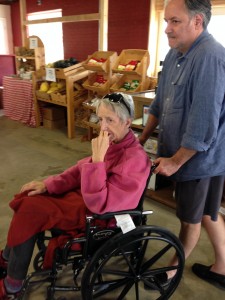
Mom and Adam in the kitchen store

Mom and Adam in the kitchen store

Mom reached for her lamp in the night and fell out of bed. It was a little after 4am. Adam heard her calling and helped her back to bed. He recorded a half milligram of Ativan and an unusual three pumps from her pain meds.

When I go into her room at 8a.m., she says, “I’m feeling a lot of pain from my leg. And I’m dizzy.”

“I’m sorry, Mom.”

* * *

She is irritable this morning. I hear her tone of complaint. It’s always been hard on me.

* * *


“I should get outside today,” she says, “don’t you think?”

“Sure, if you want to, Mom.”

“I need to take better care of myself.”

“You’re doing the best you can.”

“I just don’t know what to do anymore.”

* * *


She wants to call her bank because she has been convinced that she paid a doctor’s bill that she keeps getting in the mail.

“They’re probably not open till 9,” I say.

She looks at me. “It’s not 9 yet? This has been a long day.”

* * *


“She shouldn’t leave today,” Mom said, breaking into tears. She’s talking about Muschi. “But I know she has to watch her grandkids.”

Muschi brings mom fried potatoes and eggs. Mom begins to eat, and then to cry. She pushes the food around on her plate. I reach out to clasp her shoulder.

“I can’t do this all day.”

“Do what, Mom?”

“Watch her leave.” She looks at Muschi. “We’ve both been through this many times. We know how this goes.”

“Every time I’ve said goodbye to you,” Muschi says, “I’ve seen you again, and this time is no different, honey.”

* * *


I suggest that Mom turn over on her side, so as not to put stress on her bedsore.

“Which way?” she says. She speaks slowly, and a bit thickly, like a child just awakened.

“It doesn’t matter,” I say. She begins to roll to her right side, groaning a bit as she does so.
“You can put a pillow behind her,” the hospice nurse says.

Mom turns her head toward me. “You stay here,” she says.

“I’ll just be your bolster,” I say. I climb onto the bed and support her back with my body. The hospice nurse is delighted. My right arm goes under the stack of pillows and my left rests on Mom’s arm. She dozes. I work on being present. Mostly asleep, she says something about a fairytale. “A fairytale, Mom?”

“He dies in the end,” she says.

We all die in the end, I think.

She is so fragile. So scared. I cannot but weep unobtrusively.

In the living room later, Adam surprises me by opening his arms. “Come here,” he says.
The instant we embrace my body begins to shake, and for the first time in my life I cry on a man’s shoulder, and his hug just goes on.  His eyes are wet.

I sometimes find myself wondering how I will manage during the period after her passing. Will I be able to work? I think I will just leave the house empty until spring, no renters, and then sell it. The work that needs to be done on it overwhelms me.

* * *


“I love you, son,” Mom says.

“I love you too, Mom.”

“More and more,” she says. “Not less and less.” She is silent for a moment. “Amazing how that happens.”

* * *


In the late morning, Adam and I look into flights, prices, and frequent flyer miles to get my sister, who lives in Alabama, back to Colorado.

Adam and Muschi hatch the idea of bringing in a proper hospital bed, one with air sacs that are supposed to alleviate her bedsore. It is delivered just before noon. Mom’s German friends Monika and Inge come as well, and talk to Mom. We have the bed installed in the living room – with a couch on either side for visitors, and the TV straight ahead so Mom can watch her German TV shows. The air pump that circulates air through the sacs is quite loud. I take it off the metal bedframe and sandwich it between two pillows, where it can barely be heard.

* * *


At around noon Muschi goes into Mom’s room to say goodbye. “I will see you soon,” she says. “I love you.”

“I love you,” Mom says, groggily.

“I love you so much,” Muschi says. She caresses Mom’s face and hair.

“Just go,” Mom says, not unkindly. She always preferred just to be dropped off at the airport curb, to avoid all the long goodbyes and drama that go with accompanying a traveler inside.

They say goodbye again, these two women who have been best friends since 1948, and who came to the United States at almost the same time, and Muschi departs.

* * *

My good friend Tedd writes me from D.C.:

i send you a big hug. cried again when i saw your mom’s pic with you. it’s so hard cam, i am really sorry you and your family are going through this. always your brother, tedd

So many people have written so many nice things, some by email, some on Facebook, and some in the comments on the blog.

* * *

Mom’s legs bear some weight today, but she still began crying as we came back from the bathroom. “I can’t even be dignified,” she said. She is now in her hospital bed, which we’ve put in the middle of the living room.

“You’re plenty dignified, Mom. Courage and grace personified.”

She gave me a skeptical look.

* * *

She is upset that Pumpkin doesn’t come to her as before. I know her well enough to suspect that she is wondering if Pumpkin senses something changed in her. What she says is, “It’s too much change.” She pets him and cries more than I have seen her cry.
“I’m just having a little falling apart,” she says.

“Don’t you worry about that, Mom. You have every right. I’m surprised you’ve not done it more.”

Somehow, my nephew Dylan materializes. He hasn’t contacted Mom since he moved out of her house about four months ago. She hears his voice as he comes in the back door. “I’m not ready for this,” she says. But he is here. She hears his tales of financial and legal woes and I catch what I think is impatience. He does kiss her on the head and tell her he loves her as he leaves to go to his second job.

But before he leaves, Mom says, “I don’t know how to do this. This has been such a horrible day. Muschi left. I can’t walk . . . I just want to go to sleep.”

Did she literally mean to sleep? Or something more final? “Whenever you want to do that,” I said, in either case, “you just go ahead.”

Not long after, she asks for another Ativan, sooner than usual, because she literally wants to sleep.

* * *

In the mid-afternoon, Mom has a hankering, she says, for steak and broccoli and zucchini. Adam goes out to buy these things and then prepares them. As a cook, Adam is very enthusiastic. The meat, though expensive, turns out not to be very good – not Adam’s fault – and I’m still hungry.

“I’ll fix you something,” Mom says.

“You’ll what?” Mom hasn’t been able to stand up to cook in the kitchen for over a week now. Cooking is one of the many basic pleasures she’s been denied.

“Help me up,” she says.

So we actually shuffle into the kitchen together, and Mom goes to the refrigerator, bends down to rummage around, finds chicory roots and yogurt, and somehow stands up long enough to slice up the chicory — and make a chicory salad with curry, olive oil, and garlic. I’ve had this before from her, with sour cream in place of yogurt, and it’s surprisingly good. The soundtrack to “Rocky” may as well have been playing in the background. To sit up, to get out of bed, to shuffle and stagger to the kitchen, to bend down and push and lift, to stand and wobble and cut and pound, to stretch toward a high shelf and carry, to stir, to shuffle and stagger back to bed, to get into the bed without much use of legs – she may as well have been competing in a decathlon. If her goal was to rage, rage against the dying of the light and do what she loved, she succeeded.

* * *

I know she has a lot of life left in her because she can still annoy me.

This reminds me of a Facebook comment by my sister-in-law Jannilynn’s mother, Linda. When Linda visited a week ago, she spent a good deal of time massaging my mother’s feet. In her comment, she said that she could tell from touching my mother that it wasn’t yet time.

November 5, 2014

I was wearing my ear buds last night, watching TV on my laptop, and didn’t hear Mom calling for me. Note to self. Adam eventually heard her, and helped her to the bathroom and back. We were both up again in the middle of the night with her, and as I was stirring in the morning I heard her hiccupping – three or four times, five or six hiccups each. And sure enough, she then started to vomit. Adam was holding the bag when I came out to help. She cried. When she was done she felt dirty, wanted all the sheets cleaned, wanted to brush her teeth and use mouthwash, wanted a bath.

“I feel like I’m walking into this strange place and I don’t know what’s going on or what to do. And I’m doing it all alone.” She wept.

* * *

Getting to the bath, and into the bath, and out of the bath, and dressed, and back into bed, was a trial.  She seemed in constant pain, and it took great effort to move in small ways.  “I just wish I could go to sleep.”

I wasn’t sure I heard her. “What, Mom?”

“I wish I could go to sleep. If it must happen, I wish it wouldn’t be prolonged. I just want to go to sleep.”

So maybe that’s what she had meant yesterday, when she said she just wanted to go to sleep.

“I know, Mom.”

As she was getting back in her hospital bed she said to me, crying again, “I don’t want to do this.”

“I know, Mom.”

She curled into a fetal position and wept quietly. Tears ran down her face. There is nothing harder to watch. I leaned over the bed railing and hugged her.

“When’s the last time we clicked my pump?” she asked.

“It doesn’t matter, you can do it whenever you want.”

“Click it again,” she said. “I don’t want to feel anything. I don’t want to feel mad, sad, glad, nothing. I just want to be nothing.” I pressed the delivery button on the pump’s bolus. She had already used her glass pipe after her vomiting. Now I offered her my vaporizer. The marijuana would reduce her anxiety, and help her to sleep, and even help to prevent further nausea.

She had just taken a few draws on the vaporizer when Rob came by. Rob is Mom’s neighbor, the one who rolls the joints, and takes out her trash, and drops by to check on her.

As he walked into the living room his eyes took in her hospital bed. “Wow,” he said. I sort of hoped he wouldn’t do that. “You’ve got your own hospital bed and everything. Not doing too well?”

“Not worth a crap,” she said. “You’ve sure been gone a long time,” she said.

“My back has just been killing me,” he said. Rob had recently had back surgery. “I thought I had problems walking,” he said. “I’m sorry.”

“Light one up,” she said. “Let’s share one.”

So they did. Adam, who had begun to nap in Mom’s room before coming out to meet Rob, went back to sleep.

“It may have been a dream,” Mom said, “but I dreamt I was in a tub of pot water.” In a sort of fog now, she asked if there were any good movies out on Netflix or RedBox or at Hastings Books and Video. “I want to see a good movie,” she said. “Not weird, not heads chopped off, not muscles growing out of weird places.”

After Rob said goodbye she lay back and closed her eyes.

To sleep, perchance to dream.

* * *

In an email a few days ago, Julio had said he hoped I would soon share good news. I told him I wasn’t able to do that. He wrote back this morning.

Amigo Cameron
My spanish , my pseudoenglish aren´t good enough to express feelings
Only one thing i can tell you, Courage !
The fact that things like that happens, makes my “ faith “ collapse…
I insist, Courage !
Perhaps…
Julio

Mom awoke from her nap and turned on the TV, she said, to get her mind off things. I was putting on my shoes to hang out the wash when she said, from her hospital bed, “I didn’t know I would be so incapacitated. I thought I could do stuff. Slowly, carefully, but I thought we would still be able to do stuff. Now I don’t even know where I am.”

* * *

7:52p.m. Mom is sleeping. She is losing the use of her legs, and feels pain in them. That may be due to the retroperitoneal tumor pressing against her spine and other nerves. I think a doctor told us this could happen. She is on constant pain drip, and must take Ativan around the clock to avoid vomiting. And today she vomited in spite of the Ativan. As it has been for over a week, the vomit was greenish bile.  The hospice nurse says that may just be her liver giving up, and she may be switching to liquids-only pretty soon.

Yesterday and today Mom said what was previously unthinkable: that she just wanted to go to sleep and not wake up.

Her desire to end her suffering is finally starting to outweigh her will to live. And that is becoming my feeling as well, but more slowly. Because I’m not the one suffering, I can’t know how to properly weigh the pros of the longer life with the cons of the terrible psychological and physical suffering that life requires.

But I do know that the more time I spend fearing the end, the less time I’ll be spending with my mother.

* * *

At 8p.m. I walked into her room. “Mom,” I said. “Mom. I need you to take your Ativan.” She did not open her eyes. She just opened her mouth. I put the pill in her mouth and still without opening her eyes she drank water from the bottle I held to her lips. A few moments later, she groaned. “What is it, Mom? What hurts?”

“My butt,” she mumbled, meaning the bedsore.

Nothing to be done about that. I had already applied a marijuana and coconut salve. She whimpered again. I stood there for a moment, watching her, and then walked around the bed. I got up on it and put my head against hers.

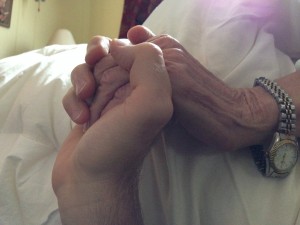
Look at her hands, crossed over her abdomen. Inscribe them on your memory. They are thin now, fingers slender, the left one looks older, in this light, than the right one, which looks smooth. My right hand lies atop hers. These are the hands that have lovingly made me many a meal. They’ve caressed me and patted me on the shoulder or the side of my head. I take in her clavicle and collarbone, more prominent now, but familiar, a part of her I must have seen thousands of times without registering what they looked like.

I start writing in my head, and then I think about the fact that I’m writing in my head rather than being present with my mother, and then I’m reminded of Natalie Goldberg, in Writing Down the Bones, relaying the story of how her Zen master had told her, “Zen or writing. You can pick only one.” Which affirmed for me that writing is a form of meditation.

Pay attention. Be here now. See and hear her breathing.

I then began thinking again, this time about the two little books hospice had evidently decided it was time to bring and casually leave lying around. The books listed the symptoms that tell you someone is likely to die in one to three months, and when they’re days to weeks away, and when they’re hours to days away. Specific changes in breathing that I didn’t commit to memory apparently happen near and at the end.

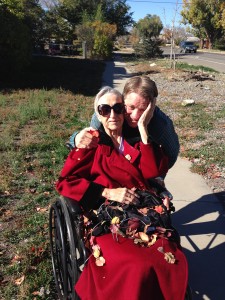
She’s still breathing.Mom and Leaves

Sticking It Out

November 1, 2014

Mom loves hands

Mom loves pictures of hands

Adam had been up with my mom since 4a.m. He’d made her coffee, grated her some apples – but she vomited up the apple.

“It’s just an apple,” she said, distressed. “An apple a day,” she added, her voice breaking. She began to cry. “I haven’t eaten in four days! Look at me,” she said, lifting her wrists. “I’m just skin and bones.”

* * *

“I love you,” she said.  This was later.

“We’ll always be connected, Mom.”

“Always have been. I don’t know how,” she said, “but I always felt that. You were such a gift. A gift. But I didn’t always treat it well.”

“Treat what well, Mom?”

“My gift,” she said. “You.”

* * *

A little while later, she called to me in the living room. “I’m getting dizzy. Can you come in here?”

I am lying on the bed next to her. Her eyes are closed but she is not sleeping. I am working on my laptop. With my left hand I caress the back of her head. I put my laptop down, sit up, and turn to her.

“Mom, I want you to know that whatever you think you did or didn’t do, you are forgiven. I just feel love for you. Just pure love.”

She nods serenely and pats my face.

* * *

The hospice nurse came and assured us that the Ativan could not be causing her nausea. Mom had probably misconstrued some cause and effect. “I think your nausea is caused by the progression of your disease,” she said.

These are chilling words.

But in fact, Mom has taken pain medication and Ativan all day, with no vomiting. A hospice nurse suggested that Mom may have felt ill a time or two, taken an Ativan – and vomited shortly afterward, before it had time to work. She could then have concluded the Ativan was at fault.

* * *

We were sitting in the living room when she said, “I wonder how much money is going to come out of this inheritance. We’ll find out next week.” The inheritance refers to her brother Horst’s estate. Horst died intestate, without a will, in June. Bonnie had told me, soon after I’d arrived in Montrose a few days earlier, that my mother was doing all she could to hang on for my sister and me. “She wants to make sure you guys get that money,” Bonnie had said.

“Did Christa tell you that?” I now said to Mom, referring to my mother’s only remaining sibling, who lives in Germany. “That we’d know next week?”

“Yes. I don’t know how long I can do this,” she said, referring, I think, to the act of staying alive.

She wonders if she can stick it out for another week?

* * *

Muschi arrived from Las Vegas and Mom cried. “Sixty-five years!” she said. They hugged a good long while, Mom’s face tear-streaked, and before long we had moved Mom into her bed, along with all her logistics. She was tired from the Ativan, barely able to stay awake. At a little after 9p.m. I took Muschi to the worst, saddest, seediest motel in all the world, and she insisted on staying because it was only three blocks away from Mom.

November 2, 2014

I awoke to the sound of my name. It was about 4:30a.m.  I bolted upright, debated pants, ran out in my boxers. Mom was at the kitchen’s backdoor. “Pumpkin!” she called. “Pumpkin.”

She was calling Pumpkin, the amateur therapy dog.

She turned and saw me. “I thought you were calling me,” I said.

“Just trying to get him inside,” she said.

She went back to her coffee, tottering on uncertain legs. Her movements were not precise; I helped her to keep her balance. She would drink about a quarter of her cup of coffee.

* * *

Adam and I offer her different choices of food.  She tells us: “If you guys keep talking about eating, I’m going to get really nauseous if you try so hard.”

She hasn’t eaten much today. She vomited once, losing what she had eaten. Sometime before noon, she interrupted a lengthy period of dozing with these words: “crunchy fish filet”. She didn’t even open her eyes. “I want a crunchy fish filet.” We baked two from the freezer, but one was perhaps freezer-burned – Mom spat it out — and the other was salmon, which Mom had never eaten and never would, Muschi relayed to us later.  Still no nutrition all day.

* * *

Between naps, Mom instructs Adam on how to make potato and leek soup her way. She has him bring a spoonful to her on the couch, where she tastes it and pronounces what it lacks. Sea salt. Dill. Heavy cream.

She mostly sleeps as we watch the British TV series, “Poirot”. Pumpkin, the old orange poodle, sleeps on her stomach or above her head.

I am standing near the couch when Mom reaches up for my hand. I kneel down on the floor and she holds my hand against her cheek. She begins to cry. “The pain,” she says, and I can’t make out the rest of it.

“What, Mom?”

She works to pull herself together. “The pain,” she repeats, “losing you – I don’t think I can handle it.”

* * *

I talk to my sister for a good while, but Mom is asleep or talking to the hospice nurse throughout. I hear Mom asking if someone can share their thoughts on food. What to eat. The nurse says it’s too individual, no advice to give. Mom is disappointed. When Candy calls back, Mom is again asleep. I make another blog post, “Missing Her Already”, and not long afterward my sister’s best friend, Tanya, who loves my mother as her own, calls to ask how I’m doing. She is amazingly loving and supportive and I thank her.

* * *

I come in and hear Mom and Nancy talking about my sister, I gather.

“. . . there’s bills, and work, and everything. I remember what it was like, being a single mother and not being able to go anywhere because of the kids.”

This makes me happy for my mother and sister, my mother’s understanding.

A few minutes later, she is complimenting Nancy on the life she has. “I see your grandkids and your kids and you’re making all those improvements. It’s really enviable,” she says. And then she turns her face away from Nancy, but I can see her features form into pain, and I see the tears in her eyes.

* * *

Candy calls again, but now Mom is asleep, again. I am determined to get them talking more. They have always had a challenged relationship, a good deal of miscommunication, and my sister is now commuting and working 14-hour days. They haven’t had much conversation since my mother and I flew my sister and niece to Colorado in June.

* * *

Silke comes and rubs Mom’s feet. Mom suddenly sees a vision of hazelnut cheese spread on crackers, along with green grapes (not the red we had on hand, those were too sweet for this kind of cheese). Adam and I head out to try both City Markets but we can’t find the Mirabo cheese she wants. I pick out a spreadable sundried tomato and basil cheese, and Adam gets another kind of cheese and hazelnuts he plans to crush and mix with the cheese. “That won’t work,” I say to him, “trust me.” Mom eats quite a bit of all this, especially Adam’s concoction. We cheer her eating.

We have her on the Ativan again.  I now keep a notebook of everything she takes and when — food, pain meds, Ativan, cannabis oil.  Now we can spot trends, and also know when to give her the next round of meds. She has stopped the frightening vomiting, which had seemed to portend a rapid, and therefore frightening, decline.

* * *

In the kitchen Muschi says to me, “Can’t we get your sister here? I would pay for her ticket.”

“It’s not so much the cost of the ticket,” I say – my sister couldn’t afford it but I’d put it on my credit card – “but the income she’d lose if she took off from work. She doesn’t have vacation time yet.”

That gives me an idea. I know the solution to this problem. I send a text to Candy, asking how much after-tax income she’d lose if she came for a week. Maybe we will get her here after all. I am thinking of Candy as much as Mom.

Carrie, who was 15 when she walked the Camino with us and just graduated in May, stops by to say hello.

* * *

At a little after 8p.m., I ask if Mom wants to call Candy. She says she’s too tired. Then she changes her mind. She fumbles with her new phone for a while and I take it from her and find Candy’s number. They talk for ten minutes or so. Mom cries a little when Candy repeats some of the memories she’d written in her letter. They must be talking about the possibility of Candy coming to Colorado. Candy says, “I’m workin on it, Mom” and Mom gives a timeframe of the next seven to ten days.

Candy told me that Mom’s oldest grandson, Dylan, who lives down the street but hasn’t been in touch with Mom since about July, is afraid to come here, to Mom’s house. “What bullshit,” Adam says.

* * *

Adam made a very good potato leek soup today from Mom’s recipe. Other than the Halloween candy, I’m eating pretty well. I’m not exercising – I don’t see anything in Montrose I want to do. I’m not a runner, I have no bike here, no mountains to hike, and no yoga class that interests me. Weightrooms bore me. I suppose I should look into Gold’s Gym and see what classes they have. Exercise is a great anti-depressant.

In the evening, Mom always goes to bed first – sometime between 7 and 9p.m. – and Adam falls asleep while we’re watching a movie. I finish the movie and go to my bedroom, where I am nightly faced with the Hobson’s choice of either closing the door and risking not being able to hear my mother, on the one hand, and subjecting myself to Adam’s locomotive snores on the other. Of course I leave the door open.

Improving, Worsening, or Leveling Out?

October 31, 2014  Journal

I am beginning to wonder if I gave too much weight to the fears of Mom’s friends on Monday.  Mom said this morning that she had wondered what was going on, on Monday. Her friends may have been greatly affected by the suddenness of her decline, but would it continue at the same rate?

* * *

12:15p.m. Mom vomits, a lot. My heart sinks. She must get sustenance. She has kept down none since yesterday.

* * *

12:45p.m. After a hot bath, before she can even get her shirt on, she begins to vomit again. She finds one of the blue vomit bags on the floor. “It’s like a heart-retching,” she would say later. “A stomach-heart-retching. Deep down.” I bring her a shirt and a glass pipe filled with marijuana. In between her vomiting I light the pipe for her and she breathes in the smoke.

“This could be cachexia,” she says, nodding. She positions her mouth back over the bag.

Cachexia. The wasting disease. We worried that she had the dreaded cachexia earlier in the year, when she dropped over fifty pounds in a few months. It’s cachexia that usually leads to cancer’s fatal malnutrition. But my co-founder in Physician Cognition, a doctor, told us that cachexia is not present with a certain albumen score. Mom’s score meant she probably didn’t have it. We were relieved at the time. But what about now?

Later, she says that she thinks the culprit is the Ativan. “Every time I take that lately,” she says, “I vomit.”

The hospice nurse thinks the vomiting could be due to her cancerous liver. She uses the phrase “your liver involvement”.

I ask the hospice nurse if the IV painkiller could be a cause of nausea too. “A few days ago,” I said, “she thought she was getting nauseated right after pressing the button.”

“I may be just sick,” Mom says firmly.

“Yes, but if you’re nauseated right after doing something, that something may be a partial cause.”

“It may be just coincidence,” she says.

What was this? We have switched roles. I seem to be the voice of hope, and she the voice of reason.

* * *

A movie that Mom isn’t paying attention to has about 20 minutes left. “Hey, Mom,” I say. “Do you want to go for a wheelchair ride?”

“Not right now,” she says. But ten minutes later, she says she’s ready. She sits up to put on her shoes. Her gorge rises and she grabs a blue bag, into which she vomits.

“Oh,” she says. “I hope this isn’t going on all day.” She begins to cry. I hand her a warm towel with which to wipe her face.

Adam and I load her into the wheelchair. She doesn’t like that it’s out front. She hadn’t remembered it was there. A minute later, she says, “I saw that we have some madelines to eat, I wish I’d known that.”

“Do you want one now?” I say. We are still near the house.

“No, I just want to know these things,” she says. She is trying to reassert a semblance of control over her life.

The neighbor’s dog, Cassie, runs up to the fence. Mom has fed her bologna nearly every day for years, and this has made the shy, small, fat Border Collie my mother’s best friend. Mom reaches down and through the fence and pets Cassie. “I know, it’s all so different now,” she coos.

Magic Wheelchair Ride

Magic Wheelchair Ride

I push her for a while, but it is hot and I ask Adam to take over so I can take off my sweater. Mom puts it on her legs, which are cold. She takes my hand and we walk like that, to Main Street. There we stop to take in a tiny Latina girl dressed up for Halloween as a bee. Mom is pleased and watches her for a while, offering compliments, and then we cross Main. No one is talking much. I am thinking cachexia. She probably is too.

She spies a new store that sells kitchen supplies and asks if we can go. “Good afternoon!” she says, as her wheelchair crosses the threshold. The clerk says hello. Adam pushes her through the aisles as she points at and sometimes fingers various kitchen implements. I pay attention to my state for a moment and confirm that I am feeling miserable.

I imagine that I am in one of the dreams I know I will have some day – the dreams in which my mother is there, simply existing, or doing something mundane, and I am filled with the greatest happiness. Why can’t I feel that now? Why can’t I look at her as if her presence is the rarest, most precious thing? I try this, and it works – I feel a smile taking over my face, and joy fills my heart – but then it becomes too much and I have to stop for fear of weeping. There is no nostalgia without pain. The meaning of nostalgia, in fact, is a return to pain.

* * *

Mom said she had wondered what was up on Monday, with everyone acting as they were. She was too groggy to express any surprise that people would visit from so far off, and at the same time, but now she says, “I just don’t want anyone to know something I don’t know.”

“No one knows anything more than you, Mom.”

* * *

Silke, Berle, Monika, Peggie. They began arriving at around 5pm. Peggie brought necklaces with flashing lights. She was ready to give out treats. “No one ever comes to my house,” she said. She lives on a ranch outside of town. Mom said the last trick-or-treater to come here was 8 years ago.

Silke told a story about how her husband Gordon once rode along in a Lear jet that flew to San Francisco, where the three passengers had lunch and then turned around and flew back to Colorado. The assembled women all made different sounds about this fact. Mom said, “Someone is out there living my life.” She paused. “And I’m living theirs.” She said she was tired of “this cancer crap”.

* * *

“Cameron, you’re so calm,” Peggie said. She thought it was the cannabis oil she had provided me with.

“I thought he’d changed,” Mom said. “He’s been really attentive – well, he’s always attentive. But – and he was patient. I thought I must be dying.”

The women laughed.

Missing Her Already

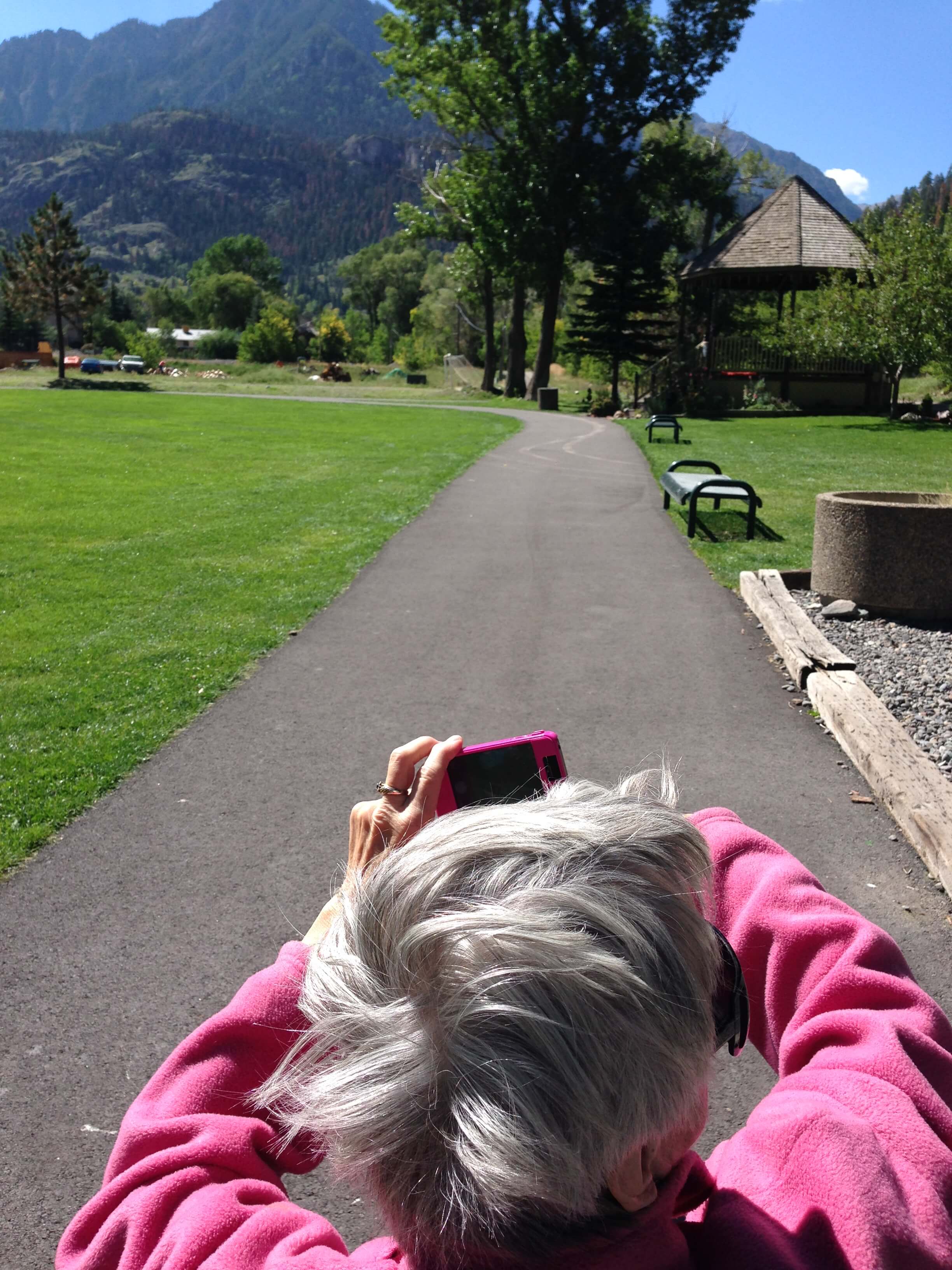
Mom enjoying the beauty in Ouray about a month ago

Mom enjoys the beauty in Ouray from her new wheelchair, jus a month ago

Adam arrived on Tuesday night. It’s good news:  he sleeps irregularly, so he’s often up in the middle of the night — just like Mom. He makes her coffee and breakfast and keeps her company before I’m even up.

On Wednesday morning there is an email from Julio, one of our companions on the Camino de Santiago. He must have read the blog post in the email he is responding to, but he cannot bring himself to mention it. He writes:

Inge , you look nice in the pic, i think last time i saw you, you were looking with less weight …
You still my heroine, my amazon, always struggling to survive and always nice smile. Olé …

She takes Ativan, otherwise known as Lorazepam. The label says it’s for anxiety, but the main benefit is to prevent nausea. The downside? It makes her very sleepy. She is usually sleeping, and when she is awake she is nearly still asleep. Her speech is slower, her cognition slower, her laugh also slowed-down. She is no longer alert. She makes a few jokes, but she isn’t talking about food and cooking, not watching TV, not making much conversation – even the kind that used to annoy me. Our shopping together, even with her in an electric cart, has stopped.

I judge myself for thoughts of missing my mother: am I being sentimental? Maudlin? But the thoughts continue: I miss my mom. She’s still here, but I miss her.

Mom groans and stirs on the couch.

“What is it?” I ask.

“I need something for my lung,” she says, reaching a hand around her right flank.

“It hurts?”

She nods.

Later, she begins hiccuping again. She has done this for a few months now.

“Something you ate?” Adam asks, tenderly.

“No,” she says.

No, I think, something that’s eating her.

And then she sleeps, and sleeps, head back, mouth partially open. Her face has lost its fat, and her skin hangs in some places and is taut in others.

My heart is breaking. My mother is still alive, and yet my heart is already breaking.

In the evening I heat up some drunken noodles, but before eating anything I stop in the doorway of her bedroom and watch her sleep. Her head is back, her mouth open. She reminds me of Oma, at the end. I go into her room and see her eyes open slightly. “Do you want the light off?” I ask. She nods or murmurs and I turn off the light. I bend down and kiss her on the head and hug her and put my head and face against hers. She says something I can’t hear. I tell her goodnight and she repeats herself so I can make it out: she wants me to lie in the bed for a while.

I go around the bed and crawl in. I had wanted to do something like this, but she was usually on her couch when she was awake. Now it doesn’t seem to make any difference if she is sleeping. She turns on her side and I lie next to her with my arm draped lightly over her side. My face is pressed up against the cloth of her pajamas at the neck and her hair. Every now and then, our breathing follows the same rhythm. I smell the scent of her hair and pajamas. She is so frail. My eyes leak water. I feel tears from my right eye drip across the bridge of my nose, down the other side, and around the left side of my mouth. I feel them wet her short, grey hair. I lie there, thinking of stopping time. Of making this moment go on forever.

Will my mother be here in a week?

After perhaps 20 minutes, maybe 30, I am hungry and want to return to my now-cold drunken noodles. I begin to extricate myself but she turns and puts her right arm across my chest and around the right side of my head. The fingers of my right hand clasp her upper arm. “You my sonny boy?” she murmurs. “My sonny boy.”

“Always,” I say, in a fierce whisper.

I try to be present, try to soak it up. Will I remember this? Let me build a memory. I feel her breathing. I feel her hand, lightly clasping mine on her stomach. I see the light coming through her open door from the living room. I can’t believe I am even here. I am so sad, so afraid.

I love her so very much.

Starting the Camino de Santiago, September 2011

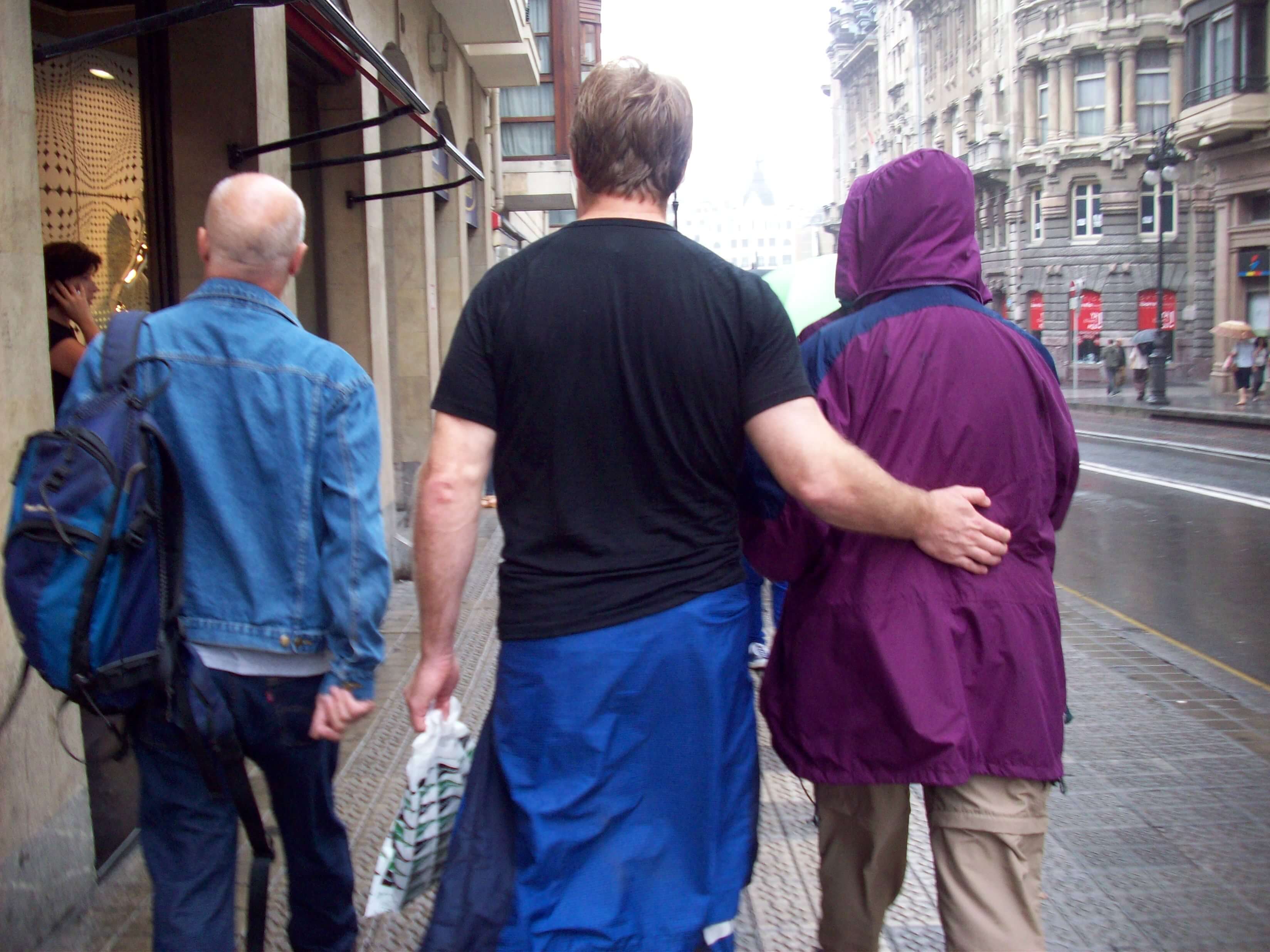
Mom and I starting the Camino de Santiago, September 2011, with Don Julio Redondo of Bilbao, left

True History of the Camino de Santiago

Mom’s new favorite book, featuring Mom and Julio

The Day the Earth Moved

Most of this post was written on Tuesday, four days ago.2014-08-16 09.19.57

Yesterday, it seemed everything was changing. At a little before 9a.m., I got a text from my mother’s friend Peggy. It was the most frightening communication I’ve ever received:

Hi Cameron. Hospice nurse is going to call you. Please come down today. I believe she is getting very close and she can’t be left alone at night.

I left her a message asking if she was saying what I thought she was saying. I was already dressed for yoga.  I wondered what to do. I thought about how the yoga mat is a microcosm of the world, and that the balance and groundedness we find on the mat can be brought with us into the rest of the world. I thought about people telling me, as a caregiver, to take care of myself. So I went. But for the first ten minutes I just wanted to leave. I was having a hard time not crying. I kept wiping my eyes so as not to draw attention to myself. I stuck it out, but left quickly after the class, without talking to anyone. I knew a single word or look could set me off.

Back from yoga, I saw a voicemail from Peggy. “Oh, God,” I said. I felt a little wobbly. I pressed play to listen to the message. “When I mean she’s getting close,” Peggy said in her message, “I mean very close.” Peggy had just watched her ex-husband die, rather suddenly, of a fast-spreading cancer. And Mom had vomited forcefully all night.  She was unable to eat or even to drink.  She was too weak to walk or even to stand up safely.

I began to sob. No! I’m not ready!

You’re never ready.

It’s just too fast. 

I began to move about my Telluride apartment quickly, throwing things into the duffel bag and laptop backpack I usually take to Montrose. I said goodbye to Danny, my new housemate. On the drive I cried. I drove sobbing, and at times with a keening wail, a wail as long as my outbreath and higher in pitch than anything I’ve heard come out of my body before.

When I came in through Mom’s kitchen door, Berle and Peggy and Monika were there.

“Superman is here!” Peggy said.

“Your mom keeps asking for you,” Berle said.

They gathered around me and hugged me. Mom called out to me.

I went to Mom, looking spent on her couch, and kissed the top of her head. I cradled her beautiful head. “I don’t want to go, she said,” in a near whisper. “I just want a little longer.”

“I know,” I said. “You are the light of my life.”

I leaned down onto the couch and hugged her for a long time. After a while I went back into the kitchen to fetch my laptop. I needed to cancel all my coaching appointments for the day, and for Tuesday as well. I sat down on one of the small white chairs in the kitchen, opened my laptop, and began to cry quietly. The women gathered around me and hugged me. “You won’t be alone, Cameron,” Peggy said firmly. “We’ll be here with you.”

A few weeks ago, my mother said she was concerned about leaving me alone because of, she said, “your abandonment issues”.

“I’ll be okay, Mom,” I said, because that is the correct thing to say. “Don’t suffer more because you’re worried about me.”

“I know,” she’d said. “I just want to continue to be able to help you, to cook food for you and do things for you.”

On the other couch, which stood parallel to Mom’s, I sat next to Bonnie, whom my mother has known since they both worked at the local courthouse in the early 1990s. I said to her, sotto voce, “I was really scared this morning when Peggy said Mom may be near the end.”  Perhaps I hoped that she would amend Peggy’s dire fears.

Bonnie, who had also recently seen death from cancer up close, looked at me with compassion. “She may be,” she said.  “We just don’t know.”

I noticed I was now barely giving a thought to the stress that had plagued me for several days prior, that of my landlord threatening to evict my housemate and I unless we signed a lease less favorable than the one we’d just signed a few days earlier, and insisting on bogus grounds that we didn’t already have a binding contract. And being pretty dickish about the whole thing. There was little room for that concern anymore. I was beside myself with the admixture of fear and sadness we feel whenever we must contemplate letting go.

My sister-in-law, Jannilyn, arrived from Grand Junction. She came with her mother, Linda, who soon put her massage skills to work on Mom’s left foot (Silke had the right). Carrie’s mother, my second cousin Laurel, had insisted on driving her, because, Laurel said, Carrie was “a mess” and couldn’t drive herself. Mom’s young friend Gregory, whom she has helped to raise since his birth, came with his father, Paul, and sat on the couch at Mom’s feet. Gregory’s older sister Annika entered and went straight for her mother’s knee. She didn’t go to Mom until she was leaving, but I did see that her eyes had filled up. Gregory saw my tear-filled eyes at one point, and the next time I looked up at him, his eyes were red too.

Linda, who is Filipino, presented my mother with a beautiful purple scarf and a stunning red wool coat that had been too long for her.Mom put the scarf on, a swirly purple contrasting with her light-blue pajamas. On my phone I looked up the poem “When I Grow Old I Shall Wear Purple,” with its stirring opening lines “When I am an old woman I shall wear purple / With a red hat which doesn’t go, and doesn’t suit me.” I read it aloud and Mom smiled. I wondered if she would ever wear that red coat.

On a few occasions, as she lay on her couch by the window, Mom spoke to the assembled American visitors in German. Something about her sister, her father, and a letter. She said other, unclear things. She was heavily medicated with her IV painkiller and Ativan, a powerful anti-anxiety drug and relaxant that would supposedly help her to feel less nauseated, and to vomit less.

In the late afternoon my friend Laurel drove from Telluride bearing red curry and wine and hand-crafted sodas, as well as her own sleeping bag. She went to the store and bought groceries and night-lights. She doled out red curry and rice.  Later, she helped the four of us put Mom to bed, which is a logistical operation involving four pillows, the microwaveable Teddy bear, several forms of marijuana, smartwater, the IV unit, and a small orange bowl of Ativan tablets I’d cut in two. Mom was too weak to get up – unlike earlier in the day, when we’d led her to the bathroom and she’d come back draped on my back and shuffling behind. So I leaned down, cradled her legs in one arm and upper body in the other, and picked her up. As I turned toward the bedroom, she lay her head against my chest. I heard someone, maybe Berle, say Awww. I carried her to her bed and gently laid her down in it. I kissed her face and temples, called her sweetheart.

“She has been so much calmer since you got here,” Peggy said.  “You really calm her down.”


“It’s just surreal,” I said to Laurel. We had been watching the mostly mindless TV series “Arrow” almost non-stop from 8:30 to 12:30 and for a moment I wasn’t feeling awful. I knew it wouldn’t last. Morning would come and the mood would return.

11:47p.m. I am troubled that Mom, groggy and often sleeping from the medication, isn’t able to be fully present. It’s harder for her to follow conversations, and certainly difficult for her to express her deepest thoughts, much less her former, larger-than-life personality. One casualty has been those who would communicate by phone. She feels too little energy to have a conversation – most of
her speaking is done in sentence fragments – which is too bad for my sister, Candy, my niece, Brianna, and my former wife, Mieshelle, who still says she feels connected to, and tells everyone she meets about, my mother. I don’t want Mom to hurt, or feel nausea, but I do miss her. Will it always be thus, until the end?

I feel a great wave of sadness come over me. I am missing her already.

12:35a.m. Laurel and I had just turned in for the night, Laurel on the green couch in the living room, with her sleeping bag, when I heard a loud thump and my mother’s cries.

“Cameron, your mother!” Laurel cried. I had already sprung out of bed and sprinted out my bedroom door, running into the bathroom where I saw my mother lying face down on the floor like a police outline. Her pajamas were down to her knees. I reached under her arms and picked her up in an instant. If she’d weighed 300 pounds I’d have still lifted her up like that.

She was sobbing, a bit groggily, and not speaking, so that she sounded eerily like a hurt and confused child. She’d hit her head falling. Laurel helped me to seat my mother on the toilet. I caressed her head, told her to call me whenever she needed to use the bathroom. Having calmed her down, Laurel and I exited. Only a nightlight was on in the bathroom, so I peaked through the crack in the door to make sure she was okay. She was hanging her head, as if asleep.

She was up in the middle of the night. She walked on her own power to the kitchen and made coffee. Laurel awoke and got up with her, and later reported, “She was totally herself.  She was walking around, didn’t need any help, and she was bossy.” She laughed. “She said to me, ‘This is my quiet time, so you can go back to sleep now.’” Laurel laughed again at the memory.

Women my mother has never met are writing in, their love filling up various Facebook pages.

In the morning, I awoke to a message from my good friend Adam, whom I’d known since the first days of law school, in 1989. Without any ado at all, he informed me he would be arriving in Montrose at 8:23p.m. on Tuesday night, and on Facebook he said he would be staying in Colorado “indefinitely”. I felt immediately relieved, and very grateful.

Messages to My Mother

Listening to all the letters and Facebook posts we’ve been reading to her, my mother has had a

Mom, early September 2014

Mom, left, and sister Christa, early September 2014

hard time believing how people really see her.  She seems truly bewildered that she inspires people so much with her signature combination of passion and gratitude. With her passion for cooking and teaching kids to cook, she’s inspired an extraordinary proportion of her pupils to go into the culinary business.  She inspired many people with her walk on the Camino de Santiago, and with the blog she wrote of her journey with cancer before, during, and after the Camino.  On Facebook, and especially in the Teal Warriors group of women with ovarian cancer and their caregivers, she is known as an eternally positive, encouraging presence, and readers are clearly inspired by her perspective, like her gratitude for nature’s beauty even in the midst of life’s great challenges.

Here’s what I’m talking about.  Herewith, a letter from Grace, whom I met in Washington, D.C. several years ago, and, below that, a number of Facebook posts from my mother’s Teal Warriors, a wonderful Facebook group consisting of women with ovarian cancer and their caregivers:

Dear Inge,

We have never met, and yet, you have influenced my life immensely. I write these words to you today with so much love and gratitude.

Many years ago, I decided that someday I would walk the Camino de Santiago.

Last year, when the funds were (finally) there for me and the trip became a real possibility, I began my research and planning.

Your blog, Camino not Chemo, appeared on my Google search.

I read the entire story in one evening. I remember so clearly curling up on the couch, laptop there with me, ignoring my phone as it rang, literally blocking out the world… reading long into the night. “Just one more entry…and then I’ll go to sleep…”

But I couldn’t stop reading. Hours went by. Quickly!

Reading all about your journey, the physical one and the spiritual one, was a godsend to me. I know the words were sometimes yours, sometimes Cameron’s, but what shined through always was your strength. Your infallible spirit. Your determination. Your bravery. You are, quite frankly, one of the strongest women I “know”.

I was truly overcome with emotion when I saw the pictures of you there, outside the Cathedral in Santiago. A beautiful, joyful face. Healthy in body and soul.

And then, upon your return to America, I continued to follow your journey…

This battle that you have faced with such dignity and courage.

Many months later, when I began my own pilgrimage across Spain, you were with me. I thought of you as I followed your footsteps across the Pyrenees, when I knelt at the base of the Cruz de Ferro, when I swam in the lake at Molinaseca, and when I embraced my friends when we arrived in Santiago. I thought of you as I continued on to Fisterra, when I jumped in the ocean there at the “end of the world”; for me a pagan baptism, of sorts.

And I think of you now. Everyday! With so much love and gratitude.

Thank you Inge. Thank you for sharing your journey. Thank you for sharing your life. Thank you for educating so many of us, your faithful readers, on healthy living.

Your story has inspired me. In many ways, you have changed my life. My journey would not have been the same without your words. And I will think of you as I continue to walk my life’s journey.

I am eternally grateful.

Your friend,

Grace Santarelli

The notes below are a sampling from the comments from members of Mom’s Facebook group, Teal Warriors:

‪Denise:  Please tell Inge I’m thinking of her from the UK. Her posts, her pictures helped me through my toughest times with my late ‘Little Mum’.

‪Pam: There are no words to describe my feelings and I am sure those of many others. ‪Inge Cheatham‬ – you are an amazing warrior. As Kerie said, you have set a very high bar. I too was drawn in by the beautiful pictures and inspiring comments you posted each day. I miss them but mainly because they reflect you. Even through all of what I just read about, you were posting encouraging positive comments when you could. I am pleased that you are receiving such wonderful support. We will have tea together in a beautiful flower garden someday… Praying for a miracle. Also comfort, peace, and some joy in each day. I love you my friend!

‪Susan:  Please Let dear ‪Inge Cheatham‬ how very much she is loved by us all. We are keeping you all in our thoughts and prayers. She has warmed all of our hearts at one time or another.. God Bless

‪Linda: ‬ This flower is for you Inge… Protea – the flower of strength. Love and Prayers to you sweet Inge. Thinking of you now and always.

‪Andrea:  All the beautiful words and photos you have given us Inge here is one for you [with a photo]

Colleen:  Thank-you for letting us know ,your Mom has helped so many of us please let her know we are sending her positive healing thoughts.

‪Betty: ‬ Inge, my dear teal warrior sister, never have I known a more compassionate and loving lady that understands the sad part of our illnesses yet always finds joy in everyday. I love you, Inge. Please find peace and comfort in your coming days. God bless you, my special friend.‪

Valerie:  Inge….you are an inspiration to a lot of us,,,you are very courageous and beautiful. Prayers to you my dear.

Victoria: Cameron! Thank you very much for updating us. I am thinking about your Mom every day, and she is in my prayers. Even when i am not feeling good and can not write my post, i am looking if there an update from Inge. She is Amasing. Sending my prayers, energy and healing hugs to her. God bless your family!

Karen:  When I check Facebook, I usually start by looking for Inge’s post. The beautiful pictures and encouraging words are a great start to my day. Even when she is going through a rough time, she remains optimistic and informing. I have been going through a rough patch and had not checked for Inge so this news is hitting hard. Please let her know what an inspiration she is to us and what pleasure she gives us. You, Cameron, are such a loving and caring son. I’m sorry for all you’ve gone through but you have given so much to your mom and her pride in you comes through in all her posts. My heart is breaking but thank you for keeping us informed.

‪Ruth:  Please tell Inge all the messages she is getting, she has helped so many of us. She inspired me to get on with life. Cancer does not define us, it’s a part of us. She has helped so many of us to stop and see the beauty in nature around us. She is the rock on our teal warriors. (((((((((((((((Biggest hug ever))))))))))))

Susanna:  Thank you for letting us know Cameron , I think about you Inge every day , you are my backbone , you giving all of us hope and strength , and a lot of useful advice, a kick in the butt sometimes, you made us cry, and you made us laugh, you are an absolute angel. Lots of hugs prayers for you and your loved ones.

Sharon:  Prayers for you ‪Inge Cheatham‬, you have given so many of your teal sisters inspiration to keep going. Love and hugs to you.

Beth:‬ ‪Inge Cheatham‬ has been a beacon to me. She is the light of love and caring. Always striving for just a bit more of life’s beauty.

Want to see what they all mean?  Then enjoy this!

True History of the Camino de Santiago

Mom’s new favorite book, featuring Mom and Julio

Das war die Grenze

I am on the phone, trying to listen to a coaching client. This is harder than you might think, because I can also hear, through the spare bedroom door, the sounds of my mother retching.  My Mom’s journey through 2014 has not been what we expected.

This is how many of her days begin, but to truly understand the beginning of her days, we need to start the night before. She goes to bed at nine o’clock. Just before she retires, she or a friend pulls a spoon out of the freezer and, from the refrigerator, both an orange wedge and a container of applesauce. The spoon is glazed with flour, so that the cannabis oil placed there comes off easily once frozen. She dips the spoon in the applesauce and collects some on the tip. She bites into her orange wedge with one hand, lifts the spoon to her mouth with the other, closes her eyes, grimaces, and swallows the little lump of cannabis oil and the applesauce. She washes away the bitter taste with the rest of the orange wedge. She may take an Ibuprofen — “half an ibuprofen,” she tells people — but for months she took no medication other than cannabis and half an ibuprofen.

Mom, early 2014

Mom, early 2014

More recently, she takes with her to bed the small pump that, with the press of a button, delivers painkillers to the chest port that was installed for last year’s failed chemotherapies. The button works only every eight minutes, though my mother tries to push it only a handful of times a day. I remember when, soon after she got it, she unplugged it for just a little while, and the pain returned. “I guess I’m tied to this thing now,” she said, somewhat mournfully. She is very aware of all the things that she can no longer do, or do alone.

At times that list has included eating, one of her greatest pleasures, or cooking, which for her may rate even higher for the joy it gives to other people. She had to stop visiting me in Telluride many months ago; the altitude was too much, and she could no longer enjoy the spectacle of me singing karaoke. Walking became difficult next, and when it became too much so we got her a wheelchair. Her young friends Annika and Gregory, to whom my mother is practically a grandmother, burst into tears when they saw it.

Annika, right, at a party for Mom

Annika, right, at a party for Mom

On her bedside table you would find a glass pipe into which she will stuff marijuana from a local medical marijuana store, some shatter hash made by some friends, which she will smoke with the marijuana to help her sleep, a bottle of smartwater, her cannabis oil vaporizer pen, and a long bean bag made for her by her friend Madeline. It requires 3 minutes in the microwave and is a balm to the pain in her midsection.

Until recently, at about midnight, perhaps one o’clock, she would wake up in crippling pain. “It feels like there is an animal inside me that’s trying to chew its way out,” she has said.  She would take some more of her cannabis oil (which, as she will tell you, is really more of a paste), and perhaps, though she usually tried not to, some morphine. (Painkillers constipate, which can lead to pain worse than they solve). Some nights the pain was so bad she’d take three hot baths. Somehow the hot water helped where even drugs did not. On a few occasions she called out to me, or even came to my door to wake me up. But there are a few times I will never forget: waking up in the middle of the night to the sound of my mother sobbing, vomiting, as she collapses, exhausted, with her arms over the commode.

Two weeks ago, I was in Telluride when our friend Bonnie texted me to say that she was taking Mom to the ER in Montrose. I jumped in my car and met them at the hospital about eighty minutes later. They put her on pain and nausea medication, but a few hours later she was discharged. At around eight o’clock that night, the pain in her abdomen and kidneys was too much. She was moaning, gasping, with pain. The pain, she had once told me, was worse than childbirth, not quite as bad as kidney stones, but longer-lasting. I would watch her as she sat on the couch, hugging herself, rocking to and fro, tears in her eyes, and I would try to imagine that.  We had to go back to the ER.

We walked out through the back door of her house. I steadied her with one arm and carried her bags and medicine pump in the other hand. Every step or two, she would stop, bent over, sobbing from the pain. Soon I was crying too, quietly, as always, and we stood there together like that, on the flagstone path in the moonlight, and then we trudged on, one step at a time.

There is nothing in life that quite prepares one for this.

From the ER she was admitted to the hospital, where she stayed for three nights. Friends visited. She told one friend, Silke, “Das war die Grenze. Das war die absolut Grenze.” Which means, That was the border, the absolute boundary.  “I couldn’t ever go through that again,” she said to several people afterward. “I’d shoot a dog in that kind of pain.”  She longed for home. But home, when we returned, was a very different place: friendly and helpful hospice nurses were in it now, and Mom was connected to her pain medication pump at all times.

Lately, due to the intravenous medications from hospice, she gets up in the morning less with pain and nausea, and she may sleep without interruption until a luxurious four o’clock. But on one recent morning I was up at nine and found her still in bed, looking drawn and spent. “Are you okay?” I asked. She shook her head, looking forlorn. “Nauseous,” she said. “I’m just trying to get on top of it.” She says this a lot, about pain and nausea: “If I can just get on top of it.” I ask if she wants a joint, she says no, so I draw her a hot bath with Epsom salts. As I retreat to the spare bedroom where I sleep, I can hear her moaning in the tub.

This is how the new day begins. Yesterday she posted on Facebook that she wanted to go for a drive today, to see the colors before they depart. But she doesn’t think she can leave the house. I bring her hot tea and a baguette with butter, and then I get on my coaching call.

After my call we watch her German TV for a while, soaking in the images of the Bavarian Alps on some travel show, oohing and aahing with our desire to be among them. Like in happier times, when we spent many a magical time at her brother Horst’s hotel in the Swiss Alps. Horst, who died unexpectedly only four months ago, from cancer. When the program is over we watch one of the movies I got from a RedBox at City Market the day before, “The Bone Collector,” with Denzel Washington and Angelina Jolie. For lunch we eat a thick soup made by Karla, a darling 83-year-old German friend of my mother’s. Then I go to Starbucks to get in three hours of work.

Her friends visit. Berle, who once texted me, “I love your mother!”, and who for many months brought the fresh goat’s milk that was the only thing my mother could eat. Peggy, who says my mother is like a mother to her (and she like a big sister to me), and whose house I sometimes stay in when Mom’s spare bedroom is full, or I have a friend in town. Karla makes soup and conversation. Silke brings apples and footrubs and a

Silke, center, with my Aunt Christa, left, and cousin Fiona

Silke, center, with my Aunt Christa, left, and cousin Fiona

never-ending smile. Bonnie was with Mom during her first chemotherapy, in 2001.  She comes every Tuesday night. They used to go out to dinner, now they eat in.

Rob comes from across the alley to check on Mom, and to roll the joints that no one else knows how to roll. The neighbors next door mow the lawn. Monika brings kaffee sahne, Epsom salts, and flowers, and fixes Mom’s German TV. Lynn, mother of Annika and Gregory, brings groceries.

Gregory, Mom's little buddy from birth

Gregory, Mom’s little buddy

Lynn also bought my mother a new washing machine, and insisted on giving Mom money for the new Samsung Galaxy phone I recently bought her. Another German named Inge brings books about historical Germany and fresh blueberry scones. Sometimes my sister-in-law, Jannilynn, visits from Grand Junction, bringing her young son, Braxton. Jannilynn has no relation to my mother, but she has really taken Mom to her heart.

Mom hides behind Jannilynn's tresses

Mom hides behind Jannilynn’s tresses

On a weekday afternoon, I will take several more coaching calls in the spare room, pacing the cramped space as I talk. And then from about seven to nine we will watch another movie. Tonight, we watch two-thirds of “Gandhi,” which I last saw in the early 1980s, when it came out.

Some nights I draw her bath, or fetch her oil, or lie next to her on her bed and rub her back or hold her as she tries not to vomit, but holds the blue vomit bag in front of her mouth, just in case.

My mother still expresses gratitude. For a call, a visit, a meal, a strawberry, a tree turning yellow and orange.

The writer and doctor Atul Gawande, in his thoughtful new book, Being Mortal: Medicine and What Matters in the End, writes, “The brain gives us two ways to evaluate experiences like suffering—how we apprehend such experiences in the moment and how we look at them afterward. People seem to have two different selves—an experiencing self who endures every moment equally and a remembering self who, as the Nobel Prize–winning researcher Daniel Kahneman has shown, gives almost all the weight of judgment afterward to just two points in time: the worst moment of an ordeal and the last moment of it. The remembering self and the experiencing self can come to radically different opinions about the same experience—so which one should we listen to?”

Those who love my mother believe their job is to make her most recent memories as full of love and warmth as possible. I am eternally grateful for all of them.


My niece, Brianna, visited for two weeks in June, along with her mother, Candace

My niece, Brianna, visited for two weeks in June, along with her mother, Candace

2014-07-10 09.58.06

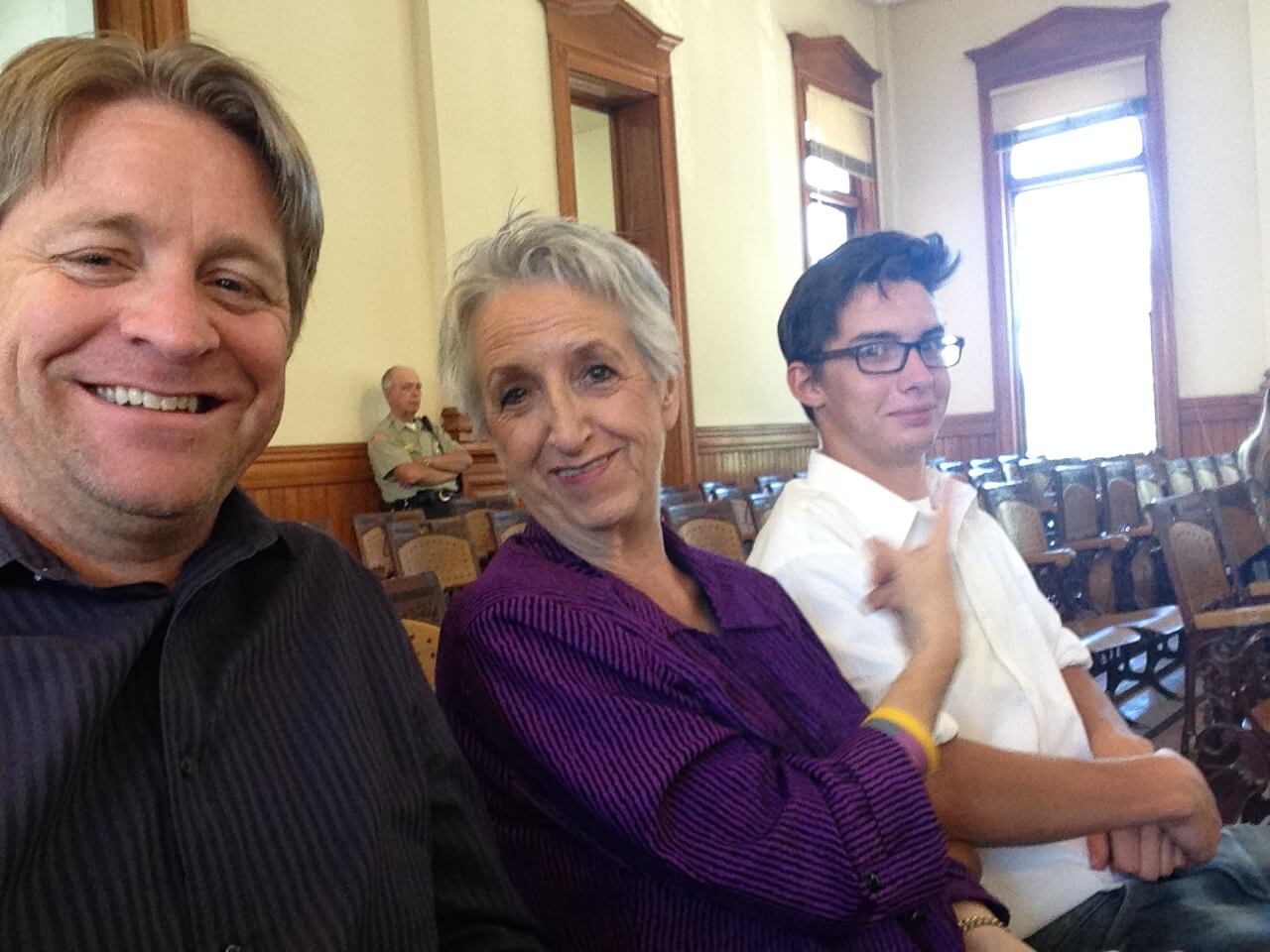
Mom and I accompany my nephew Dylan to court for a traffic violation